The Ancient Tea Horse Road

As our travelers sleep warmly bundled in the stone cabin at the base camp of Haba Snow Mountain, the wind whips and howls outside, distributing icy haze throughout the thin air of the night sky.  Before they wake up, we will pause for a brief intermission. We will step back a thousand years to explore the importance of these lands, and the traders who traversed similar mountain passes with far fewer amenities or modern comforts.  Brought to you by Mekong Bureau chief and international chiller Mr. Stewart Motta, we present a special report on the ancient Tea Horse Road.

Tea Caravan - Sichuan 1926

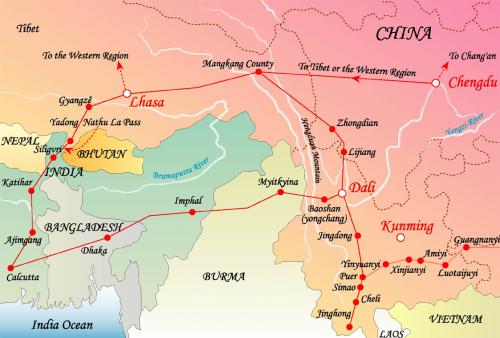
The Tea Horse Road, sometimes known as the Southern Silk Road, although silk never was a large commodity on the route, was first recorded as a major vein of trade during the Tang Dynasty (618-907).  The route was in operation long before tea and horses moved across it, and tombs found in the northern reaches of the route suggest that it has been a corridor of travel for 4,000 to 5,000 years. Over the millennia this road and its tributaries carried not only commerce, but also culture, linking a myriad of people, traditions, and ideas, from Southeast Asia, China, Tibet, and then further west into the kingdoms of northern India.

Both the Silk Road and the Tea Horse Road were mainly in existence to supply the empires of eastern China with ample numbers of horses. China’s military relied on acquiring horses from Central Asia, and both silk and tea became China’s main exports to barter for the four-legged beasts. The scarcity of horses in China was a significant advantage to the “barbarians of the north” (Mongols, Turks, Tibetans) who frequently pillaged and invaded the empire on horseback, and would eventually form the greatest cavalry the world has ever seen, conquering most of mainland Asia on horseback in the name of Ghengis Khan. The Book of Tang reads “Horses are the military preparedness of the state. If Heaven takes away this preparedness it will totter and fall.”

A death sentence was in place for any individual trying to destroy China’s monopoly on silk. However, silk worms, eggs, and even farmers, were eventually smuggled out of China to Persia, Vietnam, and Japan. This ended China’s domination of the world’s silk production, and caused concern over the ability to keep the flow of horses heading toward the capital of Xi’an. Fortunately for the Chinese, a taste for tea had developed among the neighboring states. Most of the tea being produced to meet this new demand was grown in southwest China, mainly Yunnan and Sichuan Provinces.

Tea is indigenous to the area around Pu’er and Xishuangbanna Prefectures in southern Yunnan, which is believed to be the birthplace of tea. Some trees found in the area can be dated back over 1,000 years. This area is a cultural cocktail and located near the juncture of present day Lao, Burma, and China. The tea derives its name from the prefecture and the mention of Pu’er will to this day bring creases of satisfaction and pride across the faces of Yunnan’s people.

Pu’er tea was exported into Southeast Asia and north all the way to Lhasa and beyond into India mainly on the backs of horses or mules, but tea porters did exist as well. The price of one horse was around 130 pounds of caked tea. Men and women would pack up horses and stack sacks weighing 150 pounds or more on their shoulders, before trekking through the treacherous terrain of western Sichuan and Yunnan. Eventually China was acquiring 25,000 horses annually in exchange for over 3 million pounds of tea. Exporting this amount of tea greatly increased the traffic on the Tea Horse Road, and multitudes of people hashed out a livelihood from the industry.

Tea porters - 1908

This toilsome travel required a certain resiliency of the tea, and a system was created to dry the tea and form it into dense cakes. The cakes naturally ferment and are treated in Yunnan similar to wine, as the tea becomes better with age and connoisseurs know which years posses the most desirable flavor. Some cakes do not reach their prime age until after 30 to 40 years of slow fermentation. A tea cake could take over a year to complete the journey to Lhasa, fermenting as it climbed up to the Tibetan Plateau. It was this dark earthy temptress of the taste buds that seduced the Tibetan Empire after its unification in the early 600’s. The tea culture quickly grabbed hold in Lhasa, and by the 1700’s the Dalai Lama was reportedly reserving 2,500 kg of tea for his court annually.  To this day, Pu’er Tea is the beverage of choice in most Tibetan areas, being mixed with yak butter to produce a frothy sour beverage that is consumed both morning and night.

Resurgence of the Tea Horse Road and Mr. Scott Norton’s Grandfather

Within months after the bombing of Pearl Harbor in December 1941, the Tea Horse Road began its revival. Japanese forces controlled Southeast Asia and the waters along most of China’s eastern seaboard. Japan then invaded British controlled Burma, cutting the military supply route to the Kuomintang forces on the Burma Road. With all the seaports closed, the Tea Horse Road became the main overland route to supply Chiang Kai-shek and the allied forces in Kunming, Yunnan. Many American and British pilots were stationed in Kunming flying over “The Hump” on their way to and from Assam, India.

Asia Wheeling’s very own Scott Norton had a grandfather who was stationed in Kunming. If his grandfather enjoyed a glass of foreign booze or cigarettes during his time in Kunming, it had mostly likely come all the way on the backs of one of the 20,000 yaks or 25,000 horses and mules from India, through Tibet, passing through Lijiang, before hitting his parched lips in a Kunming saloon.

Peter Goullart, a Russian living in Lijiang in the 1940’s, who later wrote a famous book on the area called “Forgotten Kingdom,” recorded, “articles were packed for delivery at Lijiang, especially the liquors and cigarettes which were worth their weight in gold in Kunming, crowded with thirsty American and British troops… Few people have realized how vast and unprecedented this sudden expansion of caravan traffic between Indian and China was, or how important.”

Fellow Asia Wheeling readers, this concludes our introduction to the Tea Horse Road, which these days sees minimal use besides some scattered tourism. But needless to say, the history and relevance of this road is one ripping good yarn.

All Your Basecamp are Belong to Us

We woke up bright and early in the unheated, but cozy interior of our room at the guest-house in Haba Village. We pulled on a few more layers than usual and made our way across the courtyard to the outdoor bathrooms and the large kitchen area where we had eaten the night before.

Our guide was already there with a friend of his. We were worried for a moment that this friend was to be our extra guide (which we could, due to last night’s alarming census of our coffers, of course, not afford). Our guide assured us, however, that he was not appearing in a professional capacity, and soon we all relaxed and laid into a giant breakfast of fried eggs and thick Naxi bread called “bing“.

Along with the bread and eggs, was some freshly extracted and boiled yak milk, and plenty of good strong tea. We feasted heavily, knowing that the next time we would be able to eat with abandon might be back in Lijiang.

So nearly bursting, but in very high spirits, we thanked our kind hosts and took from them a couple of large pieces of the Naxi bread and a few hard boiled eggs for each of us to eat later that day. And with that we headed up the trail. It was the lowest portion of the hike elevation-wise, but we could already feel that we were much higher up than we had been in Kunming. The trail began by cutting across agricultural land, heading steadily uphill over meadows and scrappy bits of pine forest.

From time to time, we would come up upon a small group of yaks, usually containing at least one mother and calf pair. Our guides seemed particularly wary of these, and went to great lengths to get them moving out of our way.

You see, dear reader, I have begun calling them our guides. This is because for all intents and purposes, they were. Our original guide brought along this friend under the pretexts of a normal companionship,  but in reality he was helping us almost as much as our fully employed guide in determining the way up the trail and avoiding negative interactions with maternal yaks.

The air was thin. That was for sure. We indulged in frequent breaks in order to catch our breath and take in the view. We were gaining altitude at a good clip though, for soon the entire valley began to spread out in all its terraced glory below us. Each time we took a break, and even from time to time as we hiked, our two guides would light up a cigarette. Indeed, the rate at which they smoked was only eclipsed by the degree to which they could outclimb us in this low oxygen environment.

As we climbed, the ecology around us began to change. Soon we were walking through large flowering forests of rhododendron. It was beautiful, and before we knew it, we had passed the highest point of this leg of the trip. To culminate it, our guide’s friend let out a savage whoop. Stewart explained to us that this was part of both a Tibetan and a Naxi tradition – screaming to the gods when you get up high. Delightful.

From there we had only a mildly muddy descent down to the base camp. As soon as we entered the grounds of the base camp, the temperature seemed to fall by 20 degrees. The wind whipped up, and clouds began to blow in. The camp consisted of a number of small low-lying, hand-made wooden buildings that were barely outnumbered by the number of donkeys idling around the premises, defecating and being generally ornery.

We ducked inside one of the small wooden buildings to seek shelter from the cold and the donkeys, and to eat the lunch that had been packed for us by the guest house. Paired with some salt from the base camp kitchen and some items from the market, we were able to make some positively delectable little sandwiches. As we munched and drank water from our canteens, people began to trickle down from the mountain.

It turned out that on that day there had been a Korean group that had ridden up to base camp from Haba City on donkeys and were currently climbing the mountain. They strolled one by one back into the base camp looking tired and windblown. “The wind is crazy up there,” they explained.

Some had made it all the way to the summit; others had been forced to turn back for fear of being blown off. They all appeared to be wearing very fancy cold-weather gear. I am talking North Face parkas, with elements of fur, giant gloves, fancy snow pants… all things that AsiaWheeling did not have.

We quieted any vestiges of fear of freezing to death with the notion that Koreans are notorious for over-equipping for their expeditions, and instead laid into our food.

Soon the food was gone, and then there was only the question of what to do for the rest of the day. We could not hike up to Haba, for expeditions could only be made in the morning. Our guides explained that in the afternoon, cold air and clouds came in, making the ascent too difficult.

So the only thing to do was to wait, and refrain from eating too many of our supplies. So we let the day go on, passing our time by chatting with the Koreans and marching around trying not to get too cold, for it was indeed cold, and the air was thin up there.

Finally all the Koreans had come down from the mountain, and we were actually able to check into our room. It was more of a leaky shack, but it was filled to the brim with blankets. We crawled under these and began to get warm. Now that we were not freezing, it was much easier to pass the time chatting and speculating about topics of trivial relevance. I had just regained normal body temperature when the sun sank low enough that we might safely eat our instant noodles, without fear of going to bed starving. So we headed over to the kitchen.

We found the whole crew in the kitchen, as usual, crowded around the small stove, chain-smoking inexpensive Chinese cigarettes and laughing about some jokes in Naxi.  We sat down and did our best to connect with them in Chinese and bits of English.

The noodles were delicious, though the little packets of spicy goo that are used to flavor the broth had frozen solid. They melted in the boiling stream water, that we were drinking and cooking with, and after our bowls were done, we began to discuss the logistics of the next morning.

We decided that we had better come clean with our guide and let him know exactly how much warm clothing we had. When he found out, he clicked his tongue disapprovingly. We could do it, he said, and as long as we hiked hard we would not be cold, but if we stopped, or needed to take it too easy, we would get cold and need to turn back.

This then tumbled us once again into a savage logistical debate. Can we do this? Is it safe? Is there a way we can modify the plan? Should we still rent the crampons (which were one of the most expensive things on the budget)? After contemplating many different  options, we decided that we needed to try to climb this beast. And in order to do that, we would need crampons.

The next day we would get up at 3:30 in the morning, meet the guides for breakfast, and head up the mountain. If we were too cold and had to turn back, so be it. At least we would have tried. Comfortable in our new resolve, we trundled off through the whipping cold wind to our unlit shack and piled five blankets over the tops of each of us. I took all my clothes, even my boots, and put them in bed with me dreading even then the thought of putting them back onto my body freezing from the night’s cold.

Getting Closer to Haba

Our second attempt at moving toward Haba was much more successful than the first. We woke up late and spent the day lounging around Kunming and working on logistics for our upcoming adventures in the Persian Gulf. Confirmation had just arrived that none other than the fabled and illustrious Mr. Jackson Fu was to be joining us. Along with Scott’s sister, Claudia, this was going to give us a powerful economy of scale, and introduce for the first time in AsiaWheeling’s history, a quartet of wheelers, all on Dahon Collapsible Speed Series cycles. The anticipation was dizzying.

Meanwhile nighttime grew ever nearer, and we collected our things and headed downstairs to find a cab. The driver used an alternate route this time, which circumvented much of the massive construction that had delayed us the evening before. In fact we arrived at the station in time to purchase a few waxed cardboard cups of road-side Chinese food and the materials to manufacture a round of (lukewarm) brass monkeys.

We made our way through the station and onto the train with little difficulty. The forked tongued ticket seller from the night before was nowhere to be found, perhaps better for all involved. AsiaWheeling is not a vengeful organization, after all. On board the train, our good spirits were only slightly dampened by the atypically mediocre quality of the Chinese street food. We talked through the logistics of how to get to Haba and back in time for us to catch a train to Shenzhen. You see, dear reader, we were leaving Kunming bound for Shenzhen in order to receive a tour of the very factory in which our Dahon Speed TRs were made. So attached have we become to the Speed TR, that such a pilgrimage had become an essential part of AsiaWheeling. This meant we needed to be back in Kunming by the following Monday in order to buy a ticket for Tuesday’s train. It was Thursday night. So, we thought aloud as we munched on over-salted bits of pork, clots of old rice, and tough bits of tofu. If we could get to the Haba base camp that next evening, we would be sitting pretty. This would even get us back to Kunming in enough time to spend one last night on Stew’s porch listening to trivia. All we needed to do was get to Haba’s base camp the next day. And with the train getting us into Lijiang at 7:00 am, such a task seemed perhaps not too difficult…

After a rotten night of sleep, punctuated by intermittent screaming from some child in the next compartment, the AsiaWheeling mountaineering team peeled itself from somewhat sweaty sheets and walked out the door into the misty morning and cool mountain air of Lijiang. The train was, of course, perfectly on time. Scott and I had last visited Lijiang as part of the pilot study, but the city now seemed almost unrecognizable. For instance, the entire train line that serves the city had been built in the two years since we had last been there.

Stewart quickly chose a van and haggled a price for the three of us that was less than the price that the one other person on the van was paying for just himself.

Our fellow passenger was a rich city slicker from Shanghai; the driver dropped him off at a very swanky hotel. From there, the van took us slightly down the road to a turnoff onto a somewhat crowded side-road filled with small restaurants and random shops.

On this street, we were able to find a fellow making knife-cut noodles, by slicing thin strips from a massive chunk of dough. This, it seemed, would be the perfect breakfast spot.

We sat down and ate heartily of the noodles, envisioning the upcoming day’s hike up to the base camp and all the calories that would require.

With hunger out of the way, we headed in search of rations to use over the next two days. While Stew remembered there being a large dried fruit and nut seller somewhere on this street, we ended up wandering the region for some time, finding only random tourist shops and restaurants.

In the end we purchased a few packets of Nescafe and a couple of extra giant purple Nalgene-esque bottles for Scott and me to carry water in.

We headed out into the city, walking more briskly now with the knowledge that each moment that we spent here in Lijiang searching for supplies pushed back our arrival at the base camp by that same amount. We made our way across a few busy roads and into a new section of town that proved to be slightly more helpful. Scott and I purchased long underwear at a local clothing shop, while Motta headed out to the market in search of snacks. Dried fruit, despite many inquiries, continued to elude us, but we were able to buy some cucumbers, a large sack of nuts, and a good number of bready and eggy baked goods, which promised, if not to be tasty, at least to pack plenty of calories for the upcoming uphill battle.

We thought even more highly of these stores when we added six Snickers bars, four more bags of nuts, and a package of crunchy freeze-dried durian bits to our supplies. Now we were cooking with Crisco. Scott picked up a pair of gloves as we were leaving the market, crossing off the last thing on our list. The gloves were not thick, but they were off-white, and made of cotton, perhaps meant to be extra layers or work gloves.

So it was, with these supplies crammed into our packs and hiking poles in hand, that we headed off toward the base camp of Haba Snow Mountain (哈巴雪山) as the locals call it. The first step, of course, would be to get ourselves to the city of Haba, where we would meet our guide. This city was at the end of a long winding road that ran through the Tiger Leaping Gorge. Normally anyone who does not live in the gorge is forced to pay a hefty fee upon entrance, but we had heard that since the road was currently under construction, the fee had been temporarily waived. Good for us.

What was not so good for us was the fact that when we arrived at the bus depot, we found that the entire bus route, which included Haba City, had been closed due to the construction. We were told, in fact, that the road itself was closed, and that there was no legal way to get to Haba. Feeling somewhat dejected, we sat down to contemplate our next actions. Haba, which had seemed so close, was now vanishing into the mists of what might have been. With the time constraint of the upcoming tour of Dahon’s facility in Shenzhen, we could not spare any more days to figure a work-around.

Just then, as if sensing our predicament, Stewart’s phone rang with a call from our guide. This was a guide that Stewart had worked with in the past with Where There be Dragons, and he thus came to AsiaWheeling with the highest and most ringing recommendation. He had also been calling us from time to time during our rather circuitous approach to Haba, to make sure that all was going well and that we had no further delays. Scott and I paced around the yawning and gleaming new expanse of the Lijiang Train Station, while Stew explained our situation to the guide. Stew came back over to us a few minutes later with a stern look. “Okay, guys. I think we have a plan.”

Our guide said that the road was technically closed, but he thought that between him and his friends he could get us through. All we needed to do was to take the next bus to a town called Qiaotou (桥头). This was the end of the line before the aforementioned winding road that entered the gorge. We managed to get the last three seats on the next bus (which was leaving some five minutes from then), and climbed on. It felt great. Despite all that had already occurred to keep us away from Haba, we were finally on our way. The feeling of elation, however, was short-lived, for soon we pulled up to a gigantic line of cars that were decidedly motionless, evidenced by the fact that almost all of them had deactivated their engines for some time.

We waited in the bus for a while, and as the frustrations of waiting grew more and more insistent, we ventured out on foot to explore the full extent of what we were facing.

We were on a beautiful mountain road that wove its way along the edge of a large valley, which would at one point or another connect to the beginning of Tiger Leaping Gorge.

As far as we could see, there were motionless cars lining the road and eventually disappearing into the mists ahead. We paced around outside the bus, and looked at our watches.

We could still get up to the base camp… but as time moved on, we would be faced with a greater and greater proportion of the journey being a night hike.

Finally, we decided to eat a little at a roadside café, not because we were particularly hungry, but because we were bored and frustrated. The café was positively packed with people, this likely being its best day of business since its inception. As we ate some delightfully oily and salty fried eggs and spicy broccoli, we chatted with the stranded travelers around us. During the meal, we discovered the cause of the great traffic snarl: there had been a reasonably bad accident ahead of us. The fellows we chatted with had already been waiting around for some time, and ate with the slow deliberation of those sure of no imminent departure.

With the reality of our stalled condition staring us in the face, we decided to climb back onto the bus and grab our belongings. Despite the skepticism of our fellow passengers, we headed out, in hopes of hiking along the road past the accident and to the other side, where we might catch a cab to Qiaotou. We hiked on for a few kilometers past car after bus after giant dump truck. All the drivers had turned off their engines, and many had gotten out to erect makeshift card tables and had even been playing long enough to begin to collect little piles of cigarette butts around them.

As we hiked past, we got many looks of both skepticism and solidarity from our fellow stalled travelers. After quite a few more turns, we finally came to the accident. From what we could see, it was indeed serious.

It had likely been a collision between an automobile and a motorcycle. The motorcyclist had been killed and his or her body lay in the street, covered with a bloodied white cloth. A rooster had been brought to the scene and tied to a rock securing it near the body. The rooster’s presence was presumably for some superstitious or spiritual reason.

The bird stood frozen near the body, standing on one foot and staring, moving only enough to indicate to us that it was alive. A crowd had formed on our side of the police tape, jostling each other to get a view of the carnage, while a large group of cops sauntered around the scene holding back traffic and waiting for some unknown event or person to arrive.

We tried a few times to circumnavigate the accident, trying first one route through the surrounding countryside, then another. Finally, we succeeded by scrambling up a steep grassy hill and cutting through what looked like a small fruit orchard. From atop the hill, we could see the accident in all its gory reality.

What was it about our mission to Haba that had caused the ether to manifest so many obstacles and danger in our path? A more superstitious person might begin to think that we were for some reason not meant to climb this mountain…

On the other side of the accident, we kept walking, stopping from time to time to ask gentlemen in cars if they would be willing to drive us to the city of Qiaotou. None of them were willing to bite, and after a while it began to rain. We sought shelter from the rain near a line of fruit sellers who made a point of hassling us. The rains came and went, and we paced around haggling with people about rides to Qiaotou, and finding no one who was willing to transport us for anything less than a downright predatory rate.

We therefore idled and paced, so long in fact, that the traffic began moving once again. Then, low and behold, our same bus came around the corner, and we flagged it down and climbed on. Our fellow passengers seemed happy to see us again, as was the driver. Comfortably back in our seats, we waited out the remaining half hour of driving and climbed off in Qiaotou.

The accident had cost us a fair bit of precious time. Now the sun was hanging startlingly low in the sky. As soon as we got off the bus in Qiaotou, we were met by our guide’s men, who we waiting with a small van. We climbed in and began the drive into the gorge.

I could see why the road was closed. It was not fit even for a modestly sized bus to travel. It was also actively under construction.

We drove along through a fog of rock dust, through large crowds of Chinese men and women hacking away at building a new road. From time to time, we had to stop and wait for a bulldozer or steam shovel to move out of the way for us to pass.

Finally, we came to a clearing where there was a cluster of people who were decidedly not construction workers. In fact they appeared to be tourists interested in heading farther into the gorge, but they were stopped by a large obstacle.

What was the obstacle, you ask? Well, it was something like a level from a 1980s computer game, except that it was very real.

You see, dear reader, there was a section of the road which had become more like a flattened out pile of large rocks, above which, some 50 meters over the road, there was a team of Chinese workers who had tied themselves to the side of the mountain and were hacking away at the rock face. Their work was sending a steady stream of boulders down the mountain, which would speed up and tumble, crumbling into smaller pieces on their way down, and finally flying headlong across the flattened out section one might call the road.

On the other side of this treacherous obstacle, stood our guide. He had parked his own van, and had been smoking a great number of cigarettes while waiting for us. He stood now next to his van and his pile of butts, staring at us across the hazard. He looked up at the workers, then back at us… then he made a run for it.

It worked. He made it across to our side unscathed. Once he was closer, we were able to get a better look at him. The man was wiry, dressed in army fatigues, and chain smoked cigarettes like few people I have seen outside of Indonesia. He greeted Stewart and then us warmly. He then looked back at the terrible trickling landslide. This was going to be tough…

Our guide stared up at the workers, and we watched the rocks falling. If we were hit by one of those, it would probably break our legs, if not toss us head over heels into the gorge. We looked at the guide, then at Stewart. Our guide squinted harder, looking at the motions of the distant workers, and timing the falling of the rocks. Then suddenly, he screamed “GO!” and we scrambled across. I was not sure which to spend more time looking at: my feet (so I didn’t trip and fall into the gorge) or the slope above me (so I could dodge a giant falling boulder).

Thanks be to Jah, we made it across in one piece and climbed into our guide’s van.

We then began a three-hour drive through one of the most hectic construction sites I have ever seen. Everywhere, people were hacking away at stone and blowing things up with dynamite. Meanwhile, the river which had carved the immensity of the Tiger Leaping Gorge tore on to our right, barely audible above the sound of busting rock and revving diesel engines. The steep rocky cliffs that formed the sides of the gorge tore upward at inconceivable angles, sporting impossibly green vegetated nooks and totally isolated plateaus of prairie grass.

It was so beautiful that we needed to climb out of the car and take in the view. Unfortunately, we were not prepared for the intensity of the wind that whipped through the gorge, carrying with it a peppering of rock dust and small pebbles. It pulled Stew’s Iowa Hawkeyes hat off his head and sent it spiraling into the gorge. It was all we and our guide could do to keep the man from risking his life scrambling down the steep and loose gravel after it.

When we finally got to the city of Haba, some two and a half hours later; it was well after dark. At the advice of our guide, we decided to stay the night there rather than attempt to climb up to the base camp in the night. So we stayed at a Naxi guesthouse that Stewart had used in the past during his work with Where There Be Dragons.

The owners of the guesthouse greeted us warmly and served us a splendid meal of roasted yak meat, yogurt, beans, eggs, and rice. It was one of the best meals we’d had on the entire trip. And once we had finished, we sat down to drink tea and chat with them briefly about finances. Our guide was suggesting to us that we might be interested in getting a second guide. It’s not a hard climb, but two guides might be helpful. We suspected that he was looking to spread some of the wealth among his friends, but we also earnestly promised to consider it in a more private meeting later that evening. We talked briefly about the cost of guide services, but did not hammer out an exact price. We also figured out how much a night and two meals, and a packed lunch from the hotel would be: extremely cheap. Once we had a good idea of how much this whole thing was going to cost, we headed back to our room and counted our money.

And then a shock of fear hit us. We had not visited an ATM before the trip, so we were left with just what was in our pockets, and it was not much. We worked furiously to put together a budget and tallied up all our expected expenses. It looked like we were about 500 Yuan short of being able to pay for this adventure. We looked at each other across the small room as the temperature fell outside. It was going to be a cool night. Probably the coolest of all of AsiaWheeling. I pulled a blanket around me and looked back down at our projected expenditures. Where were the huge ones? Where had we made too conservative an estimate…

One thing was for sure: we would need to completely refrain from eating anything at the base camp restaurant. Getting an extra guide would be completely out of the question. What else… Motta called the guide to get an exact price. When he hung up the phone his face was stricken. It was still too much for us. We were in the middle of nowhere, without enough money to execute this mission. But how could we turn back now? Would it be better to just go for it, and ask our guide to accept an IOU… that would not be so good for the guanxi…

Once again, as if sensing our predicament, the guide called Stewart’s phone. He was calling to lower the price. “We’re friends right?” he said.

“Of course,” Stew replied.

“And we are going to do business in the future?”

Stew replied with the same.

And then it was done. He reduced the price by just enough to put us 100 Yuan under budget. We were going to do this. But now we were yet another day behind, still with the hike up the the base camp to do tomorrow. It would likely be two days before we could summit. Things were tight, financially and temporally. We still could do it, but one more set back and we might have to scrap the whole mission.

The temperature kept falling, and we put on our new warm clothes, exiting our room to climb onto the roof of the bathroom complex. We idled up there for a while, taking in the stars. When was the last time we had even seen stars, let alone stars this dramatic?

Soon the chill of the night began to get to us, and we made our way back to the room to catch a few hours of shuteye before tomorrow’s climb.

It’s Not Easy to Get to Haba

Stewart greeted us in Kunming with a great many options for things to do in this fine city of his, among the more exotic of which were paragliding, going on a savage multi-day wheeling/camping trip around a nearby lake, and heading into the Tiger Leaping Gorge to climb a 17,400 ft-tall mountain called Haba Snow Mountain (哈巴雪山).

We pondered our next moves while enjoying the unbeatable hospitality and decadent luxury of Stewart’s apartment. We spent our time wheeling around Kunming, feasting on the wireless Internet in Stew’s apartment, eating plenty of Hui food, and drinking brass monkeys while arguing over trivia during the evenings in the cool dry air of Stew’s apartment balcony.
Most nights we lit off a Chinese lantern. These are giant, paper fire hazards that can be purchased for about one USD in the cities to the north of Kunming. Once unfolded, they are large hollow fingers, about the size of a respectable lawn gnome. They sport a large chunk of wax hanging from the bottom of them, via a system of wires. The wax chunk can then be carefully ignited and, after patiently waiting for the air inside the finger/gnome cavity to get hot, the lantern may be set aloft, on a suicide mission, up to the heavens where it either self-ignites and plummets to the earth or runs out of fuel and does the same.
Anyway we had ourselves a grand old time, covering these lanterns with all kinds of decorations and secret wishes and setting them to whisk off, at the whim of the breeze, over the rooftops of Kunming, many threatening to rain fire onto the hundreds of tall concrete buildings.
Among other things, our time in Kunming was healing and productive, but lest we fall into another Bangkok-like black hole, we needed to once again heed the call of the open road.
So although our thirst for chilling was far from quenched, we set about planning our last few days with Motta in the fine land of Yunnan, cooking copious amounts of tofu and chili, and eating plenty of noodles.
After returning to the aforementioned list of more extreme choices for adventure in Yunnan, and after some careful weighing of the options, we finally settled on Haba as the extreme portion of our Yunnan experience.
And with that, we climbed onto the cycles and began collecting what we would need for the trip. From what we read, it was not that cold on the summit. This is somewhat surprising since Haba is actually taller than any mountain in the lower 48 states. Stewart explained to us that to the best of his knowledge, we should be able to do it in just a few layers of warm clothes, hiking poles, and crampons (which we could rent at basecamp).
First things first: we needed to get tickets on that evening’s train to Lijiang. Lijiang, to the north of Kunming, is a tourist city and a gateway to the wilder lands of Tiger Leaping Gorge and beyond. Getting the train tickets was no problem. We climbed on bikes and wheeled downhill to the station, through a particularly savage bit of construction, and rolled up to the ticket windows, where they were playing a thunderous patriotic communist anthem over the loudspeaker. Stewart hopped off his cycle and walked directly past the giant arching queue of Chinese people over to a closed window, where a woman was hard at work at a computer terminal. He somehow smooth-talked the woman, in Chinese, into opening up her station and selling him tickets, saving us the time in the queue.
Motta walked back toward us grinning, “I don’t wait in lines.”
From there we headed out to find a couple more warm layers. Scott and I both had one sweater, but at Motta’s counsel, we decided that the addition of another thermal layer would be prudent. So we wheeled around Kunming for a while, poking our heads into knock-off outdoor gear shops. Eventually, we settled on a couple of knock-off Osprey fleeces. Mine was female.
With that, we settled down to eat a quick meal, and after finishing the last leftovers of a savage batch of chili we had made a few nights back, we hopped in a cab.
Kunming was, as is the case with all Chinese cities of mild notoriety, massively under construction. The main road to the train station was in the midst of being ripped up in order to add a new city metro line.  As a result, our journey to the train station took significantly longer than we had budgeted, and we arrived at the train station with only about 10 minutes to get to our train. It was an overnight train, and was timed to travel extra slowly along its line, timing its arrival for a civilized wake-up time of 7:00 am.
As we climbed out of our cab, other passengers were sprinting with their luggage, and yelling frantically. We walked quickly, all the time wondering why, with 10 minutes and only a few meters to traverse to the platform, our fellow passengers were so rushed. We found the answer as soon as we arrived at the platform only to find it totally locked down. A uniformed woman frowned at us from behind a door made of steel bars. “The doors to the train close five minutes prior to departure,” she explained in Chinese. Stewart had not even begun to open what I could see was a sizzling hot can of Chinese door-opening rhetoric on her when she added, “But you can catch the next train, which leaves in one hour. It will be no problem… you can even change your ticket for free.”
Fair enough, we thought. And touting the wonders of Chinese rail travel, we jogged back downstairs to the ticket counter to exchange our tickets. When we got there we were sorely disappointed, nearly irate, in fact. “She lied through her teeth!” Motta bellowed.
The next train she had spoken of terminated only half way to Lijiang, in city called Dali. We frowned and looked at each other. We had to face the bitter truth: we were not getting to Lijiang the next morning. We weighed all the options for a while and finally decided to head back to Stewart’s house. We would be set back by a day, but we should still be able to make it up to the top of Haba and back in time to catch a train to Shenzhen for our tour of the Dahon Factory.

Return of the Motta

We awoke somewhat late in the day on our last morning in Jianshui, mostly because of the weather. The impossibly blue and cloudless skies that had shown us through our previous two days of impeccable wheeling had been replaced with a perpetually dawn-like gray. Wake we did, however, and headed off in search of noodles.

The streets were strangely empty for almost 10:30. Normally, it seems, Chinese cities are filled with people rushing around increasing the GDP by about 6:30 am. The strange weather must have put them in a funk as well. Our funk was slightly diminished when we were able to find a couple of very reasonably priced giant bowls of noodle soup, and deciphered a friendly note written by the previous night’s patrons of the restaurant.

As we sipped the last bits of broth, we pondered our next moves.

We were headed to Kunming (昆明), to meet up with the illustrious and debonair Stewart Motta. Our bus was at 2:00 pm, which gave us just enough time to feast on the last bits of Internet at our hotel, and to take advantage of the most delightful practice of 1:00 pm checkout amongst Chinese business hotels.

We bid a sorrowful farewell to Jianshui, being sure to apply a firm seal of approval before leaving. At the bus station, the Speed TRs made quite an impact on the luggage handlers. Although folding bicycles are quite common is Jianshui, and in China in general, I believe this may be the first time these luggage handlers had actually seen one of them in the collapsed state, and the act of folding the cycles produced the kind of positive response normally reserved for B-level celebrities.  We folded up the Speed TRs and placed them next to a bag of chickens in the luggage compartment of the bus.

The ride to Kunming was comfortable, and just the right length.

We stopped midway to eat eggs boiled in tea sold by sweet elderly ladies.

Just as we were pulling into one of the many Kunming Bus stations, I felt a vibration in my pocket. It was Mr. Motta, who had somehow managed to sense our arrival. We were somewhat disheartened to learn that we had arrived at the new bus station, which was some 35 kilometers from Stewart’s residence, wheeling to which would require traversal of some particularly gnarly lengths of elevated highway, most of which were currently flooded with frustrated rush hour drivers. As an added danger, China is the fastest growing car market in the world. This means that most Chinese behind the wheel are new drivers, and as such, not so attentive to their fellow traffic.

So we took a cab. Our cabbie was an incredible woman, who drove very well, wore a splendid set of arm protectors, and brought us quickly and directly to Stewart’s door.  He appeared downstairs to meet us, looking dapper and all smiles. This was going to be splendid. We parked the Speed TRs in his parking garage, which was not only lorded over by a surly security guard, but also featured a large bank of electrical outlets for refueling electric vehicles.

Excellent move, China.

His pad was glorious. Truly glorious. It was perched at the top of a large apartment building, filled with light, and featured a balcony with a splendid view of the city.

We were also given the great pleasure of finally meeting Stewart’s significant other, Juliet.  It was no surprise that Juliet proved to be delightful company, sharp as a tack, and drop dead gorgeous.

As we all gathered around a steaming bowl filled with tofu, hot peppers, lots of oil, and a large fish, we salivated, and glanced out the window at the beautiful streets of Kunming below.

I could tell this was going to be a new, and certainly delightful chapter.

In fact, in honor of the return of Stewart Motta to our wheeling lifestyle, we are pleased to announce the launch of our new line of “International Chiller” tee-shirts in the AsiaWheeling store. Click here to learn more!

Nipping over to Ba Xin (坝心)

Our second morning in the glorious town of Jianshui began with a visit to a small Chinese Muslim joint, where we feasted on thick Hui noodles, in spicy tomato broth. Our bowls were served on a table that had been mostly converted into a large barbecue grill. As we sat down to the noodles, the owner of the shop took a seat opposite from us and began to make small talk over the large grill. On the grill were a great number of semi-fermented bits of tofu.

He shoveled a small pile of these over on to the section of the grill that was hot, and they began to slowly sizzle. He continued to chat with us as he poured a mixture of chili oil, vinegar and a salty orange powder in a couple of small bowls.

He handed us the small bowls of spicy dipping sauce and began taking the piping hot bits of tofu off the grill and giving them to us.

So as we ate our soup, we now were able to punctuate the experience with little spicy bits of oily crispy tofu. The meal was stupendous, and it turned out the tofu bits were a free and standard addition to any meal at this restaurant. With full stomachs, we felt compelled to execute a savage wheel.

We began by heading up and out of the old city, toward the western outskirts of town. On our way, we passed a large market at the opening of which was a gigantic crowd of mostly young men in the midst of an even more gigantic crowd of red Honda motorcycles.

After some in-depth investigation, we found that this was not what we had first guessed – some kind of a red Honda rally – but a mixture of bikes for sale, and motorcycle drivers who were offering their services as couriers of goods purchased inside the interior vastness of the Jianshui Sunday market.

We decided that such a hubbub at the entrance to the market certainly warranted some exploration inside. It was, of course, no Kashgar Sunday market, but it was certainly lively and filled with all kinds of interesting goods. We wandered the interior for some time, keeping our eyes peeled for possible project K9 purchases, but eventually settled only on a small 15 cent pair of folding scissors. These scissors would later prove to pay for themselves one thousand fold over the remainder of the journey.

We exited the market and headed farther uphill, cresting the highest point of the city of Jianshui, where we turned left and headed down toward the other side of the fertile valley which surrounded the place. Jianshui itself is on a hill, which rises like a fortress out of the fertile surrounding valley.

We began our descent into the valley, which took us through a large cluster of stonemasons, all of whom seemed to be in the tombstone business. Perhaps because of the proximate availability of stone, or because of elaborate local burial customs or perhaps even because of the centralization of industry by the Chinese government, it seems Jianshui had become a hub for complex and ornate tombstones, sarcophagi, and the like.

We wheeled down an endless street of masons, feeling compelled from time to time to cover our ears against the shrill cry of a circular saw or electric sander. More often than not though, the stonework was done by hand, at great expense of time, simply using a hammer and chisel.

Once we had made it through the street of stonemasons, we came upon a giant snarling traffic jam. The road was small and packed to the brim with buses and cars. All the vehicles seemed to be burning oil like crazy, and try as we might, there was not even room enough for a bicycle to make its way through the mess.

In place of a sidewalk, there was merely a sandy drop-off into an open (though rather dry) sewer. It looked like we were stuck. So we waited and sucked exhaust for about a half hour, as the traffic slowly worked its way along. Then finally there came an opportunity for a lichtenschtein.

We took it, and followed a tiny concrete path, much too small for anything but the tiniest of cars. Our road fell steeply from the main road, and then leveled off as it ran along the wet flat floor of the valley. We wheeled past a group of old women and men seeking shelter from the mid-day sun beneath the canopy of a solitary tree. A man straightened up from his water pipe to bark a greeting as we made our way past.

Now we were alone in a sea of green rice, wheeling along the brilliant white arc of this small concrete road. The colors seemed almost too intense for reality. The complexity of the rice and the blue of the sky all the more brilliant behind polarized lenses.

We could see the traffic still raging in a gridlock to our right, so when the concrete strip turned back toward the main road, we set out once again on the small raised-dirt pathways that separated plots of rice. From these, we found our way to a low-lying thick brick wall that acted as a separator between the rice fields and the stream of rubbish that came from the highway. We hoisted our Speed TRs onto this wall and made our way along it, eventually ducking under the highway.

In the space below the overpass, we encountered two Chinese children. It appeared we had interrupted a romantic encounter, and we apologized, quickly making our way onto a new road. This new road wound by two large swimming complexes, one was a vast and crowded chlorinated pool, complete with diving board and water slide. The price of entry was about 40 cents. The other was a large green pond, which sported a great deal of algal and lily-pad growth. Entrance to this swimming zone was only about 7 cents. However, lacking swimming trunks, we refrained from both of these tempting options.

From there we headed on, out of the greater Jianshui urban block and out into the open tranquility of the rice paddies. We now rode on a large, brand new, completely empty two-lane concrete road, which was suspended over an expanse of deep green agricultural land. The green of the crops was so saturating, and the fragrance of rice so thick in the air, that there was little we could do but allow the beauty of all that was around us to carry us forward.

We came around a corner and could see, nestled in the arid hills ahead of us, an ancient Chinese town. Once spotted, it seemed obvious this was to be our next waypoint. Taking only a few false turns, we successfully made our way into the center of the old quarter of this city. Inside the old quarter, we found a set of giant gates that marked the entrance to some kind of ancient walled compound.

Looked like an interesting wheel… We parked our bikes in the shade of the large wall and began chatting with a group of uniformed fellows to investigate whether or not we might wheel into the ancient walled compound. The answer was resoundingly “no.” Furthermore, we would be charged to enter, even if we followed their rules and did it on foot. Our interest in the ancient citadel diminished rapidly upon hearing this news.

So we took a water break in the shadow of the wall, and headed back out in search of more adventure.

Outside the ancient city, we decided to take a left and strike out on an old road that ran parallel to the highway which had brought us to Jianshui.

We were not sure of our next waypoint, but we were confident  there would be Chinese villages scattered along this road, some of which would contain establishments that were serving up noodles.

So on we rode. The first hamlet that we came to was very small and very poor. There were no restaurants in town, and we saw only two signs of life (apart from livestock). One was a group of old men, smoking water pipes and playing Mahjong, the other was a lone, totally naked, elderly woman, who was wandering the streets in an obviously drugged haze. We rode by her unsure of which way to look, and continued through the remainder of the town, which put us back onto the sun-drenched road, running roughly parallel to the large toll road that had brought us into Jianshui.

By this point we were becoming quite hungry and thirsty. We could see signs on the distant road, which declared to the traffic heading our way that there was another town, by the name of Ba Xin (坝心), not far from us. It would likely take less time to ride on to this city and find more food and water there than to turn around, so we headed on, through a cleft in the mountains. Soon enough, the road we were on swung hard to the right and became very sandy, the concrete mostly crumbled into gravel.

We wheeled under the highway and began traveling parallel to it on the other side now. The reason for the sorry state of the road became apparent as we approached Ba Xin. A large stone harvesting operation was in full swing outside  the city. We wheeled past huge crowds of men, breaking stone by hand using repeated strikes of a sledge hammer. They all had cigarettes clenched in their mouths and frowned into their work. Most of them took a break to scrutinize us as we rode by. Some waved.

A brief uphill section took us into the heart of Ba Xin.

There we found ourselves starving, rather parched, and quite thrilled to have arrived. The first problem we solved was the starving one, though it was initially more of a stop-gap measure. We called a waypoint at a local bakery, and for less than 25 cents purchased five pastries.

These hit our systems with a thrilling burst of blood sugar and lucidity, and propelled us on to the grocery store, where we purchased some similarly priced bottles of drinking water.

At the grocery store, we asked for directions to a street where we might find noodle shops, and armed with that information set out. Our search took us to the center of the city, where there was a vast round-about, in the center of which was what looked like a giant flying saucer skewered by a flagpole. From there, we were able to head up to the street of noodles. There were three or four restaurants to choose from, most of which were empty or contained only one or two people; but a restaurant at the end of the street seemed relatively crowded, so we chose that one. Outside was a small group of old men who appeared to be oscillating between smoking from a large steel water pipe, and engaging in schtick with one another. Inside were a group of school girls slurping huge piles of fried noodles from a plate.

We were warmly greeted by the advance guard of old, water pipe-smoking men. They paused from smoking 50 cent packs of Chinese cigarettes through the giant metal pipe, and smiled at us. They seemed a bit shy, and we were hungry, so we politely acknowledged them and passed on toward the kitchen, from which the tempting smell of fried noodles was emanating. The smell was intoxicating. I did my best to order a couple of the same. In the meantime Scott sought out a table for us.

As we waited for our noodles to arrive, we chatted with the school girls sitting next to us. They seemed interested in practicing their English, and even more interested in blushing, giggling nervously, and pushing each other. We did our best to be amiable, and after a short while, the children departed and our noodles arrived. In my supremely bad attempts at Chinese/pantomime communications, I had failed to order the school-girl special, but had successfully  ordered two totally different dishes of cold spicy peanut noodles. The noodles were delicious and startlingly cheap, likely hand pulled in the back of the shop.

Once we had finished the noodles, we rejoined the gents outside, to chat and do bicycle schtick with them. They were very interested to hear that the Speed TRs were, in fact, made in China, and glad to hear that we enjoyed the local cold noodles. We explained that we had come from Jianshui, and they tut-tutted about city folk, while heartily congratulating us on having made it this far. When the time was ripe, we bid them farewell, and climbed back on the Speed TRs headed for Jianshui.

The ride back was glorious. It was hard and fast, with some very good stretches of long downhill, followed by gnarly climbs. The sun was sinking low and the dry heat of the day was quickly being replaced by the comfortable temperatures of evening in the desert. We encountered a bit of traffic again in the same stretch of road we had on the way out, just before the street of the stonemasons. It was less thick, though, and we were able to take advantage of the small size of our steeds and weave through the traffic, passing hundreds of cars, and capitalizing on the breaks in traffic made by motorcycles. Soon we were through the worst of it, and climbing back up into the city.

We crested the highest point in Jianshui just as the sun was setting. I paused at the top to wait for Scott and watched as a dog that had just killed a chicken walked by with the corpse in its teeth, leaving a trail of blood drips on the pavement. Just then Scott arrived.

There was only one question: where to feast? And the answer seemed pretty straightforward. So we coasted downhill toward the same restaurant where we had eaten the night before. Our friend was thrilled to see us. Once we ventured with him over to the cooler where all the ingredients were on display, he insisted that we get four dishes rather than our usual three. This we were happy to do, since after such an incredible wheel, we were starving. And at the end, the bill was a fraction even of what it had been the night before. We tried our best to pay him more money but he became offended and gruffly refused us.

Once again, as new customers came in, he would show us off as his two American friends who were so Chinese. It felt great to be such a VIP.

We parted with warm regards, and headed back to the hotel for some much deserved sleep.


Vietnormal: Announcing the AsiaWheeling Trading Post

Dear and most valued reader:

In honor of our departure from the beautiful and welcoming country of Vietnam, and with it, the transition from the first half of AsiaWheeling, centered in Southeast Asia and India, to the second half, featuring the AsiaWheeling team venturing as far as the Middle East and Turkey, circling back through Russia and re-entering China from the north, it is our great pleasure to announce the launch of the AsiaWheeling Trading Post.

With an inventory that will grow as we continue on our journey, the AsiaWheeling Zazzle shop is an online store featuring AsiaWheeling-related tee-shirts, mugs, and other schlock for the informed and discerning reader, or the aspiring Gonzo Journalist.

You can find us at: http://www.zazzle.com/asiawheeling.

Or just click this new icon on the sidebar.

Diligently Yours,

The AsiaWheeling Team

In Search of the Obelisk

It was around 4:00 in the morning in Hekou, China, when the Sim City 2000 theme song rang out once again calling us to action. There was a slight mist falling, as we rode the still empty and glistening streets toward the bus station, which lay deep in the heart of the import-export/prostitution part of town. When we got to the station, our half-sized bus to Jianshui (建水) was idling, as though waiting for us. There was no extraction of extra luggage charges here. In China, it seems, people are expected to be transporting large things, and the Speed TRs were treated as a welcome addition to the belly of the bus. We climbed on and immediately fell asleep.

When I awoke, we were driving through wide open country, rocky and arid, with scrubby vegetation clinging to rolling and gravely hills. I wiped the sleep out of my eyes and looked around. It looked like Wyoming.

The roads were brand new, wide and inviting. As we rode, the bus passed through a great many tolls, demonstrating that it was also not cheap to drive this route. The cars that rode alongside us were Japanese and European and quite new-looking. This part of Yunnan had money… where it came from though, is perhaps best left to speculation in the comments.

We stopped at a gas station to refuel the bus, and a woman came on board, peddling from a steaming bucket of Chinese-style corn on the cob. I was quite surprised when the majority of people on the bus actually purchased ears, and for the price of about 13 cents an ear, Scott and I were finally tempted to do the same. As we munched away on what I must admit was a chewy and rather distasteful cob (at least by Iowa standards), we humored our fellow passengers who, now that the foreigners had awoken, were very interested in chatting, and in particular to hear whether or not we approved of the corn.

The roads grew larger, and the traffic denser, and soon we were swooping through a great clover-shaped round about, making our way into Jianshui. The bus stopped in the outskirts of town, not at a bus station, but just at the side of the road, in a large intersection. We climbed out, and the dry hot air engulfed us. After so many weeks of humidity, we had come to cherish these dry climates. The sun was exceedingly bright in the cloudless blue sky, and after unloading the cycles from the bottom of the bus, we were quick to put on the Maui Jims and Panama hats.

As the bus pulled away, we were surrounded by an interesting collection of characters, most of them equipped with small three-wheeled goods transportation vehicles. This fellow was particularly dashing.

We strapped our luggage to our cycles and headed toward town. We rode by a number of very tempting giant Chinese business hotels, many of them featuring large KTV centers. We were headed for the older part of town. You see, dear reader, Jianshui is actually a rather old city, known for its large population of the Muslim “Hui” minority.   Once walled and gated against outside attack, some parts of the wall and the great central gate still exist, and it was these that we were looking for. Unfortunately, we were not sure where they were. The city was large, by anything other than Chinese standards, and as far as we could tell it was just giant brand new boulevards and huge (probably mostly empty) business hotels in every direction.

We finally reached an intersection at the top of a long gently sloping hill, and saw a tree-lined street. There had been very little green for the entirety of the ride hitherto, so we decided to take a licht onto this road. It turned out to be serendipitous, for instantly not only were we granted a cool shady thoroughfare, but we began to see the telltale terra-cotta roofs of an old Chinese city. It was then that we realized that other than the corn, we had eaten very little and were seriously lacking in the caffeine department. To rectify this, we called a waypoint at a news stand, where Scott requested a recommendation for a tasty local noodle house. It happened to be that a passing Chinese woman overheard his request and offered to lead us to exactly such a place, if we would follow her on her moped. This we happily agreed to. As an added bonus, she took bishop and led us directly into the old city.

The noodle spot was incredible, specializing in a local delicacy called Mi Xie, which is a tomato-based, spicy pork noodle dish.

We slurped and fell quickly into the mists of noodle ecstasy. Once the mists had cleared, we were free to look at the city of Jianshui with new eyes. This part of town was markedly different from what we had seen earlier. The streets were cobblestone, and few cars dared venture in. The majority of foot traffic consisted of what appeared to be wealthy Chinese women carrying shopping bags. Basically, Jianshui was doing just fine.

Refueled and refreshed, though still drastically under-caffeinated, we headed out into the old city in search of a hotel. We found a great many of them with little difficulty. Most were of a rather distinctive style, which I had not yet had the pleasure of encountering in my travels. The exterior of these hotels was painted and carved with a great many ornate panels, mostly in shades of turquoise, yellow, and red. These panels covered each of the balconies and were removed or folded back once the room was rented. We toured a great many of these, all of which were quite affordable. We were, of course, interested in accessing the Internet from our room, so it took a fair bit longer to find the right place, but when we did, we were so thoroughly ecstatic about it, that the prolonged searching felt more the justified.

The place was of that same exciting new variant that we discussed previously, except with that Chinese business hotel flare that we had come to know and love during our time in Hekou. Our room was immaculately clean, with Internet, in-room water bubbler, startlingly white sheets and bedspreads, a delightful balcony, in-room tea set, a gigantic television, which we were able to hook up via RCA to our computers for broadcast of hi-fidelity American hip hop tunes, and all for about 16.00 USD a night. We threw down our things and wasted little time in climbing back on the cycles.

We headed out into the city in search of coffee. This proved exceptionally difficult, and finally we were forced to settle for a box of Nescafe packets. We headed from the Nescafe to search for a small Chinese restaurant that might be willing to grant us free hot water, or perhaps a cup of hot tea into which we might dissolve the artificial, though necessary, brew. We managed to stumble upon an unassuming little shop, where a tall Chinese man was lounging and reading a newspaper.

We sat down and ordered two teas and two cups of hot water. For the tea, he headed over to a very old and special looking greasy cardboard tube, out of which he pulled two large nuggets of fragrant dry tea. He filled our cups and we began to chat. Soon we had gone through many cups of tea, as the chap guided us through the arc of flavor which one experiences after many soakings of the leaves.

We found ourselves even getting somewhat embarrassed, as the punk Americans who had the audacity to try and drink coffee in Jianshui. We asked him a little bit about the restaurant. It was a very down-home version of one of those Chinese choose-from-the-bank-of-ingredients joints, and this fellow was the proprietor and chef. He had been running the restaurant for over 20 years, and seemed to be somewhat of a local wiseman, evidenced by a number of people who came to him to ask advice on unknown topics during our time there.

When we finally left to continue our wheel, the man refused to take any money from us. It seems he had taken a bit of a shine to AsiaWheeling, and we had certainly taken a shine to him, so we vowed to come back before we left Jian and eat dinner with him. In the meantime there was wheeling to do.  Back on the cycles, we headed north, out of the city into the surrounding countryside.

The natural landscape of this part of China is semi-arid, but the people of the city had dug an elaborate system of irrigation ditches that allowed them to grow rice, in addition to all manner of other plant life. I was very impressed by the massive diversity of crops which were being grown in this small fertile valley, and even more impressed with how heterogeneous were the crops that were being grown: greens, corn, herbs in greenhouses, beans, rice, livestock… they all seemed to be coexisting in this little artificial green zone. It was beautiful.

We were getting a little peckish just as we were wheeling by a group of Chinese gentleman who were harvesting carrots from a large muddy plot. They had a small flatbed auto-rickshaw that they were filling with carrots and we wheeled up to see if they might be interested in selling us a couple to munch on.

When we arrived, they were so delighted to see us wheeling up on the speed TRs that it was all we could to to walk away without a giant bundle of free carrots.

Jianshui was quickly climbing the ladder in terms of favorite places on our journey.

As we were munching carrots, and doing our best to relate to the carrot-pulling chaps, we noticed a large stone obelisk looming in the distance on the top of a hill overlooking Jianshui.

What was this, we asked our new carrot-pulling friends. They seemed to have little interest or knowledge of the place, but Scott and I found it rather intriguing. We decided it would be a good waypoint, and with hearty farewells, headed out in search of a means to climb up to its base for a better investigation.

To reach the obelisk, we had to make our way across the artificially fertile valley into which we had wheeled in search of adventure and carrots.This meant taking the Speed TRs across the web of raised dirt walkways that separated the plots of irrigated land.

Luckily the cycles were more than up to the task.

On the other side of the great irrigated valley, we found ourselves in a much older looking settlement. We took a number of wrong turns, climbing a number of crumbling brick roads, none of which seemed to get us any closer to our goal. We finally called an uberlichtenschtein near a small child defecating in the street, and eventually made our way from there to a dirt road that appeared to be the only remaining option which had any chance of getting us closer to the obelisk. So on we rode, sheltered from the afternoon sun by a canopy of thick, bushy foliage. The obelisk was now looming very close, towering over us in fact, but we had no idea how to get to it, save trespassing across what looked like a large fenced-in grape-growing operation.

It was then that we pulled over to ask a group of women and children about how to access the obelisk. The women seemed thrilled to meet foreigners this far out of town and were more than happy to tell us at great length that one had to circle around to the other side of the hill in order to get up to the obelisk.

And so we did. The dirt road we had been taking eventually became paved, and merged with a larger road, headed toward the other side of the mountain. The main purpose of this road, however, was obviously not to serve traffic to the obelisk. Our fellow travelers were all large mining trucks that lumbered by, clanking and emitting great clouds of smoke and dust.

The drivers of the trucks seemed thrilled to see us working our way down the road, and were more than happy to honk (deafeningly) and wave emphatically at us. We saw a giant unintelligible sign in Chinese and decided this must be the road to the obelisk, so we turned.

Now we were climbing uphill, over a rough rocky path. As we gained elevation, the mining operation began to spread out to our right, and the vastness of the artificial fertile valley on our left. Soon, the road we were riding became too steep, gravely, and hard to follow, and we parked the bikes.

From there we headed forth on foot, climbing up the last bits of rocky soil to find ourselves at the base of a giant obelisk. What exactly the purpose of this strange tower was, we will likely never know, but the feeling of finally reaching it was intoxicating.

We spent some time at the top of the hill, overlooking the valley and the mining operation, studying the tower, which itself turned out to be made of large stone blocks, and exploring the general vicinity.

With the sun beginning to sink low in the sky, we climbed back on the cycles, and headed back to town, cutting once again through the irrigated valley, and climbing back up into Jianshui’s old city.

At the top of the hill, we stumbled upon a large community effort to harvest great bucketfuls of water from the community well, which were carefully transferred into the kind of large plastic vessels that often contain gasoline.

We passed the people drawing water, and headed toward the same small restaurant at which we had enjoyed tea earlier that day.

The owner seemed to be expecting us, and met us at the door with a kind of knowing grin. We spent the rest of that evening feasting on pork and greens, associating with the owner and a few other patrons who trickled into the two-and-a-half-table restaurant as the night went on. The owner seemed quite proud of us, and with a large smile explained to the other patrons how we spoke very good Chinese, used chopsticks well, and could handle spicy food.

It felt great, like we had been invited into a kind of Jianshui secret society. At the end of the meal, the owner quoted us a price for the food that was so small, even by Chinese standards, that we felt compelled to reverse bargain with him to ensure that he was not suffering a loss due to our dining with him.

We parted on the very best of terms, shaking hands warmly with everyone in the restaurant and riding through the warm night air back to the air-conditioned luxury of our hotel.


Wheeling Fully Loaded

For some time we had been contemplating a new strategy for wheeling fully loaded. You see, dear reader, up until this point, I had been consolidating my belongings by strapping my technology bag onto the top of my pack and wheeling with the entire thing on my back, while Scott would put one pack on his back and one on his front.  An illustration from Surabaya, Indonesia may be found below.

This system worked fine for short missions, but it had a number of marked drawbacks. We were rather top-heavy and as we rode, blood flow to our heads was painfully restricted at times. In addition to that, the weight of our entire inventory was concentrated on the points where our rear ends made contact with the seats. And as you, dear reader, can no doubt imagine, this develops into a painful situation after extended amounts of wheeling.

Back in Vietnam, we had just awakened and ordered the cheapest coffee in Sa Pa, which was true to advertisement, served at our hotel, followed by another down the block.

In order to get up to Sa Pa, we had taken a winding but steadily uphill road. The road was about 35 kilometers long, and originated in Lao Cai, the Chinese border city.

It was our plan that day, to strap our technology bags onto the rear racks of the speed TRs and ride with only our packs on our backs. This, we hoped, would alleviate much of the strain and top-heaviness. So in the courtyard of our hotel in Sa Pa, we spent some time working on properly strapping technology bags onto the rear racks. We shook the bikes back and forth simulating the g-forces of a downhill ride. It was a pretty smooth road, but based on our preliminary wheel on our first day in Sa Pa, we knew there were a few sections of construction that would test the security of our arrangement.

As we were obsessing over our bikes, a crew of five or six Vietnamese men came by and insisted on taking photos with us and the Speed TRs, trying on the Maui Jims, and generally assessing AsiaWheeling. We did our best to satisfy their appetites for documenting their interaction with foreigners, and stood for photos with each of them individually.

After checking and double checking our setup, we climbed on the bikes and began to coast downhill.

It was glorious. With about half the weight of my gear off my back, I was set free to enjoy the thrill of whipping down the road, drinking in the lush green of the scenery. Traffic was very light, and with the aid of all the potential energy that we had racked up on our ascent, we were wheeling at nearly the speed of the few cars and trucks with which we shared the road.

As we grew nearer and nearer to the border town of Lao Cai, we started to notice fellow wheelers as well, like these two women transporting a startlingly large load. They both greeted us heartily, sharing the camaraderie that only those riding long distances downhill through the mountains of northern Vietnam can.

As we descended, the temperature rose, and the cool thin mountain air was replaced with a thick humidity. As we leveled out into the outskirts of Lao Cai, we began to sweat profusely, and with it came the hunger. We had forgotten to eat, again, and madness quickly ensued.

With little more than knowledge of the general direction of China, we set out searching for a Pho place. And for the first time, it was difficult to find. For one reason or another, we had inserted ourselves into the industrial goods and paint-trading section of town. So it was with sweat pouring, maddening hunger gripping us, and serious delirium setting in, that we wheeled the last four or so kilometers, which brought us to the river that separates the two countries. There we found a restaurant.

It was mostly empty, with only the odd table of Vietnamese men, feasting on very Chinese-looking chicken and greens dishes, and ripping huge lungs-full of thick tobacco smoke from a long bamboo water pipe.

Though we shared no language, the owner of the shop was supremely determined to communicate. He helped us park our bikes and took us into the back of the shop to select our food from the ingredients he had stored back there. The meal was amazing, consisting of roast chicken, cucumber salad, and rice.

As we picked our teeth, the owner, and the rest of the fellows in the restaurant came over to join us and discuss (mostly non-verbally) our mission, the nature of the Speed TRs, and our previous and upcoming waypoints. We ended the interaction by all taking a large rip from the huge water pipe. This induced a giant fit of coughing and a brief period of delirium. After the effects of the rip wore off, it was as though we all were made brothers. Warm regards were exchanged, and directions to the border of China were drawn for us on a napkin.

We wheeled on, with the help of the napkin map, easily finding the border crossing, which was marked by two giant arches on either side of a bridge. We exchanged the last of our Vietnamese Dong for Chinese Reminbi and headed to the border.

Outside passport control, we were accosted by a large group of currency changers who, though we had no interest in their services, insisted on continued interaction and soon encircled me. One of them reached out and removed my Maui Jims from my face, placing them on his own. I prepared for battle, and called over to Scott for reinforcement.

Just then, a customs official exited the building and yelled out to the men in Vietnamese. The group began to disperse, and I grabbed my glasses back off the man’s face. That was twice now, that I had taken those spectacles from a would-be thief.

The border of China and Vietnam is not the friendliest of borders, and I believe very few tourists cross at Lao Cai. Officials are strict and gruff, and your fellow travelers are mostly scrubby Chinese and Vietnamese traders, chain smoking cigarettes and shuttling large loads of consumer goods across the bridge on large hand-pulled wooden carriages.

We waited in line for some time, and then even longer, as the customs officials scrutinized every stamp and visa in my passport, before allowing me to exit Vietnam. For Scott, the process was even longer. I was lazily doing laps around a large flagpole in the middle of no-man’s land when Scott emerged from Vietnamese passport control. “What was that about?” he asked.

“No idea.” Speculation, however, is invited in the comments.

On to China! We climbed on the Speed TRs and, with a great deal of gusto and excitement, wheeled toward the rather Klingon-looking archway that symbolized the entrance to China. Our attempts to wheel across the bridge, however, were foiled by a Vietnamese official who forbade riding into China. So it was with slightly less billowing sails that we crossed under the great angular concrete archway into China.

One thing was obvious from the very beginning: the Chinese run a very tight ship. We were immediately, and respectfully greeted (in Chinese) by a starched and uniformed official who showed us where we could park our bikes in order to enter the customs building, which was a large and brutally unassuming structure. Inside the customs building, we were greeted by two more immaculately put together chaps, who greeted us in polite and formal, though heavily accented, snippets of English. After seeing the many Chinese visas and entry and exit stamps in Scott’s passport, he was waved on to passport control. Mine, on the other hand, was carefully inspected, detected, and scanned stamp by stamp, presumably to confirm the authenticity of my documentation. Though it took some time, it was done with the utmost professionalism and politeness. Finally, I was ushered over to passport control, past a large door labeled in large English type “Further Interrogation Room.” It seemed their discussions with Scott had alleviated all skepticism of AsiaWheeling, and I was flagged through with no further problem. Meanwhile, Scott’s bags were being carefully inspected, at the culmination of which, the customs official removed a certain bottle of Burmese smelling salts, which we had acquired in Sanklaburi, Thailand. They seemed to pass inspection as well.

We were in China, but the bikes were still in no man’s land. We were beginning to confer about how to best retrieve them when the Chinese officials once again proved their organization and foresight, by showing us back through the customs and allowing us to ride our cycles around and out into China through the same entrance that large cargo trucks use.

And we were in, bikes and all. The city was called Hekou, and so far it appeared to be the usual AsiaWheeling border town. It was a jungle of import-export businesses, and bustled with small-scale international trade. Women who appeared to be prostitutes roamed the streets in short skirts and high heels, strolling in packs. We poured out of the customs building into traffic, wheeling our way through an immense gridlock of Chinese men and women, transporting all nature of goods.

There were a few important missions we needed to complete: we needed Chinese SIM cards; we needed to find a hotel; and we needed to wheel the city of Hekou. We were still in the jungle of import-export businesses, so we headed on toward the interior of the city. On our way, we passed a bus station. We had spoken to the honorable Stewart Motta since our encounter with him in Lao, and at his recommendation, our next waypoint in China was to be a predominantly museum town by the name of Jianshui. Jianshui was also positioned conveniently between the border town of Hekou and Stew’s current residence in Kunming.

Inside the bus station, Scott demonstrated his Chinese skills, quickly manifesting for us a couple of tickets for early the next morning to Jianshui.

We declined a number of offers from fellows at the bus station to provide us with professional female companionship, and climbed back on the cycles. We soon found our way to the riverside, where we called a waypoint at a roadside juice stand, where the owner came to join us at our plastic table, explaining to Scott in Chinese where we might find a cheap hotel, what price we should pay, and how to find SIM cards. We thanked him, and after finishing our freshly blended mango juices, headed off toward the hotel and SIM card district.

All around us China was just churning with activity. Men strolled the streets yakking away on cell phones while wearing no shirts. Construction workers furiously bent and welded metal in the streets. Beautiful women zipped around on silent electric mopeds, and everywhere things were growing, being improved, remodeled, or torn down to make room for the future. Acquiring SIM cards was easy, and the staff at China mobile was exceedingly patient and helpful.

Armed with newly active phones, we headed down the street where we saw a giant gleaming Chinese business hotel.

Scott went inside, and firmly bargained them down to the price that had been communicated by our juice-making friend. It worked, and after declining more offers for paid companionship from a woman who had set up shop with a large placard of optional women at the base of the elevator, we headed up to our room.

The room was stupendous and cheap. For about US$20.00 dollars per night we were enjoying a spotlessly clean room, with new shiny fixtures, and the solid kind of furniture one expects at a place like the Westin. We had free in-room Internet (Facebook, Youtube, and Twitter were, of course, blocked by the Chinese government). We took only the time to pound a little water from the in-room water bubbler, and change into our Speed Matrix biking jerseys, before heading back out for a wheel.

The staff of the hotel, which was no doubt used to Chinese businessmen and international traders who were mostly interested in feasting and paid companionship, seemed baffled that we would head back out into the heat of the day, after just arriving sweaty and disheveled from the savage wheel. But thus is the habit of the AsiaWheeler. China was just too new and fascinating for us to separate ourselves from it by a pane of spotlessly clean hotel window glass.

We wheeled down the road, stopping briefly to purchase refreshingly affordable water at a brand new giant supermarket, and then headed down the road that skirted the riverside. On one side was China, on the other was Vietnam. The Chinese side was clean, orderly, and marked by gigantic blocky, brutalist structures. Meanwhile, the Vietnamese side was mostly undeveloped, covered with mineral extraction operations and tent cities. It’s true that Vietnam has one of the fastest growing GDPs in the world, but China was the clear winner in this race. We wheeled on past another large border crossing, this one for rail only. On the Chinese side, there was a huge brand new facility, imposingly constructed from concrete and glass, which dwarfed its modest Vietnamese counterpart.

On we wheeled, the opportunity to explore the wide smooth roads that connected the brand new housing and administrative developments of Hekou was too tempting not to. The sun sank low and hunger took hold. We had just made it back into the neighborhood of our hotel when we wheeled by a street filled with restaurants, and the glorious smells coaxed us in. We dismounted and walked the Speed TRs, scanning for a place to eat.

We finally selected a restaurant at the end of the row. It was one of the standard kind of Chinese joints, with no menu, instead just a giant bank of ingredients in an open cooler. We were invited inside to select from the ingredients, and once we had selected some, were expected to enter into an involved discussion of how we would like them to be prepared. This, we unfortunately lacked the vocabulary to execute, so we just asked the waitress to choose for us, and headed over to the table.

The meal that arrived was amazing, a truly emotional experience.

As I leaned back from my feasting, I was overcome with the delightfully new vibrations of China. The traffic, the food, the attitude of the people, it was somehow perfect for AsiaWheeling. This was a decidedly new chapter, and I could tell already it was going to be a glorious one.

Up the Mountain then Back Down

We awoke hungry  in our comfortable and roomy hotel room in Sa Pa. I guess the dinner of Bia Hoi and unborn chicken had not been quite enough for us. We headed out in search of Pho, and found and ate a fatty bowl of it with very little expenditure of time or money.

Now, escaping the Pho joint without letting everyone in a giant group of local Vietnamese men ride the Speed TRs and try on the Panama hats and sunglasses was a completely different story. It seemed that we spent easily double the amount of time spent on the entire Pho mission just navigating this little gauntlet. Finally, we were free to head out in search of coffee and more wheeling advice.

Both were quite easy to find at a coffee shop just down the road. Here in Sa Pa we were back in high tea country, so unfortunately the locals did not drink coffee as they had in Saigon and Hanoi. This made the black gold a little harder to find and more expensive than than it had been up to this point in Vietnam. As the result, this coffee shop was more of a tourist joint, and in it we met a Vietnamese-American woman, who told us of a certain waterfall, up in the mountains beyond and above Sa Pa. It would be a nice, easy, inclined ride, she explained, over her mocha-caramel-whipped-o-chino. Scott and I looked at each other. “Sounds great,” we agreed.

And we were off again, this time up and out of Sa Pa. And once again, with our departure from the city, the view opened up into a jaw-dropping vista of indescribable grandeur. As we grew farther and farther from the city of Sa Pa, the buildings that clung to the mountainside began to change, and the people who lived in them and worked in the land around us became more unique, less touched by the outside world.  The road simply got more and more beautiful, and the whole time we rode, we passed perhaps only one other vehicle. It was as though we had the mountain to ourselves.

We stopped at a particularly savage vista to take a few glam shots of us and the Speed TRs, when we were approached by a few young lads from the neighboring hamlets. One of them, presumably the leader, carried a small plastic bottle attached to his belt, in which he kept small snakes that he had caught and killed. On his finger he carried two small birds that, despite the fact that he waved them around , appeared to be permanently attached (live) to him. His crew were all younger, and were interested in, but wary of your humble correspondents. They came over to take a look at the camera when it was sitting on the grass photographing us.

We decided that these young lads might be, in fact, budding photographers and encouraged them to try out Scott’s Olympus, but they seemed nervous about the thing, and just getting them to touch it was quite a task.

Soon the leader of the gang began to give us the signal to get out, so we did.

We wheeled off the small road that we had taken out of Sa Pa and onto a large mountain road. Still traffic was very very light, but from time to time on this one we would pass motorcycles, and even the odd small truck. We were getting plenty hungry; our breakfast of Pho long turned into energy for cycling the elevation change, and just when we were starting to think about drastic maneuvers, a roadside fruit stand appeared on the horizon. We wheeled up to it and feasted on a kilogram or so of high country plums. These turned out to be some of the best plums I’d ever had in all my meandering life.

The scenery around us just never ceased to amaze, with a new type of farming taking hold. This consisted of large networks of rope and branches, hammered into the 45º pitch of the mountainside. In the safety of these networks, we saw people growing everything from corn to berries. As we came around the corner, we ran into a woman and her guide (a small girl) walking down the mountain from the waterfall that we were on our way to see. The woman turned out to be from Portland, Oregon, one of the wheeling capitals of the U.S. We talked wheeling for a bit, standing in the middle of the road. No cars came by during our conversation. And soon we warmly parted ways.

When we finally reached the waterfall, we were once again starving. There was a cluster of stands and restaurants around the entrance to the falls, but a price gouge was inevitable. We ate two lackluster and overpriced bowls of noodles at a nearby restaurant, and then bought a couple pieces of grilled purple yam from a woman at a roadside stand. The yam was tasty, and the noodles at least gave us new energy.

We looked at the falls from a distance, and at the cost of entrance from up close, and decided, as we often do: more wheeling.

<<pic of us near the falls>>

We kept climbing, seeking solace in the knowledge that unlike yesterday’s wheel, this one would terminate with a luxurious downhill. Up and up we went, making our way around a vast section of road that curved in on itself as it clung to the edge of a steep ravine.  It reminded me so much of a wheel Scott and I had taken at Colorado National Monument during our pre-AsiaWheeling tour of the U.S., that I found myself, for perhaps the first time on the trip, getting a little sentimental about AmericaWheeling.

And with that we reached the crest of the mountain road, the highest point of our trip to date. It was a glorious view, and positioned in the midst of appropriately post-apocalyptic bits of crumbling settlement and roadside advertising.

And then we had the downhill. Ah, to fly downhill. All that potential energy… more than you could ever use. We whipped down the mountain at the speed the road was built to be driven at. And with the ease of movement, the scenery around us seemed to come alive all the more. As if the parts of my mind that had been preoccupied with humping our way up the mountain could now be free to focus on the pure enjoyment of our enchanting surroundings.

We rolled into Haba, once again with the same thing on our minds: where to find more Pho.  Settling down for a few snacks at the same roadside stand as the night before, we encountered a Frenchman executing a “Tour du Monde,” who took particular interest in the WikiReader.


« Previous Entries | Next Entries »

Privacy Policy | Terms and Conditions