Author Archive

« Previous Entries Next Entries »

It’s Not Easy to Get to Haba

Stewart greeted us in Kunming with a great many options for things to do in this fine city of his, among the more exotic of which were paragliding, going on a savage multi-day wheeling/camping trip around a nearby lake, and heading into the Tiger Leaping Gorge to climb a 17,400 ft-tall mountain called Haba Snow Mountain (哈巴雪山).

We pondered our next moves while enjoying the unbeatable hospitality and decadent luxury of Stewart’s apartment. We spent our time wheeling around Kunming, feasting on the wireless Internet in Stew’s apartment, eating plenty of Hui food, and drinking brass monkeys while arguing over trivia during the evenings in the cool dry air of Stew’s apartment balcony.
Most nights we lit off a Chinese lantern. These are giant, paper fire hazards that can be purchased for about one USD in the cities to the north of Kunming. Once unfolded, they are large hollow fingers, about the size of a respectable lawn gnome. They sport a large chunk of wax hanging from the bottom of them, via a system of wires. The wax chunk can then be carefully ignited and, after patiently waiting for the air inside the finger/gnome cavity to get hot, the lantern may be set aloft, on a suicide mission, up to the heavens where it either self-ignites and plummets to the earth or runs out of fuel and does the same.
Anyway we had ourselves a grand old time, covering these lanterns with all kinds of decorations and secret wishes and setting them to whisk off, at the whim of the breeze, over the rooftops of Kunming, many threatening to rain fire onto the hundreds of tall concrete buildings.
Among other things, our time in Kunming was healing and productive, but lest we fall into another Bangkok-like black hole, we needed to once again heed the call of the open road.
So although our thirst for chilling was far from quenched, we set about planning our last few days with Motta in the fine land of Yunnan, cooking copious amounts of tofu and chili, and eating plenty of noodles.
After returning to the aforementioned list of more extreme choices for adventure in Yunnan, and after some careful weighing of the options, we finally settled on Haba as the extreme portion of our Yunnan experience.
And with that, we climbed onto the cycles and began collecting what we would need for the trip. From what we read, it was not that cold on the summit. This is somewhat surprising since Haba is actually taller than any mountain in the lower 48 states. Stewart explained to us that to the best of his knowledge, we should be able to do it in just a few layers of warm clothes, hiking poles, and crampons (which we could rent at basecamp).
First things first: we needed to get tickets on that evening’s train to Lijiang. Lijiang, to the north of Kunming, is a tourist city and a gateway to the wilder lands of Tiger Leaping Gorge and beyond. Getting the train tickets was no problem. We climbed on bikes and wheeled downhill to the station, through a particularly savage bit of construction, and rolled up to the ticket windows, where they were playing a thunderous patriotic communist anthem over the loudspeaker. Stewart hopped off his cycle and walked directly past the giant arching queue of Chinese people over to a closed window, where a woman was hard at work at a computer terminal. He somehow smooth-talked the woman, in Chinese, into opening up her station and selling him tickets, saving us the time in the queue.
Motta walked back toward us grinning, “I don’t wait in lines.”
From there we headed out to find a couple more warm layers. Scott and I both had one sweater, but at Motta’s counsel, we decided that the addition of another thermal layer would be prudent. So we wheeled around Kunming for a while, poking our heads into knock-off outdoor gear shops. Eventually, we settled on a couple of knock-off Osprey fleeces. Mine was female.
With that, we settled down to eat a quick meal, and after finishing the last leftovers of a savage batch of chili we had made a few nights back, we hopped in a cab.
Kunming was, as is the case with all Chinese cities of mild notoriety, massively under construction. The main road to the train station was in the midst of being ripped up in order to add a new city metro line.  As a result, our journey to the train station took significantly longer than we had budgeted, and we arrived at the train station with only about 10 minutes to get to our train. It was an overnight train, and was timed to travel extra slowly along its line, timing its arrival for a civilized wake-up time of 7:00 am.
As we climbed out of our cab, other passengers were sprinting with their luggage, and yelling frantically. We walked quickly, all the time wondering why, with 10 minutes and only a few meters to traverse to the platform, our fellow passengers were so rushed. We found the answer as soon as we arrived at the platform only to find it totally locked down. A uniformed woman frowned at us from behind a door made of steel bars. “The doors to the train close five minutes prior to departure,” she explained in Chinese. Stewart had not even begun to open what I could see was a sizzling hot can of Chinese door-opening rhetoric on her when she added, “But you can catch the next train, which leaves in one hour. It will be no problem… you can even change your ticket for free.”
Fair enough, we thought. And touting the wonders of Chinese rail travel, we jogged back downstairs to the ticket counter to exchange our tickets. When we got there we were sorely disappointed, nearly irate, in fact. “She lied through her teeth!” Motta bellowed.
The next train she had spoken of terminated only half way to Lijiang, in city called Dali. We frowned and looked at each other. We had to face the bitter truth: we were not getting to Lijiang the next morning. We weighed all the options for a while and finally decided to head back to Stewart’s house. We would be set back by a day, but we should still be able to make it up to the top of Haba and back in time to catch a train to Shenzhen for our tour of the Dahon Factory.

Return of the Motta

We awoke somewhat late in the day on our last morning in Jianshui, mostly because of the weather. The impossibly blue and cloudless skies that had shown us through our previous two days of impeccable wheeling had been replaced with a perpetually dawn-like gray. Wake we did, however, and headed off in search of noodles.

The streets were strangely empty for almost 10:30. Normally, it seems, Chinese cities are filled with people rushing around increasing the GDP by about 6:30 am. The strange weather must have put them in a funk as well. Our funk was slightly diminished when we were able to find a couple of very reasonably priced giant bowls of noodle soup, and deciphered a friendly note written by the previous night’s patrons of the restaurant.

As we sipped the last bits of broth, we pondered our next moves.

We were headed to Kunming (昆明), to meet up with the illustrious and debonair Stewart Motta. Our bus was at 2:00 pm, which gave us just enough time to feast on the last bits of Internet at our hotel, and to take advantage of the most delightful practice of 1:00 pm checkout amongst Chinese business hotels.

We bid a sorrowful farewell to Jianshui, being sure to apply a firm seal of approval before leaving. At the bus station, the Speed TRs made quite an impact on the luggage handlers. Although folding bicycles are quite common is Jianshui, and in China in general, I believe this may be the first time these luggage handlers had actually seen one of them in the collapsed state, and the act of folding the cycles produced the kind of positive response normally reserved for B-level celebrities.  We folded up the Speed TRs and placed them next to a bag of chickens in the luggage compartment of the bus.

The ride to Kunming was comfortable, and just the right length.

We stopped midway to eat eggs boiled in tea sold by sweet elderly ladies.

Just as we were pulling into one of the many Kunming Bus stations, I felt a vibration in my pocket. It was Mr. Motta, who had somehow managed to sense our arrival. We were somewhat disheartened to learn that we had arrived at the new bus station, which was some 35 kilometers from Stewart’s residence, wheeling to which would require traversal of some particularly gnarly lengths of elevated highway, most of which were currently flooded with frustrated rush hour drivers. As an added danger, China is the fastest growing car market in the world. This means that most Chinese behind the wheel are new drivers, and as such, not so attentive to their fellow traffic.

So we took a cab. Our cabbie was an incredible woman, who drove very well, wore a splendid set of arm protectors, and brought us quickly and directly to Stewart’s door.  He appeared downstairs to meet us, looking dapper and all smiles. This was going to be splendid. We parked the Speed TRs in his parking garage, which was not only lorded over by a surly security guard, but also featured a large bank of electrical outlets for refueling electric vehicles.

Excellent move, China.

His pad was glorious. Truly glorious. It was perched at the top of a large apartment building, filled with light, and featured a balcony with a splendid view of the city.

We were also given the great pleasure of finally meeting Stewart’s significant other, Juliet.  It was no surprise that Juliet proved to be delightful company, sharp as a tack, and drop dead gorgeous.

As we all gathered around a steaming bowl filled with tofu, hot peppers, lots of oil, and a large fish, we salivated, and glanced out the window at the beautiful streets of Kunming below.

I could tell this was going to be a new, and certainly delightful chapter.

In fact, in honor of the return of Stewart Motta to our wheeling lifestyle, we are pleased to announce the launch of our new line of “International Chiller” tee-shirts in the AsiaWheeling store. Click here to learn more!

Nipping over to Ba Xin (坝心)

Our second morning in the glorious town of Jianshui began with a visit to a small Chinese Muslim joint, where we feasted on thick Hui noodles, in spicy tomato broth. Our bowls were served on a table that had been mostly converted into a large barbecue grill. As we sat down to the noodles, the owner of the shop took a seat opposite from us and began to make small talk over the large grill. On the grill were a great number of semi-fermented bits of tofu.

He shoveled a small pile of these over on to the section of the grill that was hot, and they began to slowly sizzle. He continued to chat with us as he poured a mixture of chili oil, vinegar and a salty orange powder in a couple of small bowls.

He handed us the small bowls of spicy dipping sauce and began taking the piping hot bits of tofu off the grill and giving them to us.

So as we ate our soup, we now were able to punctuate the experience with little spicy bits of oily crispy tofu. The meal was stupendous, and it turned out the tofu bits were a free and standard addition to any meal at this restaurant. With full stomachs, we felt compelled to execute a savage wheel.

We began by heading up and out of the old city, toward the western outskirts of town. On our way, we passed a large market at the opening of which was a gigantic crowd of mostly young men in the midst of an even more gigantic crowd of red Honda motorcycles.

After some in-depth investigation, we found that this was not what we had first guessed – some kind of a red Honda rally – but a mixture of bikes for sale, and motorcycle drivers who were offering their services as couriers of goods purchased inside the interior vastness of the Jianshui Sunday market.

We decided that such a hubbub at the entrance to the market certainly warranted some exploration inside. It was, of course, no Kashgar Sunday market, but it was certainly lively and filled with all kinds of interesting goods. We wandered the interior for some time, keeping our eyes peeled for possible project K9 purchases, but eventually settled only on a small 15 cent pair of folding scissors. These scissors would later prove to pay for themselves one thousand fold over the remainder of the journey.

We exited the market and headed farther uphill, cresting the highest point of the city of Jianshui, where we turned left and headed down toward the other side of the fertile valley which surrounded the place. Jianshui itself is on a hill, which rises like a fortress out of the fertile surrounding valley.

We began our descent into the valley, which took us through a large cluster of stonemasons, all of whom seemed to be in the tombstone business. Perhaps because of the proximate availability of stone, or because of elaborate local burial customs or perhaps even because of the centralization of industry by the Chinese government, it seems Jianshui had become a hub for complex and ornate tombstones, sarcophagi, and the like.

We wheeled down an endless street of masons, feeling compelled from time to time to cover our ears against the shrill cry of a circular saw or electric sander. More often than not though, the stonework was done by hand, at great expense of time, simply using a hammer and chisel.

Once we had made it through the street of stonemasons, we came upon a giant snarling traffic jam. The road was small and packed to the brim with buses and cars. All the vehicles seemed to be burning oil like crazy, and try as we might, there was not even room enough for a bicycle to make its way through the mess.

In place of a sidewalk, there was merely a sandy drop-off into an open (though rather dry) sewer. It looked like we were stuck. So we waited and sucked exhaust for about a half hour, as the traffic slowly worked its way along. Then finally there came an opportunity for a lichtenschtein.

We took it, and followed a tiny concrete path, much too small for anything but the tiniest of cars. Our road fell steeply from the main road, and then leveled off as it ran along the wet flat floor of the valley. We wheeled past a group of old women and men seeking shelter from the mid-day sun beneath the canopy of a solitary tree. A man straightened up from his water pipe to bark a greeting as we made our way past.

Now we were alone in a sea of green rice, wheeling along the brilliant white arc of this small concrete road. The colors seemed almost too intense for reality. The complexity of the rice and the blue of the sky all the more brilliant behind polarized lenses.

We could see the traffic still raging in a gridlock to our right, so when the concrete strip turned back toward the main road, we set out once again on the small raised-dirt pathways that separated plots of rice. From these, we found our way to a low-lying thick brick wall that acted as a separator between the rice fields and the stream of rubbish that came from the highway. We hoisted our Speed TRs onto this wall and made our way along it, eventually ducking under the highway.

In the space below the overpass, we encountered two Chinese children. It appeared we had interrupted a romantic encounter, and we apologized, quickly making our way onto a new road. This new road wound by two large swimming complexes, one was a vast and crowded chlorinated pool, complete with diving board and water slide. The price of entry was about 40 cents. The other was a large green pond, which sported a great deal of algal and lily-pad growth. Entrance to this swimming zone was only about 7 cents. However, lacking swimming trunks, we refrained from both of these tempting options.

From there we headed on, out of the greater Jianshui urban block and out into the open tranquility of the rice paddies. We now rode on a large, brand new, completely empty two-lane concrete road, which was suspended over an expanse of deep green agricultural land. The green of the crops was so saturating, and the fragrance of rice so thick in the air, that there was little we could do but allow the beauty of all that was around us to carry us forward.

We came around a corner and could see, nestled in the arid hills ahead of us, an ancient Chinese town. Once spotted, it seemed obvious this was to be our next waypoint. Taking only a few false turns, we successfully made our way into the center of the old quarter of this city. Inside the old quarter, we found a set of giant gates that marked the entrance to some kind of ancient walled compound.

Looked like an interesting wheel… We parked our bikes in the shade of the large wall and began chatting with a group of uniformed fellows to investigate whether or not we might wheel into the ancient walled compound. The answer was resoundingly “no.” Furthermore, we would be charged to enter, even if we followed their rules and did it on foot. Our interest in the ancient citadel diminished rapidly upon hearing this news.

So we took a water break in the shadow of the wall, and headed back out in search of more adventure.

Outside the ancient city, we decided to take a left and strike out on an old road that ran parallel to the highway which had brought us to Jianshui.

We were not sure of our next waypoint, but we were confident  there would be Chinese villages scattered along this road, some of which would contain establishments that were serving up noodles.

So on we rode. The first hamlet that we came to was very small and very poor. There were no restaurants in town, and we saw only two signs of life (apart from livestock). One was a group of old men, smoking water pipes and playing Mahjong, the other was a lone, totally naked, elderly woman, who was wandering the streets in an obviously drugged haze. We rode by her unsure of which way to look, and continued through the remainder of the town, which put us back onto the sun-drenched road, running roughly parallel to the large toll road that had brought us into Jianshui.

By this point we were becoming quite hungry and thirsty. We could see signs on the distant road, which declared to the traffic heading our way that there was another town, by the name of Ba Xin (坝心), not far from us. It would likely take less time to ride on to this city and find more food and water there than to turn around, so we headed on, through a cleft in the mountains. Soon enough, the road we were on swung hard to the right and became very sandy, the concrete mostly crumbled into gravel.

We wheeled under the highway and began traveling parallel to it on the other side now. The reason for the sorry state of the road became apparent as we approached Ba Xin. A large stone harvesting operation was in full swing outside  the city. We wheeled past huge crowds of men, breaking stone by hand using repeated strikes of a sledge hammer. They all had cigarettes clenched in their mouths and frowned into their work. Most of them took a break to scrutinize us as we rode by. Some waved.

A brief uphill section took us into the heart of Ba Xin.

There we found ourselves starving, rather parched, and quite thrilled to have arrived. The first problem we solved was the starving one, though it was initially more of a stop-gap measure. We called a waypoint at a local bakery, and for less than 25 cents purchased five pastries.

These hit our systems with a thrilling burst of blood sugar and lucidity, and propelled us on to the grocery store, where we purchased some similarly priced bottles of drinking water.

At the grocery store, we asked for directions to a street where we might find noodle shops, and armed with that information set out. Our search took us to the center of the city, where there was a vast round-about, in the center of which was what looked like a giant flying saucer skewered by a flagpole. From there, we were able to head up to the street of noodles. There were three or four restaurants to choose from, most of which were empty or contained only one or two people; but a restaurant at the end of the street seemed relatively crowded, so we chose that one. Outside was a small group of old men who appeared to be oscillating between smoking from a large steel water pipe, and engaging in schtick with one another. Inside were a group of school girls slurping huge piles of fried noodles from a plate.

We were warmly greeted by the advance guard of old, water pipe-smoking men. They paused from smoking 50 cent packs of Chinese cigarettes through the giant metal pipe, and smiled at us. They seemed a bit shy, and we were hungry, so we politely acknowledged them and passed on toward the kitchen, from which the tempting smell of fried noodles was emanating. The smell was intoxicating. I did my best to order a couple of the same. In the meantime Scott sought out a table for us.

As we waited for our noodles to arrive, we chatted with the school girls sitting next to us. They seemed interested in practicing their English, and even more interested in blushing, giggling nervously, and pushing each other. We did our best to be amiable, and after a short while, the children departed and our noodles arrived. In my supremely bad attempts at Chinese/pantomime communications, I had failed to order the school-girl special, but had successfully  ordered two totally different dishes of cold spicy peanut noodles. The noodles were delicious and startlingly cheap, likely hand pulled in the back of the shop.

Once we had finished the noodles, we rejoined the gents outside, to chat and do bicycle schtick with them. They were very interested to hear that the Speed TRs were, in fact, made in China, and glad to hear that we enjoyed the local cold noodles. We explained that we had come from Jianshui, and they tut-tutted about city folk, while heartily congratulating us on having made it this far. When the time was ripe, we bid them farewell, and climbed back on the Speed TRs headed for Jianshui.

The ride back was glorious. It was hard and fast, with some very good stretches of long downhill, followed by gnarly climbs. The sun was sinking low and the dry heat of the day was quickly being replaced by the comfortable temperatures of evening in the desert. We encountered a bit of traffic again in the same stretch of road we had on the way out, just before the street of the stonemasons. It was less thick, though, and we were able to take advantage of the small size of our steeds and weave through the traffic, passing hundreds of cars, and capitalizing on the breaks in traffic made by motorcycles. Soon we were through the worst of it, and climbing back up into the city.

We crested the highest point in Jianshui just as the sun was setting. I paused at the top to wait for Scott and watched as a dog that had just killed a chicken walked by with the corpse in its teeth, leaving a trail of blood drips on the pavement. Just then Scott arrived.

There was only one question: where to feast? And the answer seemed pretty straightforward. So we coasted downhill toward the same restaurant where we had eaten the night before. Our friend was thrilled to see us. Once we ventured with him over to the cooler where all the ingredients were on display, he insisted that we get four dishes rather than our usual three. This we were happy to do, since after such an incredible wheel, we were starving. And at the end, the bill was a fraction even of what it had been the night before. We tried our best to pay him more money but he became offended and gruffly refused us.

Once again, as new customers came in, he would show us off as his two American friends who were so Chinese. It felt great to be such a VIP.

We parted with warm regards, and headed back to the hotel for some much deserved sleep.


Vietnormal: Announcing the AsiaWheeling Trading Post

Dear and most valued reader:

In honor of our departure from the beautiful and welcoming country of Vietnam, and with it, the transition from the first half of AsiaWheeling, centered in Southeast Asia and India, to the second half, featuring the AsiaWheeling team venturing as far as the Middle East and Turkey, circling back through Russia and re-entering China from the north, it is our great pleasure to announce the launch of the AsiaWheeling Trading Post.

With an inventory that will grow as we continue on our journey, the AsiaWheeling Zazzle shop is an online store featuring AsiaWheeling-related tee-shirts, mugs, and other schlock for the informed and discerning reader, or the aspiring Gonzo Journalist.

You can find us at: http://www.zazzle.com/asiawheeling.

Or just click this new icon on the sidebar.

Diligently Yours,

The AsiaWheeling Team

In Search of the Obelisk

It was around 4:00 in the morning in Hekou, China, when the Sim City 2000 theme song rang out once again calling us to action. There was a slight mist falling, as we rode the still empty and glistening streets toward the bus station, which lay deep in the heart of the import-export/prostitution part of town. When we got to the station, our half-sized bus to Jianshui (建水) was idling, as though waiting for us. There was no extraction of extra luggage charges here. In China, it seems, people are expected to be transporting large things, and the Speed TRs were treated as a welcome addition to the belly of the bus. We climbed on and immediately fell asleep.

When I awoke, we were driving through wide open country, rocky and arid, with scrubby vegetation clinging to rolling and gravely hills. I wiped the sleep out of my eyes and looked around. It looked like Wyoming.

The roads were brand new, wide and inviting. As we rode, the bus passed through a great many tolls, demonstrating that it was also not cheap to drive this route. The cars that rode alongside us were Japanese and European and quite new-looking. This part of Yunnan had money… where it came from though, is perhaps best left to speculation in the comments.

We stopped at a gas station to refuel the bus, and a woman came on board, peddling from a steaming bucket of Chinese-style corn on the cob. I was quite surprised when the majority of people on the bus actually purchased ears, and for the price of about 13 cents an ear, Scott and I were finally tempted to do the same. As we munched away on what I must admit was a chewy and rather distasteful cob (at least by Iowa standards), we humored our fellow passengers who, now that the foreigners had awoken, were very interested in chatting, and in particular to hear whether or not we approved of the corn.

The roads grew larger, and the traffic denser, and soon we were swooping through a great clover-shaped round about, making our way into Jianshui. The bus stopped in the outskirts of town, not at a bus station, but just at the side of the road, in a large intersection. We climbed out, and the dry hot air engulfed us. After so many weeks of humidity, we had come to cherish these dry climates. The sun was exceedingly bright in the cloudless blue sky, and after unloading the cycles from the bottom of the bus, we were quick to put on the Maui Jims and Panama hats.

As the bus pulled away, we were surrounded by an interesting collection of characters, most of them equipped with small three-wheeled goods transportation vehicles. This fellow was particularly dashing.

We strapped our luggage to our cycles and headed toward town. We rode by a number of very tempting giant Chinese business hotels, many of them featuring large KTV centers. We were headed for the older part of town. You see, dear reader, Jianshui is actually a rather old city, known for its large population of the Muslim “Hui” minority.   Once walled and gated against outside attack, some parts of the wall and the great central gate still exist, and it was these that we were looking for. Unfortunately, we were not sure where they were. The city was large, by anything other than Chinese standards, and as far as we could tell it was just giant brand new boulevards and huge (probably mostly empty) business hotels in every direction.

We finally reached an intersection at the top of a long gently sloping hill, and saw a tree-lined street. There had been very little green for the entirety of the ride hitherto, so we decided to take a licht onto this road. It turned out to be serendipitous, for instantly not only were we granted a cool shady thoroughfare, but we began to see the telltale terra-cotta roofs of an old Chinese city. It was then that we realized that other than the corn, we had eaten very little and were seriously lacking in the caffeine department. To rectify this, we called a waypoint at a news stand, where Scott requested a recommendation for a tasty local noodle house. It happened to be that a passing Chinese woman overheard his request and offered to lead us to exactly such a place, if we would follow her on her moped. This we happily agreed to. As an added bonus, she took bishop and led us directly into the old city.

The noodle spot was incredible, specializing in a local delicacy called Mi Xie, which is a tomato-based, spicy pork noodle dish.

We slurped and fell quickly into the mists of noodle ecstasy. Once the mists had cleared, we were free to look at the city of Jianshui with new eyes. This part of town was markedly different from what we had seen earlier. The streets were cobblestone, and few cars dared venture in. The majority of foot traffic consisted of what appeared to be wealthy Chinese women carrying shopping bags. Basically, Jianshui was doing just fine.

Refueled and refreshed, though still drastically under-caffeinated, we headed out into the old city in search of a hotel. We found a great many of them with little difficulty. Most were of a rather distinctive style, which I had not yet had the pleasure of encountering in my travels. The exterior of these hotels was painted and carved with a great many ornate panels, mostly in shades of turquoise, yellow, and red. These panels covered each of the balconies and were removed or folded back once the room was rented. We toured a great many of these, all of which were quite affordable. We were, of course, interested in accessing the Internet from our room, so it took a fair bit longer to find the right place, but when we did, we were so thoroughly ecstatic about it, that the prolonged searching felt more the justified.

The place was of that same exciting new variant that we discussed previously, except with that Chinese business hotel flare that we had come to know and love during our time in Hekou. Our room was immaculately clean, with Internet, in-room water bubbler, startlingly white sheets and bedspreads, a delightful balcony, in-room tea set, a gigantic television, which we were able to hook up via RCA to our computers for broadcast of hi-fidelity American hip hop tunes, and all for about 16.00 USD a night. We threw down our things and wasted little time in climbing back on the cycles.

We headed out into the city in search of coffee. This proved exceptionally difficult, and finally we were forced to settle for a box of Nescafe packets. We headed from the Nescafe to search for a small Chinese restaurant that might be willing to grant us free hot water, or perhaps a cup of hot tea into which we might dissolve the artificial, though necessary, brew. We managed to stumble upon an unassuming little shop, where a tall Chinese man was lounging and reading a newspaper.

We sat down and ordered two teas and two cups of hot water. For the tea, he headed over to a very old and special looking greasy cardboard tube, out of which he pulled two large nuggets of fragrant dry tea. He filled our cups and we began to chat. Soon we had gone through many cups of tea, as the chap guided us through the arc of flavor which one experiences after many soakings of the leaves.

We found ourselves even getting somewhat embarrassed, as the punk Americans who had the audacity to try and drink coffee in Jianshui. We asked him a little bit about the restaurant. It was a very down-home version of one of those Chinese choose-from-the-bank-of-ingredients joints, and this fellow was the proprietor and chef. He had been running the restaurant for over 20 years, and seemed to be somewhat of a local wiseman, evidenced by a number of people who came to him to ask advice on unknown topics during our time there.

When we finally left to continue our wheel, the man refused to take any money from us. It seems he had taken a bit of a shine to AsiaWheeling, and we had certainly taken a shine to him, so we vowed to come back before we left Jian and eat dinner with him. In the meantime there was wheeling to do.  Back on the cycles, we headed north, out of the city into the surrounding countryside.

The natural landscape of this part of China is semi-arid, but the people of the city had dug an elaborate system of irrigation ditches that allowed them to grow rice, in addition to all manner of other plant life. I was very impressed by the massive diversity of crops which were being grown in this small fertile valley, and even more impressed with how heterogeneous were the crops that were being grown: greens, corn, herbs in greenhouses, beans, rice, livestock… they all seemed to be coexisting in this little artificial green zone. It was beautiful.

We were getting a little peckish just as we were wheeling by a group of Chinese gentleman who were harvesting carrots from a large muddy plot. They had a small flatbed auto-rickshaw that they were filling with carrots and we wheeled up to see if they might be interested in selling us a couple to munch on.

When we arrived, they were so delighted to see us wheeling up on the speed TRs that it was all we could to to walk away without a giant bundle of free carrots.

Jianshui was quickly climbing the ladder in terms of favorite places on our journey.

As we were munching carrots, and doing our best to relate to the carrot-pulling chaps, we noticed a large stone obelisk looming in the distance on the top of a hill overlooking Jianshui.

What was this, we asked our new carrot-pulling friends. They seemed to have little interest or knowledge of the place, but Scott and I found it rather intriguing. We decided it would be a good waypoint, and with hearty farewells, headed out in search of a means to climb up to its base for a better investigation.

To reach the obelisk, we had to make our way across the artificially fertile valley into which we had wheeled in search of adventure and carrots.This meant taking the Speed TRs across the web of raised dirt walkways that separated the plots of irrigated land.

Luckily the cycles were more than up to the task.

On the other side of the great irrigated valley, we found ourselves in a much older looking settlement. We took a number of wrong turns, climbing a number of crumbling brick roads, none of which seemed to get us any closer to our goal. We finally called an uberlichtenschtein near a small child defecating in the street, and eventually made our way from there to a dirt road that appeared to be the only remaining option which had any chance of getting us closer to the obelisk. So on we rode, sheltered from the afternoon sun by a canopy of thick, bushy foliage. The obelisk was now looming very close, towering over us in fact, but we had no idea how to get to it, save trespassing across what looked like a large fenced-in grape-growing operation.

It was then that we pulled over to ask a group of women and children about how to access the obelisk. The women seemed thrilled to meet foreigners this far out of town and were more than happy to tell us at great length that one had to circle around to the other side of the hill in order to get up to the obelisk.

And so we did. The dirt road we had been taking eventually became paved, and merged with a larger road, headed toward the other side of the mountain. The main purpose of this road, however, was obviously not to serve traffic to the obelisk. Our fellow travelers were all large mining trucks that lumbered by, clanking and emitting great clouds of smoke and dust.

The drivers of the trucks seemed thrilled to see us working our way down the road, and were more than happy to honk (deafeningly) and wave emphatically at us. We saw a giant unintelligible sign in Chinese and decided this must be the road to the obelisk, so we turned.

Now we were climbing uphill, over a rough rocky path. As we gained elevation, the mining operation began to spread out to our right, and the vastness of the artificial fertile valley on our left. Soon, the road we were riding became too steep, gravely, and hard to follow, and we parked the bikes.

From there we headed forth on foot, climbing up the last bits of rocky soil to find ourselves at the base of a giant obelisk. What exactly the purpose of this strange tower was, we will likely never know, but the feeling of finally reaching it was intoxicating.

We spent some time at the top of the hill, overlooking the valley and the mining operation, studying the tower, which itself turned out to be made of large stone blocks, and exploring the general vicinity.

With the sun beginning to sink low in the sky, we climbed back on the cycles, and headed back to town, cutting once again through the irrigated valley, and climbing back up into Jianshui’s old city.

At the top of the hill, we stumbled upon a large community effort to harvest great bucketfuls of water from the community well, which were carefully transferred into the kind of large plastic vessels that often contain gasoline.

We passed the people drawing water, and headed toward the same small restaurant at which we had enjoyed tea earlier that day.

The owner seemed to be expecting us, and met us at the door with a kind of knowing grin. We spent the rest of that evening feasting on pork and greens, associating with the owner and a few other patrons who trickled into the two-and-a-half-table restaurant as the night went on. The owner seemed quite proud of us, and with a large smile explained to the other patrons how we spoke very good Chinese, used chopsticks well, and could handle spicy food.

It felt great, like we had been invited into a kind of Jianshui secret society. At the end of the meal, the owner quoted us a price for the food that was so small, even by Chinese standards, that we felt compelled to reverse bargain with him to ensure that he was not suffering a loss due to our dining with him.

We parted on the very best of terms, shaking hands warmly with everyone in the restaurant and riding through the warm night air back to the air-conditioned luxury of our hotel.


Wheeling Fully Loaded

For some time we had been contemplating a new strategy for wheeling fully loaded. You see, dear reader, up until this point, I had been consolidating my belongings by strapping my technology bag onto the top of my pack and wheeling with the entire thing on my back, while Scott would put one pack on his back and one on his front.  An illustration from Surabaya, Indonesia may be found below.

This system worked fine for short missions, but it had a number of marked drawbacks. We were rather top-heavy and as we rode, blood flow to our heads was painfully restricted at times. In addition to that, the weight of our entire inventory was concentrated on the points where our rear ends made contact with the seats. And as you, dear reader, can no doubt imagine, this develops into a painful situation after extended amounts of wheeling.

Back in Vietnam, we had just awakened and ordered the cheapest coffee in Sa Pa, which was true to advertisement, served at our hotel, followed by another down the block.

In order to get up to Sa Pa, we had taken a winding but steadily uphill road. The road was about 35 kilometers long, and originated in Lao Cai, the Chinese border city.

It was our plan that day, to strap our technology bags onto the rear racks of the speed TRs and ride with only our packs on our backs. This, we hoped, would alleviate much of the strain and top-heaviness. So in the courtyard of our hotel in Sa Pa, we spent some time working on properly strapping technology bags onto the rear racks. We shook the bikes back and forth simulating the g-forces of a downhill ride. It was a pretty smooth road, but based on our preliminary wheel on our first day in Sa Pa, we knew there were a few sections of construction that would test the security of our arrangement.

As we were obsessing over our bikes, a crew of five or six Vietnamese men came by and insisted on taking photos with us and the Speed TRs, trying on the Maui Jims, and generally assessing AsiaWheeling. We did our best to satisfy their appetites for documenting their interaction with foreigners, and stood for photos with each of them individually.

After checking and double checking our setup, we climbed on the bikes and began to coast downhill.

It was glorious. With about half the weight of my gear off my back, I was set free to enjoy the thrill of whipping down the road, drinking in the lush green of the scenery. Traffic was very light, and with the aid of all the potential energy that we had racked up on our ascent, we were wheeling at nearly the speed of the few cars and trucks with which we shared the road.

As we grew nearer and nearer to the border town of Lao Cai, we started to notice fellow wheelers as well, like these two women transporting a startlingly large load. They both greeted us heartily, sharing the camaraderie that only those riding long distances downhill through the mountains of northern Vietnam can.

As we descended, the temperature rose, and the cool thin mountain air was replaced with a thick humidity. As we leveled out into the outskirts of Lao Cai, we began to sweat profusely, and with it came the hunger. We had forgotten to eat, again, and madness quickly ensued.

With little more than knowledge of the general direction of China, we set out searching for a Pho place. And for the first time, it was difficult to find. For one reason or another, we had inserted ourselves into the industrial goods and paint-trading section of town. So it was with sweat pouring, maddening hunger gripping us, and serious delirium setting in, that we wheeled the last four or so kilometers, which brought us to the river that separates the two countries. There we found a restaurant.

It was mostly empty, with only the odd table of Vietnamese men, feasting on very Chinese-looking chicken and greens dishes, and ripping huge lungs-full of thick tobacco smoke from a long bamboo water pipe.

Though we shared no language, the owner of the shop was supremely determined to communicate. He helped us park our bikes and took us into the back of the shop to select our food from the ingredients he had stored back there. The meal was amazing, consisting of roast chicken, cucumber salad, and rice.

As we picked our teeth, the owner, and the rest of the fellows in the restaurant came over to join us and discuss (mostly non-verbally) our mission, the nature of the Speed TRs, and our previous and upcoming waypoints. We ended the interaction by all taking a large rip from the huge water pipe. This induced a giant fit of coughing and a brief period of delirium. After the effects of the rip wore off, it was as though we all were made brothers. Warm regards were exchanged, and directions to the border of China were drawn for us on a napkin.

We wheeled on, with the help of the napkin map, easily finding the border crossing, which was marked by two giant arches on either side of a bridge. We exchanged the last of our Vietnamese Dong for Chinese Reminbi and headed to the border.
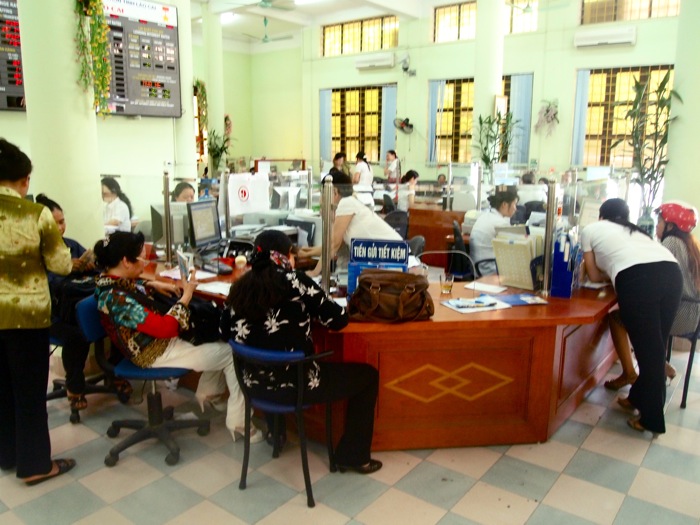
Outside passport control, we were accosted by a large group of currency changers who, though we had no interest in their services, insisted on continued interaction and soon encircled me. One of them reached out and removed my Maui Jims from my face, placing them on his own. I prepared for battle, and called over to Scott for reinforcement.

Just then, a customs official exited the building and yelled out to the men in Vietnamese. The group began to disperse, and I grabbed my glasses back off the man’s face. That was twice now, that I had taken those spectacles from a would-be thief.

The border of China and Vietnam is not the friendliest of borders, and I believe very few tourists cross at Lao Cai. Officials are strict and gruff, and your fellow travelers are mostly scrubby Chinese and Vietnamese traders, chain smoking cigarettes and shuttling large loads of consumer goods across the bridge on large hand-pulled wooden carriages.

We waited in line for some time, and then even longer, as the customs officials scrutinized every stamp and visa in my passport, before allowing me to exit Vietnam. For Scott, the process was even longer. I was lazily doing laps around a large flagpole in the middle of no-man’s land when Scott emerged from Vietnamese passport control. “What was that about?” he asked.

“No idea.” Speculation, however, is invited in the comments.

On to China! We climbed on the Speed TRs and, with a great deal of gusto and excitement, wheeled toward the rather Klingon-looking archway that symbolized the entrance to China. Our attempts to wheel across the bridge, however, were foiled by a Vietnamese official who forbade riding into China. So it was with slightly less billowing sails that we crossed under the great angular concrete archway into China.

One thing was obvious from the very beginning: the Chinese run a very tight ship. We were immediately, and respectfully greeted (in Chinese) by a starched and uniformed official who showed us where we could park our bikes in order to enter the customs building, which was a large and brutally unassuming structure. Inside the customs building, we were greeted by two more immaculately put together chaps, who greeted us in polite and formal, though heavily accented, snippets of English. After seeing the many Chinese visas and entry and exit stamps in Scott’s passport, he was waved on to passport control. Mine, on the other hand, was carefully inspected, detected, and scanned stamp by stamp, presumably to confirm the authenticity of my documentation. Though it took some time, it was done with the utmost professionalism and politeness. Finally, I was ushered over to passport control, past a large door labeled in large English type “Further Interrogation Room.” It seemed their discussions with Scott had alleviated all skepticism of AsiaWheeling, and I was flagged through with no further problem. Meanwhile, Scott’s bags were being carefully inspected, at the culmination of which, the customs official removed a certain bottle of Burmese smelling salts, which we had acquired in Sanklaburi, Thailand. They seemed to pass inspection as well.

We were in China, but the bikes were still in no man’s land. We were beginning to confer about how to best retrieve them when the Chinese officials once again proved their organization and foresight, by showing us back through the customs and allowing us to ride our cycles around and out into China through the same entrance that large cargo trucks use.

And we were in, bikes and all. The city was called Hekou, and so far it appeared to be the usual AsiaWheeling border town. It was a jungle of import-export businesses, and bustled with small-scale international trade. Women who appeared to be prostitutes roamed the streets in short skirts and high heels, strolling in packs. We poured out of the customs building into traffic, wheeling our way through an immense gridlock of Chinese men and women, transporting all nature of goods.

There were a few important missions we needed to complete: we needed Chinese SIM cards; we needed to find a hotel; and we needed to wheel the city of Hekou. We were still in the jungle of import-export businesses, so we headed on toward the interior of the city. On our way, we passed a bus station. We had spoken to the honorable Stewart Motta since our encounter with him in Lao, and at his recommendation, our next waypoint in China was to be a predominantly museum town by the name of Jianshui. Jianshui was also positioned conveniently between the border town of Hekou and Stew’s current residence in Kunming.

Inside the bus station, Scott demonstrated his Chinese skills, quickly manifesting for us a couple of tickets for early the next morning to Jianshui.

We declined a number of offers from fellows at the bus station to provide us with professional female companionship, and climbed back on the cycles. We soon found our way to the riverside, where we called a waypoint at a roadside juice stand, where the owner came to join us at our plastic table, explaining to Scott in Chinese where we might find a cheap hotel, what price we should pay, and how to find SIM cards. We thanked him, and after finishing our freshly blended mango juices, headed off toward the hotel and SIM card district.

All around us China was just churning with activity. Men strolled the streets yakking away on cell phones while wearing no shirts. Construction workers furiously bent and welded metal in the streets. Beautiful women zipped around on silent electric mopeds, and everywhere things were growing, being improved, remodeled, or torn down to make room for the future. Acquiring SIM cards was easy, and the staff at China mobile was exceedingly patient and helpful.

Armed with newly active phones, we headed down the street where we saw a giant gleaming Chinese business hotel.

Scott went inside, and firmly bargained them down to the price that had been communicated by our juice-making friend. It worked, and after declining more offers for paid companionship from a woman who had set up shop with a large placard of optional women at the base of the elevator, we headed up to our room.

The room was stupendous and cheap. For about US$20.00 dollars per night we were enjoying a spotlessly clean room, with new shiny fixtures, and the solid kind of furniture one expects at a place like the Westin. We had free in-room Internet (Facebook, Youtube, and Twitter were, of course, blocked by the Chinese government). We took only the time to pound a little water from the in-room water bubbler, and change into our Speed Matrix biking jerseys, before heading back out for a wheel.

The staff of the hotel, which was no doubt used to Chinese businessmen and international traders who were mostly interested in feasting and paid companionship, seemed baffled that we would head back out into the heat of the day, after just arriving sweaty and disheveled from the savage wheel. But thus is the habit of the AsiaWheeler. China was just too new and fascinating for us to separate ourselves from it by a pane of spotlessly clean hotel window glass.

We wheeled down the road, stopping briefly to purchase refreshingly affordable water at a brand new giant supermarket, and then headed down the road that skirted the riverside. On one side was China, on the other was Vietnam. The Chinese side was clean, orderly, and marked by gigantic blocky, brutalist structures. Meanwhile, the Vietnamese side was mostly undeveloped, covered with mineral extraction operations and tent cities. It’s true that Vietnam has one of the fastest growing GDPs in the world, but China was the clear winner in this race. We wheeled on past another large border crossing, this one for rail only. On the Chinese side, there was a huge brand new facility, imposingly constructed from concrete and glass, which dwarfed its modest Vietnamese counterpart.

On we wheeled, the opportunity to explore the wide smooth roads that connected the brand new housing and administrative developments of Hekou was too tempting not to. The sun sank low and hunger took hold. We had just made it back into the neighborhood of our hotel when we wheeled by a street filled with restaurants, and the glorious smells coaxed us in. We dismounted and walked the Speed TRs, scanning for a place to eat.

We finally selected a restaurant at the end of the row. It was one of the standard kind of Chinese joints, with no menu, instead just a giant bank of ingredients in an open cooler. We were invited inside to select from the ingredients, and once we had selected some, were expected to enter into an involved discussion of how we would like them to be prepared. This, we unfortunately lacked the vocabulary to execute, so we just asked the waitress to choose for us, and headed over to the table.

The meal that arrived was amazing, a truly emotional experience.

As I leaned back from my feasting, I was overcome with the delightfully new vibrations of China. The traffic, the food, the attitude of the people, it was somehow perfect for AsiaWheeling. This was a decidedly new chapter, and I could tell already it was going to be a glorious one.

Downhill, Then Back Up

The air was cool and fresh, slightly thinner due to our high elevation here in Sa Pa, but very comfortable. The first part of the wheel was all to be downhill, which made it very easy, pleasant wheeling. We had both put on our SpeedMatrix jerseys, which added to the airy, fresh feeling. The sun was the brightest it had been since we were in Borneo or Bali, but the addition of the Maui Jims to our lifestyle even kept that cooled off. Basically, we were feeling great.

When we passed a restaurant that sported a big suckling pig, cooling on a spit outside, we decided to stop in for a bite to eat.

Inside, we discovered that this was the policeman’s haunt, and decided, after looking around at tables full of cops eating lunch, just to emulate their behavior, and order by pointing at what they had on the table. We ended up getting a very Chinese plate of crispy pork and greens (delightful though not nearly as good as those we had had in Lijiang during the pilot study), and a large pile of rather crispy French fried potatoes.

With eating out of the way, we climbed back on the Speed TRs and asked a local woman which direction she thought we should wheel in. She pointed down the road up which we had just climbed in the bus.

Okay, more downhill it would be, for now at least. We strapped a bunch of bottles of water to our cycles and headed off.

It is worth pausing to discuss here the strange trends we have observed in Vietnamese bottled water manufacturing. Aquafina, being the market leader, commands a high price for its H2O. So, following suit, all the Vietnamese bottled water companies have re-branded themselves to resemble Aquifina. We saw, among others “Aquaonly, AquahostA AquiMinimax, AquaSpa, ….”

The feeling was wonderful, just soaring down the mountain. As we coasted along, the scene opened up around us to display giant green valleys filled with terraced rice operations, dotted with little farmer’s huts. Morale was supremely high, so we just kept soaring on, stopping, of course, from time to time, to indulge a little of that old vice of ours… timed exposures.

We wheeled on past a large Colorado-esque sign indicating that we were leaving Sa Pa. And down through one valley and then another. On the slopes, everywhere we looked, people were farming various crops, presumably dependent on the availability of water and the quality of the soil. In the very bottom of most of the valleys, there were small streams, around which herds of water buffalo were being tended. Nearby the farmers would churn through the mud of their rice fields with giant devices, seemingly homemade, consisting of engines, connected to openly whirling blades, all mounted on a welded-together framework of metal. Looked like terrifying, but satisfying work.

On we went, farther and farther down, past fellows on mopeds transporting all manner of goods up to Sa Pa, and road crews hard at work maintaining the beautiful curves of bitumen that we so luxuriously rode upon. Finally, we came just to the edge of the clouds we had worked our way through on that morning’s bus. It seemed time to turn around.

And what a change it was. What had been an easy, beautiful, cool, dry wheel, suddenly became a punishing, sweat-drenched test of the human psyche. This mountain, which had once been so kind and open with us, became a cruel beast that had to be tamed. Up and up we rode, stopping from time to time to drink water like lost desert wanderers stumbling upon an oasis. No sooner had we quenched our thirst than we were back in the cycles, hammering up the mountain. We quickly digested all in our stomachs, and drank all our water.

With that came a new kind of challenge. We no longer had the excuse of water breaks. It was just us and the mountain. Even through the haze of struggle, though, from time to time the raw beauty of the landscape would captivate me. I would get lost in the curves of the terraces, or a herd of water buffalo wallowing in the muck at the valley floor.

We neared the top of the mountain and the city of Sa Pa riding a wave of energy. The heat of the moment was over and we were once again in the highest of spirits, and delighted with our recent trajectory, instantly dried and cooled by the mountain air. We wheeled to the edge of the city, where we stopped to take in one more drink of the stunning view. I sat on a tuft of green grass and Scott joined me. What a country this was!

We wheeled back into town past a table where two fried dogs heads advertised the availability of canine meat, and sat down at a hole in the wall Pho joint.

The soup was unsurprisingly delicious, and from there we wheeled slow and easy back to the roomy, Wifi-filled comfort of our hotel room. We spent the rest of the night working on correspondence for you, dear reader, stepping out only briefly to indulge in a small dinner of Bia Hoi and boiled duck eggs, each of which was filled with a deliciously fetal chick.

A Train Into the Hills

We spent our last day in Hanoi, perusing the giant indoor markets in search of more Project K9 goodies to send off to one of our readers with culinary inclinations.

For ourselves, we picked up a few of the famous and charming Bia Hoi glasses that were made from poured glass and featured a big H emblazoned on their bottoms.

A street-side cafe was eager to help pack them after we effectively communicated that we wanted 10 glasses of beer
(hold the beer).

With a large bag of spices and local cooking tools, and a heavy bag of Vietnamese glass, we headed to the post office, and made short work of dispatching the whole kit and caboodle.

Back on the road, we decided to indulge in a little bit of mid-afternoon wheeling through the steadily intensifying rush hour madness of Hanoi. This was enjoyable, but very high voltage. In fact, we were soaking wet with sweat and rather frayed at the nerves by the time we made our way back to the restaurant we had visited the night before.

The same adorably surly waitress was there, as though waiting for us. She gave us a huge grin and then snarled through the ordering process, pushing us to select certain foods and not taking no for an answer on the Bia Hoi. No sooner had our beers arrived than we were joined by yet another North Vietnamese veteran who happened to speak Russian. We sipped bia hoi, and ate with him, discussing his service as a fighter pilot, flying MIGs for the people of Vietnam, and allowing the conversation to deviate toward more relaxed topics whenever we could. In the end, we were all very good friends, and bid each other warm regards upon departure.

Back on the cycles, we returned to our beloved Liberty Hotel, where the staff bid us another warm goodbye, while we packed up our things and climbed on the Speed TRs, headed for the train station.

Our tickets that evening were on the “tourist train” to Lao Cai. Lao Cai is the border town between Vietnam and Yunnan Province, China. Since the train is really only used by tourists (foreign and domestic), it is a rather over-the-top train. Though not outrageously expensive, the train is covered with faux wood paneling; each room sports a vase full of fresh flowers, and the entire experience is groomed to be somewhat Orient-Express-esque.

We wheeled up to the station and waited outside for our train. While we waited, we passed the time joking around with the Vietnamese rail employees who had just gotten off their shift and were sitting on the steps of the station smoking cigarettes. A few of them spoke a bit of Russian, but they were less interested in chatting than they were in the folding action of the Speed TRs, and Scott and my own general pre-rail antics. When our train finally arrived, we hustled to get into our compartment and snag some of that prized under-the-bottom-bunk luggage space. This we were able to do with zero difficulty, for the train was almost empty. We were, in fact, one of perhaps four or five passengers in our whole car, and, of course, had a four-bed compartment to ourselves.

The beds were firm and comfortable, but for one reason or another, I did not sleep well. Perhaps it was the change in pressure as the train worked its way up into the mountains, or a strange but drastic oscillation in the ambient humidity in our car as we traveled. Whatever, it was, I awoke quite definitively, shortly before sunrise, and spent the next couple hours peering out the train window at the mountainous farm terrain that was being slowly but surely bathed in steadily increasing shades of gray sunlight. Despite the gray light, the land was startlingly green, reminding me once again what a splendid bit of land Vietnam had for itself. We snaked our way into the mountains, and the smell of pine and rice mingled in a refreshing bouquet.

We were pulling into a city that was large enough to be our destination just as the sunlight began to gain some hints of yellow. The train hissed to a halt, and Scott and I climbed out.

We showed our tickets to the ticket takers (here they use the Chinese system of showing one’s ticket only at the end of the ride) and exited the station into an early morning crowd of touts. It was a misty, drenching, muggy day here in Lao Chai. Just in the time it took to exit the train and make our way outside, Scott and I became completely soaked with sweat. We were getting hungry too, but the pushy nature of the many street vendors outside the station forced us to choose to simply unfold the cycles and head out in search of less pushy breakfast.

Pho was of course the goal, and since we were still in Vietnam, satisfying the urge proved quite simple. We were able to find a delicious spot, which was quickly filling up with locals catching an early morning breakfast before heading out to do whatever they did here on the border of China. It was also perhaps the cheapest bowl of Pho that we had during our entire time in Vietnam. The greens were fresh and delicious, and we were just finishing our bowl when a bus pulled up next to us.

A woman stuck her head out of the bus and called to us Sa Pa? Well… we were indeed trying to head to Sa Pa, and though on AsiaWheeling we usually decline solicitations for forms of transport, this one seemed legit. We made our way over and began the process of bargaining for a ride to the mountain outpost. Eventually we reached a deal, and Scott paid the Pho vendor, while I paid the bus driver and loaded the cycles in the belly of the beast.

The bus then left and we drove for approximately four minutes, before stopping again at the bus station, where our vessel duly waited for the next hour and a half, filling the rest of the way up with people. We were fine with this, for it gave us a chance to drink a can of coffee, use the truly hauntingly filthy bathrooms, and peer across the river into China, where we could see the border town of Hekou. From here it looked not dissimilar to Lao Chai where we were, except that the signs were in Chinese. Soon we would be wheeling in that glorious country once more, through that very border in fact. But first there was a little more to do in Vietnam…

Our bus wound its way up the mountain slowly but surely. The road steadily sloped upward and wound back and forth, climbing out of the sticky humidity into the clouds, which soon enveloped the bus, condensing on the windows, and running in thin streams down the panes. When we pulled out of the clouds, the mountain range was laid out before us, clear and bright, atop a bed of silky gray vapor.

The road wound a few more times around, taking us through an active construction site, and finally up into the village of Sa Pa. Most of the passengers on the bus were headed farther away to the city of Lai Chao. In fact, we were the only people to get off in Sa Pa. However, if you think, dear reader, that taking the local bus might have saved us from being swarmed by armies of touts once we climbed off, you would be sorely mistaken. One of them was so forthright as to even climb on the Speed TR and take it for a spin without asking! All said, though, it seemed to be a day for strange behavior on the part of the AsiaWheeling team, for not only were we swarmed by touts, but we actually selected one of them and followed her back to her guest house.

We pulled up, us on our Speed TRs and she on her moped, to a beautiful place, with an unencumbered view of the vast misty mountain range that surrounded us, and were shown to a room with three full beds, wireless Internet, and hot water all for $8.00 a night! On top of all that, they even advertised the cheapest coffee and cold drinks in town. Splendid.

Our tout brought us a thermos of hot water with which to make tea, and took our passports to go register us with the local tourist police. In the meantime, we slathered on a bit of sunscreen, cleaned off our Maui Jims and started preparing to wheel.

You’re telling me Vietnam looks like this?

We awoke at the Liberty Hotel and made our way downstairs for breakfast. Getting coffee proved very difficult, and the resulting brew was manufactured before our eyes from some off-brand instant powder that looked like it had been manufactured around the time of reunification. Next, we headed out to a noodle restaurant for the morning’s sustenance.

The broth had been prepared with a tool for boiling beef bones and scooping noodles, almost identical to a Project K9 request we were about to ship off for our dear reader Laura.

Next we wheeled onward passing various vendors and fruit stalls.

Feeling much refreshed, we climbed on the cycles in search of more adventure. This day we decided to head north, in an attempt to get a perspective on the city not dissimilar from that we had gotten when we simply wheeled west in Saigon.

We took off heading north this time, working our way through the center of town up through an area that was filled with communist statues, large blocky headquarters, and Ho Chi Minh’s tomb (which by the way is rather similar to Lenin’s).  Onward, the architectural styles varied between communist-industrial, to modern, to French colonial in an enjoyable medley of colors under the overcast sky.

We kept working our way north, past a large cemetery, and into the suburban housing projects.

Suburbs don’t work in Hanoi exactly the same way they do in the west. What I’m talking about here is a sort of wasteland of giant concrete apartment complexes connected by giant highways. Like western suburbs, there is little in the way of pedestrian activity or small-scale corner stores. But unlike western suburbs, those around Hanoi are a little closer to the city center. No one has a yard, and the only real roads are giant highways. It was along the side of one of these giant highways that we were riding at the moment we saw a new construction project, which seemed to warrant further inspection. As far as we could tell it was another (slightly more posh) cluster of sky-scraping apartment buildings. This one was still heavily under construction, but it seems before they started any other part of the project, they had to first finish and polish off a giant central gate, which loomed in full monumental glory – something in between a communist monument and the Arc de Triomphe. Of course we were barred from entering, but it was certainly a worthy waypoint.

From there we did our best to keep heading north, though the roads seemed determined to keep siphoning us eastward. Finally, we found ourselves at another great bridge, across the same river that we had traversed the day before. At first we entertained the notion of skipping the bridge, and trying to head down the riverside back toward Hanoi’s city center. But this began to seem impossible as the road turned north once it reached the river rather than south. So we were met with a conundrum: should we…

  1. cross the river and head south on the other side in hopes of faplungeoning our way back to Hanoi, or
  2. head back south the way we’d come and experience that same ride in reverse

Option 1 seemed the obvious choice, but in order to execute that maneuver, we needed a little more coffee. This we were able to acquire in the form of a couple cans of Thai coffee from a large bulk dry goods shop along the road we were currently riding upon. Refueled by the coffee, we headed up and onto the bridge. This bridge had many large lanes for cars and trucks, and a separate smaller lane for bikes and motorcycles. This is the lane we took.

It was a hard, fast ride in the midst of swarming motorbikes. From time to time we would run up on another bicyclist, but he or she would be riding so slowly, on a cycle so laden down with vegetables or cement, that there was little opportunity for comradeship, and usually the situation necessitated a hair-raising pass during which Scott and I had to put our faith in our fellow drivers and our ability to accelerate into the region of the bridge one might call the fast lane.

On the other side, we pulled over to take a breather. We were badly in need of water, and a little shaken by the high voltage bridge crossing. Once we had caught our breath, we looked around. We were certainly in a new and interesting part of Vietnam. All the buildings here were very narrow and three or four stories tall. All took interesting architectural cues from both the French colonial influence and the blocky metal and concrete communist architecture of China and Russia.

We worked our way around the block, searching for a spot to buy water, and we found one right next to this strange metal device.

Speculation as to its purpose is heartily invited in the comments.

From there we began to wheel hard, right through this little city at the end of the bridge from the Hanoi suburbs and up onto another dike. It seemed so much like the dike that we had ridden on the day before that we thought it might in fact connect. So on we rode, into the wind, through a landscape that was ever-changing and so very different than I had imagined Vietnam to be. Take a look at these pictures and do your best to reconcile them with your views of Vietnam.

We wheeled on and on. The sun was beginning to hang low in the sky, and we were still yet to find that this dike was indeed the one we had wheeled on the day before. To complicate matters, it seemed that we had acquired a new river to our right, which had not been there before. We were now almost certainly separated from the city of Hanoi by two large rivers. We continued to head south hoping against hope that we might find ourselves near something that we recognized, but still all was unfamiliar.

Then we saw it… across the river, a large communist party building we knew we had passed the day before. So the good news was we were close to the road that we had ridden before. The bad news was that we were still separated from that road by a pretty large river, with no bridge in sight, and the spot we could see was still quite a way from Hanoi and our beloved Liberty Hotel.

The sun was sinking low… perhaps two hours left before it was too dark to ride. We pulled over to have a conference. We finished the last of a red bean and fig cake we had purchased at the water stand near the strange metal object.

We decided our only rational choice was to keep wheeling south in hopes of a bridge, and if it got dark before we found one, we’d need to come up with a new plan, most likely involving folding the bikes up and getting in a cab.

So we wheeled on hard, keeping our eyes peeled for a bridge. Not that much farther down the road, we passed a sign indicating that if we kept going forward we would reach Hanoi in 23 kilometers. This was a good sign, and it gave us renewed energy to pour into the Speed TRs. We started really pushing the pavement underneath us, as the road grew larger and more filled with traffic. Finally, this road T-ed into a larger road that almost certainly led to a bridge over the river. We pulled into the traffic and triumphantly rode over the bridge.

On the other end of the bridge, we found ourselves back in the place where we had turned around on the previous day’s wheel. The same woman was there packing up her stand after having sold all her crabs and ducks. We paused for a moment to catch our breath. We were on a giant busy street and staring down the option of taking this huge street directly into Hanoi, which would be faster and might even get us in before darkness had fallen completely, and taking the route we had taken the day before, which would have us on quieter roads, but would certainly have us riding at least half the ride in the dark.

Since our ill-fated misadventures with bearings in Cambodia, Scott was left without the use of his dynamo hub. This meant that he had no headlamp. And we had neglected to bring our Knog Gekko lights with us….

We decided to take the busier, but more direct street, and to do it at highway speeds. We exchanged one last glance and then raged downhill into traffic. Keeping to the right side at first, we pedaled hard along with the stream of motorcycles, joining the throngs and breathing the fumes of burning oil. We tore through the small city that we had encountered the day before, and followed the road onto a larger bridge than the one we had taken yesterday.

Now I was really thriving on the energy of the ride, feeling great, and flying along. I was passing the slower motor bikes, and ringing my bell like a maniac. Old men on motorcycles would turn to me and smile in approval.  If I came up on a cycle burning a lot of oil, I would just lay extra hard into the old Speed TR and pass it. It was amazing – like some kind of drug. I felt great flying along there, safer and more in control than normally. As I crossed the bridge, a motorcycle with two beautiful Vietnamese women on it pulled up alongside me. The one riding on the back turned to me and smiled, giving me a peace symbol, and yelling something in Vietnamese through the wind and engine noise. I felt like a character in Easy Rider, raging through the noise of motors, smiling and interacting with my fellow traffic. I was in a world without cars, where two-wheeled vehicles ruled the road. Ah, Hanoi, one of my favorite cities yet.

On the other side I pulled over to wait for Scott. He pulled up seconds later, looking similarly ecstatic. We were back in Hanoi. There was still light left; we’d made it and we knew where we were.

We wheeled back to our hotel taking only one wrong turn that put us onto this giant street full of even more motorcycles than before. Perhaps the immensity of it is best communicated using video and photography.

Once we finally made our way back to the Hotel Liberty, we decided to stop at a nearby place for a glass of Bia Hoi. It was the perfect beverage for the end of a wheel. Mellow and malty, cool, not too sweet, and not too alcoholic. As soon as we saw it, we knew the place. It was a grubby open-air curbside beer joint. There were about 20 men there already, all Vietnamese and between the ages of 35 and 65.

As soon as we sat down, we made friends with one of them, who insisted not only on buying our beers, but also in introducing us to his extended family, talking to us in English, Chinese, and Russian, and also leading me by the hand to the bathroom.

After finishing our beers and bidding our friend goodbye, we climbed back on the Speed TRs to look for a restaurant. Without needing to wheel too long we came upon a jam-packed restaurant that emitted the most delightful smells.

We sat down to a feast and took special pleasure in engaging in a fair bit of shtick with our surly but adorable waitress.

Hallelujah It’s Hanoi

The elderly Vietnamese family that had shared our compartment on the Reunification Express had already climbed down from its lofty perch by the time that Scott and I awoke. We were in the Hanoi Station, and we were just able to get ourselves vertical in time to help our — well I would not quite call them new friends, but at least new acquaintances, who appeared to tolerate our monopolization of the luggage space — to unload their bags. This appeared to heal at least some wounds, and they bid us a reasonably hearty farewell once we were out on the platform.

Hanoi was cool. Almost chilly by AsiaWheeling’s standards hitherto. In general, we are in places where existence outside air-conditioned environments is by definition sweaty. Here it was cool and breezy and gray. We unfolded the Speed TRs on the platform while a crew of railway workers arrived to wash down the startlingly dirty exterior of our train.

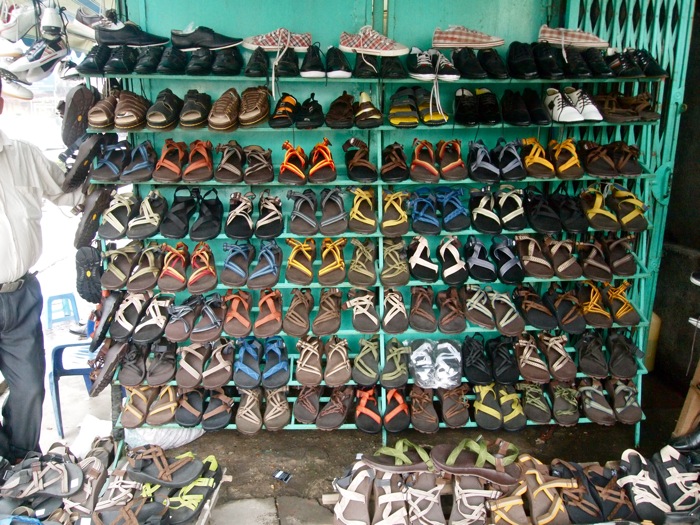
We climbed onto the cycles, and wheeled out of the train station, right by the horde of cab drivers and guesthouse touts who lay in wait. We took a right and headed down the street in search of a little pho and coffee. Instead what we found was stand after stand selling Chaco sandals. Chaco is my (and many other members of the AsiaWheeling team’s) preferred brand.

These were either knock offs or taken straight from the factory, for they were being sold at bargain basement prices. We stopped to further investigate, considering a replacement of Scott’s Sri Lankan faux leather sandals. Unfortunately, the gigantic nature of his feet precluded us from purchasing any sandal in their entire stock.

As we wheeled on, we commented to each other on how gorgeous this city was. Hanoi has a decidedly European feel to it, with large tree-lined promenades, and small side streets with plenty of outdoor cafes. Much of the architecture takes cues from the French, and many of the buildings are built from brick or stone.

It was just starting to sprinkle when we came by a shop that would at least be able to supply us with coffee.

As we parked the Speed TRs and made our way inside, the sky opened and began to soak the city of Hanoi.  While the rain fell in buckets, we ordered cup after cup of absolutely delicious iced coffee.

We had shied away from the Vietnamese coffee these past few days, after our initially terrible sample, but now we were kicking ourselves, so delicious was this shop’s offering.

Let me divert the narrative for a moment to explain this glorious brew. You are given two cups, one filled with ice, and one that has a thin pool of condensed milk in it. Onto the milk cup is placed a kind of aluminum brewing device. The device is filled with coffee and then hot water. The resulting slurry is tamped down with a  kind of of metal cap, and the whole apparatus is covered with a larger cap that is later used as a drip tray. The consumer of the coffee is then encouraged to wait while a thin stream of very strong and fragrant coffee drips through the device and into the cup. This is an opportunity for conversation, answering email, smoking cigarettes, and generally enjoying one’s self. The waiting period is an important part of the coffee consumption event and as such should not be taken lightly.

We were indulging in the email-answering functionality of the waiting period, and as our tab grew from four to eight coffees at this place, we feasted on one of the many free wireless networks that pervade the big cities in Vietnam. After about three hours, the rains finally stopped and we climbed back on the Speed TRs to begin wheeling around in search of a decent hotel.

We soon found ourselves in a delightful little neighborhood, filled with little food markets and spice shops. It seemed reasonably central and would make a great home-base for Hanoi. Unfortunately hotels were few and far between. It took us quite a bit of wheeling before we finally found one that fit our needs and our budget. It sported free fast wireless, and a nice comfortable room for less than we’d paid in a while.

The catch was we had to walk up seven floors to reach the room. But we figured this would be good training for our upcoming stint in Mr. Stew Motta’s apartment in Kunming, so we booked our room at the Liberty Inn. We dropped our stuff and began consulting the front desk as to noodle shop recommendations.

We were, of course, looking for Pho, but the man at the front desk convinced us that we might consider branching out into a new style of noodles. We agreed and followed his directions to a joint down the road that served nearly brothless noodles.

It was an amazing bowl of noodles. First each bowl was filled with a handful of fresh greens, onto which were piled steaming rice noodles, from there a spoonful each of spicy savory beef, deep fried crispy onion, and crushed peanuts were added. The entire bowl was blended with spicy and sweet condiments at the table and stirred relentlessly before eating.

Ah, we felt great after that bowl, ready for anything, and just revving to wheel Saigon. We took off toward the main river in the city, and when we saw a huge group of both motor- and bi-cyclists heading onto an old metal bridge, we took the opportunity to follow.

It was a long, old rusty bridge, which led across the river to the opposing hamlet of Cu Khoi. We wheeled over a number of river beds, some of which showed signs of being low for so long that people had begun to plant them with crops. On the other side of the bridge, we found ourselves in a smaller, slower city, which appeared to be where most of the Bia Hoi was produced.

Let me depart from the narrative once again to discuss Bia Hoi. Bia Hoi is a very weak home-brewed beer that is very popular here in northern Vietnam. It is made in small batches and transported in small plastic kegs all around the city on a daily basis for consumption at small street-side cafes. As we wheeled through this part of town past many small scale breweries, we could detect the warm sour stench of fermenting grains passing over us in waves. We decided we’d need to try some later that day.

The landscape was so different than I had imagined Vietnam to be. It looked more like Scotland, with overcast skies and deep green grassy hills. As we rode along, we had a choice of taking either the high road or the low road. The high road seemed to skirt around and out of the city along a great dike, while the low road snaked its way through the many small structures that made up the city itself.

We took the high road, and began pedaling hard, making our way around and out of the city in record time. The traffic was an interesting combination of cattle, fellows transporting large or oblong pieces of industrial equipment or building materials via motorbike, and dump trucks.

Soon we were riding along a river, and the city had dissolved into farmlands, industrial parks, and Communist Party offices. Finally, the road we were on T’ed into large iron bridge. I looked around the green land, dotted with bits of rust and concrete, which, for a moment, conjured up Pennsylvania coal country.

We stopped for a moment to investigate the wares of a very popular roadside seller, who was hawking crabs, large insects, and live birds. I found myself unable for a time to stop staring at a fellow who had bought two live ducks and strapped them quite violently, by the legs, upside down, to the front of his motorbike. The ducks looked none too excited about their immediate future, as they swung inches above the pavement.

Let me get this straight, though. I eat plenty of meat here on Asiawheeling, and when I am back in The Empire. I am in favor of killing and eating animals, but something about the predicament of these ducks unsettled me. It seemed like they were being tortured, strung up by the legs, being blown by the wind, flailing with their faces just inches above concrete which was whipping by at 40 or 50 kilometers per hour. I am sure that most of the experiences that animals undergo leading up to their consumption by humans could be construed in one way or another as torture. And I would not be surprised if inside the U.S., it is actually a more torturous approach to dinner than here in Asia. So, in the meantime, I am going to chalk this up as one of those cognitive dissonances one must acknowledge and schedule for later consideration. For certainly, I am not about to stop eating meat. Perhaps I’ll come up later with a justification for a more callous view on animal rights. In the meantime I’ll continue to pity my food as it suffers and turn right around and happily ask for seconds while I wipe the grease from my chin.

Back in Vietnam, we wheeled along the same high road, now taking the opportunity to divert our travels to the low road for the way back.

Here the smell of brewing beer was stronger than ever. The Speed TRs were put to a little test, scrambling over piles of garbage, fording deep mud puddles, and navigating a generally unwelcoming road.  They passed with flying colors, bringing us finally back to the bridge, which we crossed, finding ourselves now on the other side, in the midst of a giant kitchen wares market.

We spent some time perusing the market, and purchasing some K9-related kitchen goods.

Back on the cycles, we made our way back toward our hotel, noticing quite suddenly that we were starving. But we were deep in the touristy section of town, which seemed to be filled only with expensive western-style restaurants. We scoffed at these and kept riding, calling random turns until we had made our way out of that district. Finally we found a little roadside outdoor restaurant, where we ordered some dishes with rice, and a couple of Bia Hois.

Another great thing about Bia Hoi… it’s alarmingly cheap. A glass costs about 25 cents, and is served in a very attractive thick green glass, full of tiny bubbles. The glasses generally have a big “H” stamped on the bottom.

We were squatting on tiny wooden chairs enjoying our Bia Hois and snacking on the free peanuts that accompanied them, when a man called over from the table behind us. He spoke very little English but called out to us in what he had, asking where we were from. I said “America” and though he instantly became a little more wary of us, we began to chat. He commented on our Bia Hoi and asked whether we were enjoying it. We were, quite thoroughly, and informed him. He smiled and asked whether they had such a type of beer in the U.S. We explained to him that we did not really have such a system of down-home brewers who sold beer in small batches for widespread consumption. Sure we had micro-breweries, but microbrews are trying to be distinctive, luxury goods, and most were pasteurized and regulated. Here in Vietnam, everyone was just trying to crank out this cheap, unregulated, weak, unpasteurized lager, which was the drink of choice all over the city.

I turned to our new friend, “You know the only other place I’ve heard of this type of beer being produced?” He looked blankly at me — “Russia.”

Suddenly, the man leaned in close to me. “So you’ve been to Russia?” he said. “да,” I answered. And then we were off speaking in Russian. It was so unexpected, it took me quite a while to remember how to say certain things. I explained to him that I had studied in St. Petersburg a few years back, and that we would be visiting Russia later on AsiaWheeling. He explained that he had been sent to Russia as part of his training to fight the Americans in the NVA. Now that we were speaking Russian, his whole demeanor had changed. He congratulated me, and complimented my filthy broken Russian.

“So few Americans can speak Russian,” he said, “Did you study Russian to spy on them? Are you a soldier?”

I did my best to explain that I was just a curious fellow, hated war, and had no interest soldiering. I did my best to communicate that just like Vietnam, Russia was an enemy of the U.S. at one time, but now I am hoping that friendship can replace animosity.

He really seemed to like this, and began to go on at length about Vietnam today, comparing it with Vietnam during the war. My ability to understand him was severely hampered by my poor grasp of the Russian language, but I was able to ascertain that much of what he was saying was about how much better off they are now, mostly due to the fact that Ho Chi Minh was able to re-unify the country. He also spoke at length about the Cuban Embassy, as well, which he showed me was just visible down the street. He knew that the U.S. did not have one, and commented on the proliferation of affordable Cuban cigarettes and cigars in Vietnam as highlighting one of the great drawbacks to our embargo. I agreed with him heartily.

It was then that he started talking about vodka. I think there is something about speaking Russian with another non-native speaker that gets one or both of the parties thinking about that old Russian vice. He spoke at great length about the way that Vietnam has learned from the Russians to make very good vodka. It was still somewhat early in the day, and we had quite a few kilometers yet to wheel before we arrived back in the neighborhood of our hotel, so I declined his repeated offers to drink.

The Bia Hoi is a very weak sauce. A cup varies between 2% and 3% alcohol, but I knew that if we started drinking vodka with this fellow, we would soon be in a rather compromised state. In fact, if my estimates were right, after such a hard wheel, and under the kind of peer pressure which Russian-style vodka drinking generally encourages, we would soon be more beasts than men. So I had to stick to my guns.

Despite my refusal to drink, he ordered a bottle of the Vietnamese vodka to the table, simply to prove to me that here, like in Russia, the vodka is kept in the freezer and served cold. “This is the only proper way,” he explained.

He then shook my hand repeatedly and returned to his little table. Throughout the rest of the meal, he came by from time to time to say something congratulatory and shake our hands.

Once we had paid the bill, I bid him farewell, and we climbed back on the cycles.

We had just enough time to get hopelessly lost on our way back to the hotel before night fell on this most fascinating city.

« Previous Entries Next Entries »

Privacy Policy | Terms and Conditions