Author Archive

« Previous Entries Next Entries »

Angkor Wheeling

The alarm went off not long after sunrise and we made our way excitedly to the downstairs of the Mandalay Inn. The staff was again supremely friendly to us, hustling to remove the cycles from the room where they had stored them overnight. They spent the night right next to a full-sized cycle that the staff were just bubbling to inform us belonged to another American who was cycling here as well. Interesting, we thought, and ordered breakfast.

We don’t generally order breakfast at the hotel unless it’s included with the room. But we were in a rush to get to Angkor Wat to maximize our wheeling there. Plus they were so darned friendly here, we found ourselves tempted to support the venture. The breakfast was unfortunately only successful in the support-the-venture department, as it turned out to be expensive (by Cambodian standards) and consisted of a fried egg into which had been pushed four “Lit’l Smokies®.” (For the uninitiated, I’ll have to refer you to GOMEAT.com).

Toast was limp and depressed. Coffee was flavored with some hazelnut-type chemical, and was monstrously sweet.

Perhaps some of my complaint over the breakfast comes more from internal strife. My stomach had not been up to its usual hearty patterns of behavior, and hunger and passion for food eluded me. I had little interest in food, but scarfed this mediocre meal down knowing we had a big wheel ahead of us. Somewhat under-caffeinated, and oscillating between flourishing excitement for the day’s wheel and waves of nausea, I joined Scott on the road.

Signs for Angkor were everywhere, and the wheel took us at first along a large canal that wound its way through the city of Siem Reap. We wheeled by the place where we had enjoyed the Crazy Beef Burger the night before, and followed the signs until we were dumped onto the huge central road that leads to the Angkor temple complex. Angkor is one of the most visited tourist destinations in the world, with approximately 700,000 visitors a year. The huge road was justified, but still not all that fun to wheel. The shops that lined the street were overpriced, and we had zero luck finding a decently priced cup of coffee. When we saw an opportunity to take a break from this road, by wheeling the “Angkor Herb Gardens,” we called a lichtenschtein. The herb gardens were strange, and none too full of herbs. And before we knew it, we were simply riding up a one-way street the wrong way through thick jungle. This kind of maneuver, known in the AsiaWheeling community as the “subversive garade” is commonly accepted in Cambodia, especially if the perpetrator is a motorcycle or bicycle. So we had no fear even when passing police officers headed the other way.

I checked our bearings on my compass-bell and we appeared to be following the main road, more or less, just a kilometer or so to the east. So where were we? This was no herb garden… in fact it was such dense jungle that the amount of traffic on the road seemed unjustified. Then suddenly we came around the corner and found ourselves looking out on a giant rectangular lake, with an old stone wall around it. I was still wrapping my mind around what exactly was looming out of the center of that giant moated structure, when we were promptly stopped by a police woman. “Tickets?” she asked.

It was then that we realized we had found our way somehow onto a maintenance access road of some kind, and this was the Angkor complex. We’d made it. And as long as we were not about to be arrested for trespassing or sneaking in without paying, it looked pretty cool. Scott was able to convince the woman that she had merely caught us in an honest mistake. We asked where we might buy tickets, and she motioned the way down the road. Angkor exists on a scale that is rarely encountered by humans. The temples are large and spread out, and a fine grid of newly paved roads connects them all. You could say it’s one of the most readily wheelable tourist attractions on earth.

The ticket counter was a few kilometers away, and on the ride we stopped to buy some coffee. The roads around the main temple, called Angkor Wat, are lined with stand after identical stand, selling basic Cambodian fare: lettuce wraps, fresh fruit, French bread sandwiches, grilled meats, potato and carrot soup. We struck out with the first few stops, finding no coffee, but third time hit gold. Unfortunately, it seems we were the only people to order coffee from this stand – perhaps ever. We tried to communicate that we were in a bit of a rush, because of our illegal status in the area. In response, I believe, the woman took dirty water, half boiled it, dissolved instant coffee powder in it and served it to us.

It tasted like a Great Dane’s bathwater. My stomach, which was just starting to settle a bit, took a savage turn for the worse. It was only mildly improved by the time we reached the ticket office. We wheeled out of the park then swung around to re-enter legitimately. Having done that, we headed back to Angkor Wat.

We pulled up outside the temple and were quickly swarmed by children selling drinks, food, post cards, books, and the like. We refused most of them and haggled hard with one of them in order to still overpay a bit for a book detailing the history and relevant features of all the Angkor temples.

Once we had paid one of them, the rest of the kids caught the scent of blood and redoubled their assault. It was a new kind of sales maneuver, one we had not yet encountered. It was a clever combination of the guilt-trip and the persistence hunt. One of them was vehemently explaining to me that she was going to skip going to school that day so that she could wait for me to visit the temple then come out and perhaps buy a water from her. “Don’t skip school!” I said.

“Then buy some water so that I can afford to go to school.”

Sometimes AsiaWheeling is a tough business. Locking the bikes and extracting ourselves from this swarm was one of the tough parts. But we did it, and soon we were wandering into Angkor Wat.

Angkor Wat is an incredible piece of human ingenuity, a fascinating and haunting structure. It is just one of many temples in Angkor, and it is honestly best described using imagery. So without further adieu, let me give you a bit.

As we walked through the temple complex, in the peak of the hottest and driest season, we marveled at the scale and  interconnectedness of the ancient Khmer civilization.  While Hindu at the time of building, Angkor Wat’s temples were later retrofitted with bas relief and sculpture to reflect the now Buddhist religion of the kingdom.  Our conversation turned to the history of empire, as we attempted to identify any large-scale civilizations that had not used religion as a principal tool in social and ideological hegemony.

The large Communist powers of the Mid-20th Century seem to have been the first state governments to invest heavily in scientific institutions for answering the questions of human curiosity, rather than rely on religion to play such a role.  We continued to rack our brains, placing other societies on a gradient of separability from religion.  The Chinese dynasties held the mandate of heaven, while the Egyptians of 2500 BCE worshiped the Pharaoh as a god.  Medieval Europe intertwined church and state in an incredible force of social control, just as the Arab diaspora from their peninsula led them to use Islam as a tool of imperial organization and even urban design.

Finally, we reached feudal Japan, which seemed it might fit the bill, at least in a cursory analysis of Shintoism and feudal Japan on the WikiReader.

It was boiling hot out. I mean steaming, dripping hot. Scott and I were soaked. It seemed like we could not drink water fast enough. By the time we left the complex, we were all too happy to purchase water from the nagging hoard. This was, of course, not straightforward at all. And to simply pay the already over-priced fee of $1.00 for a bottle, I had to haggle vehemently for about 10 minutes.

With that experience under our belts, we decided to take a wheel. We headed away from Angkor Wat, and spotted a couple of cyclists darting off of a sandy side path. We decided to see where they were coming from, so we headed onto the same path. It turned out to be less of a cycling path and more of a sandy hiking trail that led around the giant Angkor Wat moat.

As we rode, we also found this was the spot of choice for a picnic on the lunch breaks of Angkor employees. They eyed us somewhat suspiciously, as we coaxed the Speed TRs over the sandy and treacherous path. All the lunching people around us began to spark a thought in Scott’s mind.

It was time for lunch. My stomach was still a mess, but eating is important. So we went to the only air-conditioned restaurant in the park, and I struggled valiantly to eat a few French fries while Scott worked hungrily at some Cambodian Anise-scented Pork and Egg Curry. For me the most pleasant part of the meal was the mint-scented cool towel they provided.

With eating thankfully out of the way, we poured our energy back into the wheel and the exploration of more temples.

Next on our list was Bayon.

Bayon is the central temple in a nearby sub-complex of temples called Angkor Thom.

We locked our bikes to a recently painted flag pole outside and headed in. This temple was much smaller than Angkor Wat, but was inviting and created intimate space in a way that Angkor had not.

This temple is famous mostly for the many faces on its surfaces. I enjoyed the dark and mysterious interior of the temple, which was filled with little stations where visitors could light incense and place it at the foot of one of the many images of Buddha.

As a result, the interior of Bayon was filled with a thick, scented smoke, which made for a most glorious effect when the sun cut it in thick yellow rays.

Back on the cycles, we made our way past a great many other temples, but since wheeling felt good, we kept going.

We did stop, however, when we passed Ta Prohm. Ta Prohm is perhaps better known to our American readers as the “Tomb Raider Temple,” as it was the temple used in this scene from that movie. It is one of the few temples in the Angkor complex that have been left more or less in its original state, still covered with strangler fig trees. Once again, perhaps the images will do a better job at describing it than I can with words.

This temple was perhaps the best yet. To explore it, Scott and I split up, making our ways through the many crumbling chambers, and doing our best to observe the many Chinese and Japanese tour groups from a distance.

It was getting late in the day, and we were still a little over 20 kilometers from town, so we decided to close this chapter of Angkor wheeling, and ride home. We had, however, purchased three-day passes to the Angkor complex. So there will be more where that came from.

Back at the hotel, we came up to the desk just as a woman was checking in. She asked about our Panama hats and Speed TRs, and through the conversation we discovered that she was the owner of the cycle that had been spending the night with our Speed TRs. She had been riding her bike in Malaysia and Thailand before this. She invited us to join her for dinner and we accepted. But first, a hearty round of showering. It had been quite a day, and we entertained each other over curries in the Khmer Kitchen with stories of wheeling and road-ready survival tactics.

Getting Real About Cambodia

Sim City 2000 rang out, just like it always does, calling us back into the world of the living. We obliged, knowing that if we did not hustle we might miss the 5:30 am bus from Nakhon Ratchasima to the border.

The sun was still not up, so we wheeled through the Thai night toward the station. Traffic was very light, and the streets were essentially deserted. As we drew nearer to the station, we started to see fellows on motor bikes coming in from the country, already in uniform for their jobs as desk clerks or factory workers. We made it to the station just in time to load our things on the bus, buy our tickets from a woman who had erected a little wooden stall next to the platform, and pay a little $3.00 graft “bicycle fee” that we were quite certain did not technically apply to the folding cycles. We considered it a $3.00 donation to the cheerful women who were overseeing the operation, and feeling quite triumphant, relaxed into our seats.

I slept so soundly I did not even notice when the bus attendant brought water and cookies around to all aboard, and only barely noticed when the bus was suddenly loaded completely full to the hilt (I’m talking people packed in, standing in the aisles) and then subsequently unloaded a few stops later, in a tiny place called Ban Dan. A little more snoozing and suddenly we were the last passengers on the bus and were being dropped off at the giant border market called the Cambodian Friendship Market.

The market was sprawling with hundreds if not thousands of small stalls selling all kinds of goods for exchange between Cambodia and Thailand. A section of the market near the center was belching smoke, indicating to us that it was either a smelter or a food court.

Either way, it would be of interest to AsiaWheeling, so we threw on our bags and unfolded the speed TRs.

There was a fellow on a pink child’s bicycle across the street yelling at us as we unfolded the cycles and started into the market. As we made our way in, the fellow on the bike came up to us. He explained in nearly immaculate English that recent changes in Cambodian law had closed this border crossing’s visa-upon-entry station, and that we would need to get a visa issued on this side.

We were dubious, but a few factors lead us to consider his argument as truth:
a) on our previous entry into Cambodia, there had been no visa-upon-entry station
b) we saw many of these visa outfits, and they all seemed to be packed with people (with foreigners getting visas)
c) we had been too long traveling in the land of the honest salesman

So we forked over about 150% of the cost of a visa-upon-entry and our passports. He helped us to fill out the necessary forms, our entry and exit cards, and ran across the border on a motor bike to get our visas.

We drew the line when he tried to tell us that without a Cambodian ID card, we would not be able to buy sim cards across the border, and that we could only buy them from him for $15.00 a pop.

Armed with our newly issued Cambodian visas, we headed toward the border, by way of a Thai-Cambodian friendship chicken satay stand. We ordered a bunch of chicken grilled on a stick, with two plastic bags of sticky rice to accompany them. This food was tasty enough, and effective in its primary mission of sustaining our energy.

Thailand let us out with little fuss. While sweating profusely in line, we ran into a German/Hong Kong/Israeli fellow who agreed to share a cab to Siem Reap with us. We also ran into the visa-upon-entry counter, which was completely operational. Well, you can’t win them all, can you?

When we finally had made our way through a large stretch of casinos, catering to Thai who wish to get around the prohibition of gambling in Thailand (express buses from Bangkok to here are called the Gambler’s Express), we found ourselves at the health check station.

Here we filled out a form indicating that we were in good health, then headed to the passport control line, which was very slow; once we finally made it to the front, it was quite straightforward. They took a picture of my face, checked my visa, and let me into the country.

On the other side of the border, I bid goodbye to our German/etc. fellow as he climbed onto a tourist shuttle to the bus station. I waited for Scott to finish his processing, passing the time by doing folding bicycle schtick with the many touts who were interested in providing me with everything from cab rides, to hotel rooms, to prostitutes. When Scott finally emerged from passport control, we discussed our options. We had been on a bus for a while, so wheeling to the station, rather than taking the tourist bus sounded more our speed. We had told our German/etc. friend that we would meet him there. Little did we know, however, it was the last we would see of the man.

We wheeled across the city, periodically asking for directions to the bus terminal. We got some strange responses, which appeared to be sending us in two different directions simultaneously, but we decided to use the Indian method of averaging all responses to produce the verdict. So we rode on, straight through and out of Poipet, into the countryside.

It was hot, and we were going through our water at an alarming rate. This would prove to be the theme of our time here in Cambodia. So far, I would deem it the most dehydrating country of the entire trip. Even when we stopped for more water, we were told to keep going, only four more kilometers ahead.

Cambodia is flat as a pancake. We rolled along on a well maintained road, lined with new looking electric lines. It was brutally sunny, mildly humid, and the landscape looked dry. If you had plopped me here out of the blue and told me this was Nebraska during the summer, I could easily have been convinced.

But the real question was: who would build a bus station way out here in the countryside? What cruel joke were the locals playing on us? We let these questions whirl around in our heads, but kept riding. The voices were promptly silenced when, low and behold, we arrived at a giant bus depot. A totally deserted bus depot.

We parked the bikes and got off, feeling something like characters in a zombie flick. We wandered into the empty interior of the depot. Almost all the shops were closed, including the ticket counter and the information counter. There were a few people wandering around doing nothing in particular, zombie-like. Interactions with them proved that some of them spoke a bit of English.

We were able to ascertain that there were two bus stations in this city. And for reasons that still remain a mystery, the Poipet officials switch between the two stations on a daily basis. One station is right in the Poipet city center. The other is this one that we had managed to find our way to.

Luckily, everyone in the station seemed to be friends with a guy who would be willing to drive us to Siem Reap. And after a fair bit of bargaining with the crowd, all present proceeded to completely forget the agreed upon price, upon the arrival of the cab driver. Scott and I looked at each other. We hadn’t really made much progress in the bargaining, so we just capitulated and climbed into the cab.

Our cab driver was a great chap, and the cab was reminiscent of a certain Toyota Camry that my friend Joe had driven in high school. I felt comfortable in the car. The cab had no radio, but proved to offer great acoustics for the ukulele. As we drove,  I sat in the back and played most of the songs I knew. We were beginning to notice a peculiar thing about Cambodia: all the cars were Toyota Camrys. And while I am, of course, mildly exaggerating here, the percentage of Camrys really was astounding, likely 90%. Any reader who can shed light on this is most heartily invited to do so in the comments.

We stopped for petrol and provisions at a road stall along the way, and watched the pump work as the hose snaked through our Speed TRs into the back of the car.

By the time we finally reached Siem Reap, the sun was beginning to sink low in the sky. On the ride we had selected a hotel from our Lonely Planet pdf and pulled up to find it quite a beautiful structure.  It was on a gravel road in the city center, and went by the name of The Mandalay Inn. It proved to be staffed by strikingly friendly and capable characters, to be totally affordable, spotlessly clean, and featured free wifi. An instant seal of approval.

That evening we wheeled into the city in search of food. We realized that we had not eaten since the friendship chicken, and were well past the point of blood-sugar-related madness. We finally sat down at a restaurant, which was in no rush to serve us, lacked the ability to make many of the things on the menu, but despite all, won us over with its charming staff, strange music, succulent Khmer curried shrimp, strange fruit smoothies, and ridiculous interpretation of the hamburger (called the Crazy Beef Burger –which Scott instantly re-dubbed the “Mad Cow” Burger).

From there, we figured there was just enough light left to take an evening sunset wheel.  We chose a direction that we guessed was not on the way to the Angkor complex, and began wheeling. Cambodia was beautiful; and the roads were smooth as silk.

We had not been able to attain speeds like this in some time, due to either bad roads or thick traffic. It felt fantastic to just let the Speed TRs eat.

And they were hungry. Once the sun began to hang low enough, we circled back, finding ourselves once again on the main road that had led to Siem Reap from Poipet. Traffic was thicker here, but manageable. We wheeled by giant hotel after giant hotel, finally finding our way back to the Mandalay Inn just as the sun ducked below the horizon.


A Shortcut Through Thailand

In light of our recent successes in the departments of Wheel Repair and Rural Navigation, we decided to, for once, reward ourselves with a lazy morning. Scott packed up the last bits of his things while I headed over to the corner store to buy some lazy morning supplies.

We made like Frenchmen, drank strong coffee, ate baguettes with butter, and devoured a couple of cups of local Lao yogurt, impossibly creamy with fresh local floral honey. One of the more imperial breakfasts of the trip, I’d wager, but also quite enjoyable.

The night before we had run into the proprietor’s son, Tao, who was more than happy to share a celebratory BeerLao with us (it seems he had already had a few) and sing a few songs on the ukulele. Sometimes it was hard to determine if he knew the words to the tunes I was playing or if he just had a knack for chiming in. Regardless, we had formed a close bond by the time Scott and I had excused ourselves to go work on our pitiful backlog of correspondence for you, dear reader.

The same fellow was now wide awake and much more himself, all grins and joviality, and more than willing to take us to the Thai border in the the family van, for a small price of course.

You see, dear reader, we were on our way to Thailand in order to cut across that fine country, saving us a little time, to make our way into Cambodia near the border crossing in the northwest, near Poipet. To do this, we would need to make our way at least as far as the city of Nakhon Ratchasima that night, and catch a bus for the border the next day.

At the border of Thailand, we bid Tao goodbye, and made our way into the line of people waiting to get out of Lao. My guess is that many of them were as sad as we were to leave. Lao had been a relaxing tour of the extremes. Lao bestowed on us a final gift, when Scott managed, while in line for his exit stamp, to connect to a free five minutes of wireless Internet, offered by Lao Telecom, and achieve a 400 kb/s upload rate while syncing his offline email activity. More points for an already AsiaWheeling-approved Lao.

Also, while in line, we ran into a Thai fellow who was interested in us and the Speed TRs. He asked where we were going and offered us a ride with him and his family who would be driving through none other than Nakhon Ratchasima on their way back to their home in Bangkok. “Will you have enough room for the bicycles?” we asked, showing him the folding technique, and attracting a huge audience in the line to exit Lao.

“Sure,” he replied. We told him we would wheel across the bridge, and if we overlapped on the other side we might take him up on the offer. This would also give Scott and me enough time to talk over our general impressions of the fellow, and decide if we would trust him. Lao let us out, no problem, even waiving the exit fee, for reasons of which we cannot right now be sure.

Wheeling across the bridge proved as fantastic an experience as we had remembered, with plenty of waiving of fees and smiling of officials. In line at Thai customs was our friend with the van, standing in an adjacent line with his family. He sent his daughter over to us with a message. She handed us a crumpled piece of paper, torn from a child’s notebook, with the fellow’s telephone number written in ball point pen. I motioned my thanks to our friend, and once we had officially re-entered Thailand, we decided to take out our phones and give him a call.

Then we remembered, Lao phones don’t call internationally. So we took out our old Thai sim cards and inserted them into our phones. I tried calling, but it seems my service had expired. So I ran over to a payphone, threw in about 60 cents in Baht and dialed. In an experience eerily similar to one we had during the pilot study, I plunged coins into the phone struggling against time and the limits of human communication only to be cut off in the middle of our conversation.

We knew our friend with the van was in the Thai border city of Nong Khai, so we saddled up and headed down the road looking for him. Not long into the ride, we began to despair; Nong Khai was not such a small place, and we were trying to find a needle in a haystack. When we were just about to give up, however, he somehow magically appeared behind us in a giant silver van, and as he pulled to the side of road, he also motioned for a nearby tuk tuk (the Lao and Thai version of the auto-rickshaw) to pull over as well.

And that was how we ended up in a family van with two folding bicycles, two sweaty members of AsiaWheeling, a Canadian couple, and a Thai family, headed for Bangkok. We stopped not long into the trip at a Vietnamese restaurant for some food. Scott and I bungled the ordering process and ended up with way too much. So laden with many white plastic bags full of delightfully diverse and fresh Vietnamese food, we sought solace in sharing with the rest of the van.

We drove on through the day and into the night, drilling our way into the heart of Isan. Isan is the name for the central and northeast parts of Thailand and also the name of the majority ethnic group in that country. Although in Bangkok you wouldn’t know it, Isan people and restaurants are seen as somewhat “country.”

When we finally arrived in Nakhon Ratchasima, it was well after dark. We did our best to compensate our man fairly for his kind transport, and headed to the bus station. As we had suspected, there was no overnight bus to the border; we would need to stay somewhere in this large city in the middle of Isan for the night.

We plugged our laptops into the wall and brought up our pdf copy of the Thailand Lonely Planet. It seemed there was a reasonably inexpensive hotel not far from here and… eh! The power was cut when a security guard unplugged our computer. It seems we would need to pay to use the electricity here.

Fair enough. We paid them and subsequently were forced to endure a drawn-out receipt writing, copying, verifying, and stamping process before we were finally able to get back to work. We took note of the location and name of the hotel and congratulated the officials on their fine work extracting money from us. With that, we hopped on the cycles and headed south into the city.

It was not a touristy town, and our presence was one of considerable interest to the many local youth who were whiling away their time on the street corners. The roads were very good and traffic was light, so we made short work of the few kilometers to the hotel. The hotel proved to be $10.00 for a night with A/C, so we registered immediately without bargaining. The room was clean, and low and behold, blessed with free wifi. Our first like this in Thailand.

We made a quick trip out to get a couple bowls of delightful Isan noodles, then retired to our hotel to have a quick Internet feast before our long day of traveling to Siem Reap, Cambodia, location of the fabled Angkor Wat.


Bearing Repairing

Sim City 2000 rang out once again, calling the AsiaWheeling team to action. We didn’t even grab a cup of coffee, we just hopped on the cycles, bungee-ing  our poor Speed TR’s wounded front wheel onto the back seat of Scott’s  rental bike. Our first stop was this place, Top Cycle, rumored to be staffed by a knowledgeable Frenchman by the name of Willy.

It was strange to see Scott on this huge-wheeled rental cycle. The wheels seemed so big for a seat that was so low. I was troubled by this new problem with Scott’s bike so soon after our ill-fated adventures in Bangkok, but it felt good to wheel. And, man-o-man were we wheeling hard. A good hard wheel always has a way of calming me down, putting things into perspective and focus. Paired with a good cup of coffee, the cocktail is downright miraculous.

Well, the coffee was yet to come, but by that time we’d arrived at Top Cycle. We thanked our lucky stars to find them open for business. When a Caucasian fellow came out the front door, Scott asked “Are you Willy?”

“Yes,” he answered in a thick French accent. We explained our predicament, and Willy frowned down at the Speed TR’s dynamo hub. He began to unscrew the lid of the thing, murmuring in the way only a Frenchman can when wrapping his mind around a new mechanism. Very early on, he identified the bearing was indeed the problem, as our fellow yesterday had hypothesized, and seemed to think it was a reasonably standard size bearing.

“I think I can fix it, but this wheel is very complex… I also will need to go to the Chinese market and buy a bearing. Come back this evening. Maybe 4:30.”

Scott and I could barely contain our glee, and headed off in search of celebratory breakfasting, coffee, and some unexpectedly free wheeling.

What had yesterday seemed like an insurmountable problem was so quickly solved! Once again the gods of wheeling had shown us mercy.

Unfortunately, now it was a holiday Sunday, and when we stopped at a local hotel to ask directions we were told COPE and MAG were closed. Without the convenient folding capabilities of the Speed TR, catching a bus to the gardens that Motta had suggested we wheel would also be tough. I guess some good old-fashioned unplanned wheeling was the move, then.

Feeling like kings, we headed toward the Mekong and rode along it, making our way out of town. Scott’s bike featured a special passenger seat over the rear tire, which when not occupied could be used for extended rough rider calls. In honor of a good friend of ours who goes by the peculiar name, G-Money, we indulged…

We wheeled out of town and into a neighboring village perched on the banks of the Mekong, where we took advantage of Scott’s rental bike’s large front basket to purchase a gross of people’s waters. From there we took the road until it petered out into more of a dirt path, where we stopped to drink water and chart our next waypoint.

From there, we wheeled away from the river, up into the modest industrial quarter of Vientiane. We passed the giant factory where all Lao’s cigarettes are made, and for a while the entirety of the countryside stank like a humidor. Past there we called a random lichtenschtein onto farm roads, where we promptly got lost.

By this point, the roads were made mostly of packed dirt, with large inexplicable puddles forming major hazards from time to time. We decided to rely on our compass and the kindness of strangers in an attempt to cut through this stretch of agricultural land back toward the city.

Using the aforementioned aids, we headed onto ever smaller and more treacherous tangled Lao farm roads. My Speed TR did an admirable job of this totally off-road wheeling, fording large mud puddles, and climbing through uphill stretches over loose gravel and rotting farm waste.

Soon enough the road started to get bigger, and traffic started to appear in the opposite direction. We had made it. We stopped for a celebratory snack at a strange convenience store. I had a milk-box; Scott had a strawberry chocolate ice-cream. The convenience store seemed to have been erected in proximity to and in preparation for a giant real estate development that was springing up out of the rice paddies. It seemed this land would soon be agricultural no longer. As dirt turned to gravel, and gravel to road, we made our way back to that good old hamlet, Vientiane.

Willy was waiting with a smile with our wheel. “Good as new,” he explained. He expressed some interest in the dynamo hub. “It’s full of very strong magnets,” he explained, “and though it’s got a large coil inside, it is not sealed.” I asked what he meant by this, and he explained that the interior of the wheel is merely covered by an aluminum cab, with no rubber gaskets to ensure water does not get inside. Despite this, he assured us that the interior of the wheel looked very clean and tidy, except for the broken bearing. This was not too surprising, since we had just bought that wheel brand new to replace the one destroyed in Scott’s accident.

Though only one of the bearings was broken, he replaced both. When we asked why, he said that the default bearing in the wheel is a Chinese knock off. He showed us the bearings that he put in. The brand was called NSK, and they said “Japan” on the side. Most good bearings come from Japan, Germany, or Switzerland, Willy explained. Here was your bearing, he held up an almost identical looking bearing, “NBK” it said on it. “This is a Chinese copy bearing.”

Interesting… perhaps Scott’s collision with Motta in the lead-up to Pi Mai Lao had had nothing to do with the bearing failing… more experimentation would be needed…

Though we could not test it right away, once we returned to the Heuan Lao  Guesthouse we found the dynamo even still generated electricity. Top Cycle? Giant AsiaWheeling seal of approval.

That evening, we ventured out into the night and came across a popular restaurant in the north of the city, far off the beaten path we had been previously searching for food.  As we sat down, a bucket of burning coals came to seat in the center of our table.
From there, a menu was brought, from which we ordered a number of meats and vegetables to pair with each other.
Next, a grilling and stewing structure was placed upon the coals for cooking the ingredients we ordered.
As the center of the apparatus grilled meat, the juice ran down into the sides of the platter, mixing the fatty oils with the boiling greens.

We continued to add beef and pork to the dome, and enjoy the greens, which were being cooked on the sides.
Finally, after a drawn out and fantastic meal, we cleared the grill and laid back.
The day had begun in a mode of intense focus and concern, and now all was well.  We had experienced the outskirts of the city, repaired a bicycle, and discovered a local specialty.  The next day was to be yet another adventure, where we were to venture again into Thailand en route to Cambodia.

Grin and Bearing

The journey from Luang Prabang to Vientiane would be no small feat.  The buses would no doubt be crammed due to the Pi Mai Lao holiday, and with no bus schedule to speak of, it was simply the luck of the draw for when we would leave and what bus we would find ourselves on.  After an incredible downpour, which took place while we were nesting in a cafe, we took to the soaked streets and wheeled up to the bus station.  There, we bought a ticket for the next bus and folded up the cycles; the bus would be leaving in 20 minutes.

The bus was packed, but it seemed we had received the two best seats in the house, right in front, despite having purchased the last two tickets available.  Together, we marveled at the freight loading process in which giant wire frames, motorcycles, and other cargo were hoisted to the bus roof rack.

Of course the journey would not be complete without mechanical and natural mishaps on what we referred to as “the best road in all of Lao,” a winding collection of switchbacks and washed-out embankments, 430 km through the jungle.  The bus stopped occasionally for the crew to inspect the fuse box.  When the bus was moving, the driver peered through the windshield, seeing no farther than a few feet in front of him because of the thick misty fog that saturated the mountain air.  The temperature difference between the interior and exterior of the bus caused the windshield to fog up from within as well, warranting a full-time crew member to wipe down the windshield so the driver could see.

But alas, by the grace of Lao, we arrived the next morning safe and sound before sunrise.  Coffee and a small feast seemed to be in order, so we ordered two fried whole baby chickens, rice, and the black gold we were so very much in need of.

Upon finishing, we wheeled south to the Mekong to scan the riverside for guesthouses.  We passed the great French style archway, as morning joggers stayed honest around the park.

Wheeling a bit farther, we came across some fellows transporting pork in what seemed like the Chinese part of town.

Finally, after traipsing back and forth past embassies, we ventured down an alley and found the perfect guesthouse, which featured a large brickwork project in progress.

After settling down and unfurling ourselves in the room, we snapped into action on the day’s first order of business: Project K9.  Our very own head of marketing and newly christened member of the team had requested “elephant” goods that could be worn or placed in the home for good luck.

In Luang Prabang, we had located items that satisfied these requirements.

First, was an elephant mask, strikingly god-like in nature.

Second was a handbag with an engraved elephantine seal,

and finally, a  peach-orange canvas bag featuring an illustrated elephant.

We wheeled to the post office, cargo strapped to our side.

There we began wrapping the goods.

Of course, the postal workers were sweet and friendly, helping us weigh and wrap the package.

After sending it off, we hit the road.  Vientiane was crying out to be re-explored.

We had a lot of waypoints, which had been suggested to us by the knowledgeable and judicious Mr. Stewart Motta, and only a couple days in which to hit them all. Scheduled for that day were COPE and MAG, two organizations dedicated to bettering Lao, by addressing problems created by the gargantuan bombing of that country by the US, and other destruction associated with the Laotian Civil War.

Few people know that Lao is the most bombed country in the world. To be precise: more conventional explosives, by weight, were dropped on Lao during the US-Vietnam War than any other country in history, including Germany and Japan during WWII, or Vietnam itself during that ugly conflict. Many of them still remain unexploded in the landscape, and much of the population of Lao that survived the bombing did so by spending years of their lives in caves in the mountains while fire and thunder fell from the sky onto their beautiful homeland. And all this while, Lao was (at least officially) respected by the US as a neutral country in the conflict.

The Ho Chi Minh Trail Through Lao, Vietnam, and Cambodia

The recent history of Lao gets even hairier when you consider that in addition to extensive bombing in the south and northeast of Lao, the US CIA had taken up the old French habit of organizing small armies of Lao to fight against Communist forces in the region. You see, dear reader, the NVA was supplying its southern troops (also called the Vietcong) via an amazingly resilient supply route called the Ho Chi Minh Trail. This was a treacherous mountainous road that snaked through Vietnam, Lao, and Cambodia, and was the main lifeline of the indefatigable Communist army. The US felt it could win the war if it destroyed this supply line, which it tried and failed at, using all kinds of war machines. All this occurred at a time of internal strife and civil war in Lao, as they were too thrown asunder with the sudden end of French Imperial rule. The large and violent American part of this struggle is commonly referred to as “the secret war”, and at its height featured what some estimate to have been the busiest airport in the world at the time: a secret air strip operated by a fake civilian airline called Air America, run by the CIA. Originally, the US was training Lao Royalist troops, mostly to aid  the French who were still fighting for control over Lao against wave after wave of Vietnamese troops.

Later on, after the French were soundly defeated by the Viet Cong, we began to take over more and more of their role, paying the salaries of the anticommunist part of the Lao army, and flying all kinds of equipment around using that puppet airline. The entire story is just too long and too unbelievable to fully recount here. Instead, I recommend the Wikipedia page, and also, if you can get your hands on it, a documentary called “The  Most Secret Place on Earth,” which AsiaWheeling is hard at work acquiring for distribution to you, dear reader. Also probably worth saying, before closing this fascinating tangent, is that this secret CIA-funded proxy war is only the second largest CIA-funded proxy war in US history. The largest was the Soviet-Afghan war… but that’ll have to wait for AsiaWheeling 3.0.

Meanwhile, in present day Lao, we were wheeling the streets of Vientiane in search of breakfast and a few bottles of what we were coming to call “the people’s water.” The people’s water is commonly the cheapest way to buy bottled water in Lao and Thailand.

It is packaged in semi-translucent malleable plastic rip-top bottles, and if you buy enough of it at once, it ends up being only a few cents for each bottle. Finding the people’s water was easy; and after drinking a few of them down, we were ready to find noodles, which also in time presented themselves to us, after a fair bit of wandering, in the form of the Chinese style of chewy freshly stretched street noodles. Ah noodles, the fuel of AsiaWheeling.

Not long into our wheel, Scott’s bicycle started to complain somewhat more vehemently in the front wheel-piece. Though we had much to do, we decided we had better stop and take a closer look. We flipped Scott’s Speed TR upside down on the side of the road and began to spin the front wheel by hand and scrutinize it. It would randomly emit this pinging noise, however, as far as we could tell, nothing was in the way of the wheel or the spokes;  we concluded it must be the hub of the wheel itself.


Feeling dark and troubled, we climbed back on the Speed TRs and went off in search of a Lao bike mechanic. Soon we found one who was really more of a bike parts dealer. He agreed to take a look. We spun the wheel around and he began to peer into its depths. Not too long into his inspection, he decided that the explanation lay in a certain scuffed up bit of the fender that he claimed was being pulled into the wheel as it spun.

It was a strange diagnosis, but we were glad to hear it was not a big deal; we bent the fender a bit and kept wheeling. Somewhere into the wheel, the noise started up again at new heights of sound and fury. It was definitely not the fender. We flipped the bike over again and removed the wheel. This time, with the wheel some feet away from the rest of the bicycle, Scott was able to spin it while I was holding the axle pegs, and it still made the sound. This was bad… something inside the dynamo hub was very sick…

So we returned to the same mechanic, and began to remove the wheel, bringing it over to him. The man spoke no English, but communication seemed fluid enough as we mimed and pointed to bits of the wheel. He seemed to immediately realize his previous mistake, and grabbed a few wrenches to began to tear the wheel apart. Some way into the process, he discovered confirmation of a new diagnosis. He looked up at us.

“Bad bearing.”

This was as much English as the man would ever speak to us. We’ll never know how much he spoke or understood, but we did buy a bike lock from him as a kind of thank you, and to relieve us of the constant hassle of the Indian lock we had bought, which had gradually grown a number of sharp pointy spikes, threatening to slice all those who dared use it.  We named the new lock “Cambodia,” since we had been told to lock the bikes more securely while in Cambodia. We named the old lock “Barack Obama,” after his highness.

All new locks and final diagnoses aside, we had a problem on our hands, and it was time to solve it.

Sometimes, dear reader, AsiaWheeling has to switch into Crisis Mode. Now was one of those times. It was still a holiday here in Lao. Tomorrow was Sunday, and we were planning to leave for Cambodia on Monday. This meant we needed to fix this wheel tomorrow.

Over one of those delightful Lao baguette sandwiches, we began to hatch a plan.

Tonight we would establish and draw up a map of all the cycle shops in Vientiane. Tomorrow we would rent a bicycle from the Heuan Lao Guesthouse and strap Scott’s wounded wheel to the back of it. We would then wheel the city in search of:

a) A bike shop that would repair the wheel
b) A bike ship that would sell us a new 74-mm (20-inch) wheel, or hub. In the event that we could not find these, we would move to plan c)

c) Go to Bangkok the next day and refit the old hub left at ProBike, the local Dahon retailer, to the new rim.

A little Googling suggested that our best bet would be a fellow by the name of Willy, who worked at a bike shop not far from the parts guy who had diagnosed our problem. With maps drawn, and fingers crossed we reserved a rental bike for the next day, set our alarm for sunrise, and prayed.

Scott Back in the Saddle

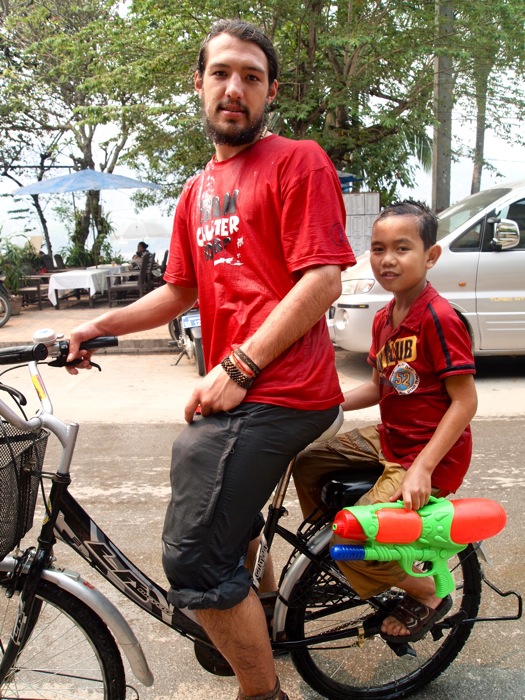
The previous night, Motta had opted to sleep with his old host family across the Mekong, in a nearby village. He returned to Luang Prabang the next morning toting his surrogate little brother. We were quick to give him a squirt gun.

Scott was finally recovering from his two odd days of illness, and while he executed the last bits of pulling himself together, Stew and I took off into the city. It was early, so many of the merry-makers were still setting up their water battle stations. Stew rode a full-size rental bike, which had a seat attached to it. His host brother had set up shop on the seat, and as we rode, we would call out potential targets to him and he would spray them down. The little tyke showed amazing promise with his use of the weapon. Having never owned a squirt gun before, he was very quick to learn to lead his target, and how to arc the stream to increase his range. A smart kid to be sure.

When we finally got a call from Scott, we returned to the guest house to meet up with him.

By then the madness of the day before had once again begun to reign, and we found ourselves pinned down on the steps of our guest house, where they turned on the hose, leaving it to drain into a large metal basin from which we could refill dippers to be used in soaking those who drove or walked by.

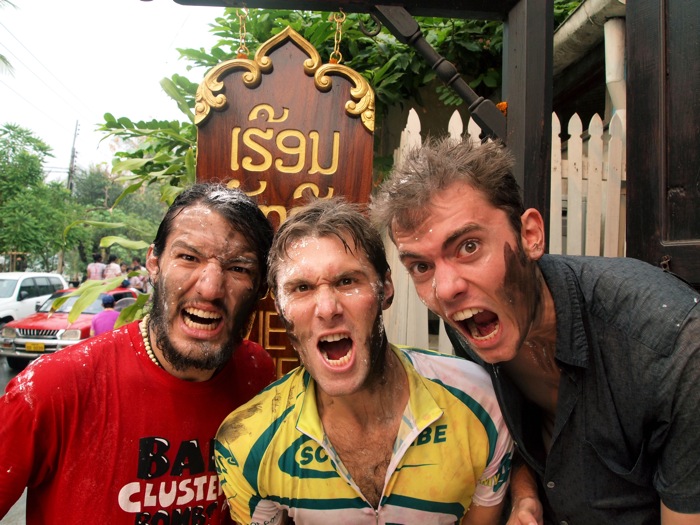
Without planning to do so, we had now established our own little Pi Mai Lao battle station. We took great pleasure in representing the home front, and managed to become quite soaked, covered in tapioca and black-faced in the process. It was glorious.

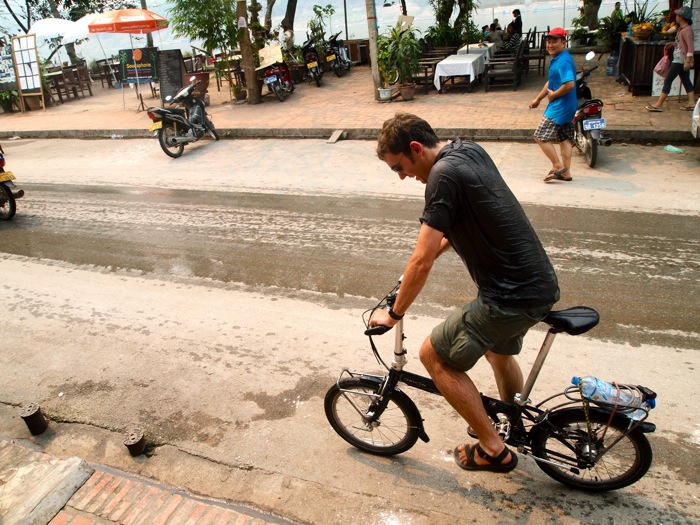
We bid goodbye to our little friend, and headed out wheeling on our own. We found more of the same, but with Scott back in action and along for the ride, we can present it to you with a richness of imagery that was previously unavailable, so perhaps I had best let the images speak for themselves.

We rode that evening to the bus station to attempt to purchase tickets for the next day back to the capital city of Vientiane. As we rode, we began to notice that Scott’s bike was emitting strange noises, almost like something was intermittently hitting the spokes of his cycle. When we stopped we were unable to diagnose anything, so we decided to monitor it and keep wheeling. At the bus station, we found that all the scheduled busses from Luang Prabang were booked for the next few days, presumably by other Pi Mai merry-makers on their way home. We would need to show up at the bus station and get on another one of the unscheduled-type buses that we had used to make the original journey. Fine by us – that’s why the AsiaWheeling mobile pharmacy includes anti-anxiety medication. Scott and I wheeled back to town and feasted at the same night market that had eaten and then regurgitated my backpack.

Pi Mai Lord

My bag was safe and sound back at the guest house and in celebration, Motta and I decided to take a quick nap. Scott, bless his soul, was still under the weather, and still in the deterioration phase, which we were crossing our fingers would soon transition to the upswing. So for the time being it was once again Mr. Motta and I who heaved out on the Speed TRs. We ordered a couple of fancy banana coffee drinks at a nearby cafe, still in celebration mode, and, fueled by those, we wheeled over to a pharmacy and picked up some electrolytic salts for our dear Mr Norton.

Pi Mai Lao was in full swing by the time we hit the streets, and were it not for the plastic bags that mercifully protected our cell phones, our robots would have been completely destroyed during the first few minutes of the wheel.

As we wheeled north in search of sandwiches, we were repeatedly soaked to the bone. In fact the entire street on which our guesthouse was built, which ran along the water, had descended into an anarchy of water warfare. Everywhere, music was playing, people were screaming, and water and powder were flying. Crowds of young people in black-face rode around in the backs of pickup trucks, jumping up and down until the trucks bounced on their springs like careening jack-in-the-boxes.

It was all we could do to keep our sandwiches dry as we scarfed down lunch at a street stall. Great parades of people were marching through the streets with hand-painted paper banners, displaying the creatures and gods that represent the new year. The winners of last night’s beauty contest were riding on great floats through the streets, still looking gorgeous, though in my estimate overly painted and uncomfortable. Children roamed the streets with water guns, and it seemed like every hose in the city was running. We were soaked and re-soaked and powdered with tapioca. Each subsequent drying left my shirt starchier and starchier, slowly turning it into a kind of crusted armor, which repelled water for a moment before giving up and capitulating to new levels of water-logging.

Foreigners were participating too. Many of the visitors had brought their children, who seemed to be thoroughly enjoying the huge water fight. Older, twenty-something foreigners were also participating, many of whom had bought giant $10 or $15 squirt guns. I found their propensity for spraying a bloke in the eyes to be a little much.

We stopped once more for another cup of coffee from Stew’s favorite coffee fellow in Luang Prabang. For a little less than a dollar, that man will whip up a large paper cup filled with a mean blended coffee drink, made from ice, startlingly strong Lao coffee, and sweetened condensed milk. Quite tasty and invigorating.

As we wheeled on, we started to notice that the streets were emptying of merry makers. This meant that everyone was headed to this large sandy island in the middle of the Mekong for the sand stupa (a structure that houses Buddhist relics) and the Bosi ceremony, the traditional Lao ceremony of well wishing. The island was a new addition to the Luang Prabang landscape. With this 50-year drought, the river had fallen so low as to create a new land mass. The people of Luang Prabang had decided to take advantage of this during the festival. The Vietnamese president was even flying in for the occasion. The people were gathering to continue the party, build sand stupas, and complete the Bosi ceremony, at the end of which white cotton threads are bound around the wrists of the participants.

We piled onto a longboat along with a whole bunch of locals and putted across the Mekong.

On the sand island, we found ourselves once again immersed in a giant crowd, while some water was still being thrown (for instance, I found it impossible to buy a bottle of water and drink more than a third of it before a beautiful woman would come up to me and dump my bottle over my head or down my back). But the weapon of choice here was the white tapioca powder and the black-face. They were selling bags of the white powder everywhere, and I was soon covered with it.

We ran into Stewart’s interns on the island. They had bought some powder and were completely covered in a starchy encrustation. Now in a larger group, we began to roam the island, taking in the many stupas being constructed on the shore, and craning our necks to see into the Bosi ceremony. It seemed the ceremony was closed to the public. Inside, we could barely see a decidedly stuffy procession taking place, while well dressed dignitaries looked on or dozed, decidedly not covered in white powder.

Meanwhile, outside that strange vortex, the party raged on. They were firing homemade rockets into the air, smearing each other with black make-up, and jumping into the Mekong to cool off. We did all of the above, save the rockets.

There were also many traditional music groups marching around the island playing Lao music. Along with these, there was usually a fellow wandering through the surrounding crowd with a gourd filled with some kind of homemade firewater, doling out drams by pouring them into a little length of horn, out of which passers-by could drink.

Having thoroughly enjoyed the sand stupa party, we headed back to the other side of the river on another longboat.

Back on the other side, the madness was in full swing again, with giant speakers pumping deafening music into the streets, a savage upping of the water fight, and even impromptu stripping poles erected in the streets.

The extremes of experience, to be sure.

Panic in Lao

Pi Mai Lao – the Lao New Year. It’s the Lao interpretation of the New Year on the same calendar used in Thailand. The Lao, usually a quiet, modest, and polite people, take this opportunity to descend into madness and debauchery, soaking each other relentlessly with water, powdering all in sight with tapioca, and smearing black gunk over their faces and those of passers-by.

The idea of watering came from the legend of King Kabinlaphom, whose seven daughters kept his severed head in a cave. The daughters would visit their father’s head every year and perform a wetting ritual to bring happiness and good weather. About the white powder and black-face, I am still searching for the cultural significance, so if any of you readers know, by all means please share.

My Pi Mai Lao experience started bright and early, when spurred by some inner failsafe, I shot out of bed, thinking in a frothing panic “Where is my backpack?!!” I ravaged through the room, turning on the light and waking Stewart and Scott. “Oh no, oh no…” I paced the room. “How could I be such an idiot?”

Stewart propped himself up to 30 degrees from horizontal and addressed me through the phlegmy veils of slumber. “Relax. I know this is hard to believe, but this is Lao. I think we can get your bag back.”

“You think we can get it back?!”

“Yeah, we lost a bag full of money once on a Dragon’s trip here, hundreds of dollars, left it at a street vendor, and they hung onto it for weeks and returned it untouched.” I was still skeptical and panicking. Motta continued calmly, as though speaking in a trance, “What time is it?”

“5:00 am,” I was cold sweating.

“Wake me up at 6:30, and we’ll try to find your bag.”

I tried, but sleeping was out of the question, so I took a long shower and paced and waited for 6:30 to roll around. Eventually it did, and I shook Mr. Motta to life. We grabbed the Speed TRs from where we had folded and stashed them under a staircase the night before, and headed out into the city.

It was the first day of Pi Mai Lao, and preparations were well underway. To get to the location of the night market, we needed to go through a giant morning market where everything from caged birds to giant catfish and beetles were for sale. The place was packed. Lao is definitely an early morning society, and today was no exception. Everyone in Luang Prabang seemed to be out and about. Despite the propellant of clenching fear and volatile hope that churned in my stomach, we had to dismount and walk the bikes through the thick crowd.

When we finally got to the street market, we found it a ghost town. Only one woman was there serving food, maybe four stalls down and across the walkway from our stall of the night before. She was serving up the Lao interpretation of Khao Soi. In the north of Thailand, it is a coconut curry soup, creamy and thick. In Lao it is a tomato and ground meat soup, with a semi-translucent reddish broth.

Stew began explaining to the woman, in Lao, what had happened to my bag. She smiled and expressed her regrets, and we were about to move on when she had a thought. She called to Stew, and we turned around. She started asking follow-up questions: Was it a young girl or an old man? Was she selling drinks or meats? Finally, she seemed to have narrowed it down, and looking satisfied, she called to her two daughters, who had been helping her wash vegetables, and told us to follow them.

We followed them, walking the bikes behind the two tiny Lao women, as they picked their way onto a side street holding hands. The two of them walked slowly, and were so dainty and frail as to seem weightless. In the strange gray morning light, filtered through the smoke all around us, I felt as though I were in a dream. We walked the Speed TRs behind them along the uneven pavement, and I felt separated from reality, afraid to hope, but not yet willing to despair.

We turned another couple of streets and found our way to a small concrete building, where some people were sleeping on the linoleum floor. One of them got up, an old man, while his younger wife (or daughter?) pulled out two chairs for us. Mr. Motta and I removed our shoes and entered the home.

The old man slowly climbed up a creaking ladder made of large bamboo poles toward the attic of the building. He then reappeared with… my backpack! I was so excited I nearly bit my tongue in half. I thanked him as much as I could in Lao and English, and after a brief counsel with Stewart decided to give him about $5.50 as an appropriate thank you. The man smiled and bowed to me with hands pressed together; I awkwardly returned the gesture.

As we walked away, with the bag on my back, I felt as though I had been given an undeserving gift by the gods of wheeling. All morning my mind had been playing over the ramifications of my lost passport. We would have needed to spend another week at least in Lao, getting a new one, and then we would have needed to re-populate it with visas… it would have been a huge investment of time, effort, and capital… but no need for that now. I had my bag, here it was.

We stopped back at the Khao Soi place for a celebratory bowl of noodles.

I opened by bag and rifled through it. Everything appeared to still be there. As I put my bag down on the seat next to me, Stewart commented… “I think I know that bag from somewhere….”

“Well,” I replied “Martin, my step brother, used it throughout most of highschool.”

“No… I think it was mine at some point.” This was not at all out of the question. We were both from the same small town of Grinnell, Iowa, where most things have a way of circulating.

“Well, now it’s coming AsiaWheeling.”

“Cool. Cool,” Motta replied.

Cool. Cool. Indeed.

Pi Mai Backpack is Gone

The next morning the three of us, Mr. Motta, Mr. Norton, and myself, awoke in our room at the View Khem Khong. The evening before, in an effort to make the two-person room more egalitarian for three people, we had overturned the  beds and spread the mattresses on the floor, allowing us to sleep three abreast, each man with his torso on one mattress and his legs on the other. This was marginally successful, but I dare say all three of us were quite glad to be awake and out of that strange arrangement. A better solution would need to be found for the next night

We made our way across the street from the View Khem Khong to have a seat on the banks of the Mekong. We shared some sandwiches and some very strong dark black coffee. So strong was the coffee, in fact, that it seemed completely impervious to milk. It was the kind that we run into from time to time on AsiaWheeling, which is brewed in a sock, this one for quite some time. A healthy shlop of full cream milk had essentially no effect on the color of the brew. But while the color stayed the same, the flavor was perhaps slightly softened, which was important, for while the strength was high, the quality was not.

Motta left us to attend to his affairs with the Dragon’s interns, and Scott and I climbed back on the cycles. The festival was still a few days off, but squadrons of Luang Prabang natives and even some foreigners were already convening on the street corners with buckets and the ladles one uses to wash one’s self in this part of the world, ready to soak any and all passers by. We pulled over and acquired some plastic bags with which to protect the contents of our pockets and pedaled into the fray.

It was quite intense. We were dripping wet by the time we made it into the central market. In addition to the stationary teams with large buckets and dippers, there were rogue squads of little boys and girls with Chinese-made super-soaker style squirt guns. Luckily it was boiling hot outside, so getting wet felt just fine. We also seemed to dry off in a matter of minutes. It was boiling hot and pretty dry. The sunlight was bright but comfortably diffuse, thanks to the thick shroud of smoke hanging over the region.

First things first. We needed to find a place to repair Scott’s wheel. At Stewart’s suggestion, we headed to the “Lao” part of town (the not touristy part of town) where we found a little shop that sported a welded metal shape that looked like it could be used to aid one in truing a wheel. A grinning old Lao man appeared from down the street  and greeted us. “Sabaidee.”

The Lao have a delightful habit of greeting one another when they meet. And they take such pleasure in it, elongating the word and stretching it out into a long honeyed syllable. “Saabaaaideee.” I took great pleasure in greeting people in Lao, for they lit up with such glee at the greeting and returned it so lusciously, nuanced with the understated song of Lao’s tonal language. Even a very small child would almost invariably return your greeting. Ah, Lao, really a gem.

Sure enough, the man was more than happy to help us with the wheel. While he went to town on the rim, Scott and I produced a canister of paint thinner we had purchased earlier, along with a couple of toothbrushes, and went to work on our derailleurs, cleaning large clods of the red dust of Tamil Nadu, whetted with Indian typewriter oil, from the inner workings of the machine.

About the time that we had gotten the derailleurs back to ship-shape, our fellow had finished with the wheel. He asked only about a dollar for the work, and we were thrilled to get back on the road.

Back in the old-city, the water fighting in the streets had taken on a new fierce intensity. It seemed it was time to arm ourselves. We wheeled back to the vicinity of our wheel truing shop, and haggled our way into three Chinese-made super-soaker style water guns.

With one of them strapped to the back of the cycle, and the other two loaded and in hand, Scott and I headed back into the fray.

Now we were able to participate in the action. Soon the game became spotting those people who were about to soak you, and stopping them in their tracks with a well aimed drive-by. Often though, I was still caught unaware, and was forced to whip around and fire a stream of retribution as we pedaled on, dripping wet. The traffic was very light and quite slow, which was great because wheeling and water gunning (I’m talking to you kids) is not advisable in any kind of technical wheeling situation.

Growing peckish, we ventured into an alleyway off the touristy main street to sample some spring rolls.

To finish off the snack, we enjoyed one of the famed Franco-Lao baguette sandwiches, with ham.

We met Mr. Motta at an Internet cafe that evening.

We had been soaked and dried over 100 times, and I felt as though my clothes had been laundered on my body. Stewart appeared with his interns, the three of them were a little wet around the edges as well, having arrived by longboat from across the river, and shortly thereafter been ambushed by a few water gangs of their own.

“It’s wild out there,” we agreed.

That evening, Scott began feeling under the weather, likely with the same virus that had laid me up during our eleventh hour bicycle repairs in Bangkok, so Stewart and I let him retire early, and went out night-wheeling together.

We called a dinner waypoint at a vast night street food market, where we ordered some fantastically delicious Mekong fish. The fish was gutted and its stomach filled with lemongrass. It was then sandwiched between two slivers of bamboo, which were secured tightly around the fish using bits of wire. The fish was then slow roasted over a charcoal fire. Paired with Lao eggplant mush, which one could dip bits of Mekong seaweed sheet into, the meal was to die for. Two frosty bottles of the local BeerLao, an incredibly tasty golden lager they produce in this magical country, completed the meal.

Since we had been working in an Internet cafe earlier, I had been carrying my backpack with me. Inside the backpack was my computer, my passport, a bunch of cash in about 20 different currencies, my Maui Jim sunglasses, my camera, a bottle of Michael’s Paraherbs and about everything else of value I’ve brought on this odyssey. When I got up to leave the wooden table where we had been eating fish I left my bag behind, leaning against a greasy stone wall in one of the largest and most crowded night markets in Lao. And I didn’t even notice.

After that little occurrence, we made our way to a night carnival being thrown in honor of the impending New Year. It was giant and sprawling, next to where we had purchased the Chinese battery charger the previous day. It was jam packed with Lao people, and on the center stage, a beauty contest was taking place to determine the most beautiful maid in all of Luang Prabang Province. The women on stage were quite beautiful, but covered in makeup. They also seemed uncomfortably packed and cinched into their costumes. A couple of giant spotlights, operated by two fellows hovering overhead chain smoking cigarettes in the basket of a cherry picker, played over the women. I felt very aware of the differences between Lao and Western concepts of beauty as we walked through the crowd. Many of the women  walking by in tee-shirts and jeans appeared to me much more beautiful than what was happening on stage. But, I guess, there’s no accounting for taste….

We wiled away the rest of the evening playing five- and ten-cent carnival games, such as throwing darts at huge banks of balloons. We also tried our hand raging around in groaning and twisted bumper cars while thundering Thai techno-dance music played in the background. The bumper car rink was incredible, festooned with many flashing lights, and pulsing neon shapes. The rink reeked of ozone. The carts had no throttle and no seat belts; they were just always going, powered buy a giant sparking snarl of wire that extended to the electrified ceiling above us.  To reverse, one simply turned the wheel far enough to begin thrusting backward.  Depending on which part of the ceiling you were touching and collecting power from, the bumper car would vary in speed from very slow to downright breakneck. A giant painted sign proudly exclaimed “TUBULAR” in English characters above the rink.

All at the carnival appeared to be in stupendously high spirits, screaming and laughing and generally letting loose in preparation for the impending New Year. We wheeled home feeling like kings and generally enamored with Lao. Meanwhile, my poor yellow bag languished in the ether, lost and forgotten.

Landing in Luang Prabang

We arrived in Luang Prabang just as the sun was rising.

The many delays on our bus ride had unexpectedly worked in our favor, delaying the journey long enough to put us in right at sunrise, rather than at 2:00 or 3:00 in the morning. Once again, we were the last off the bus, taking a bit of time to rustle ourselves. By this point, the cycles and our bags were laying on the dusty earth, under the careful guard of the driver, who was chain-smoking cigarettes nearby.

We collected our things and retired to a small cafe about 20 meters away, across the gravel floor of the bus station. We sent Stew a text message. I knew that the fellow was not much for sleeping, but at 6:00 am,  everyone deserves the common courtesy of SMS. In the meantime, we procured a couple cups of Lao-style coffees and a baguette sandwich, filled with omelet.

Thanking the French again for their delightful cultural additions to Lao, we scarfed these down and climbed on the cycles.

Stewart, we knew, had a hotel in mind. He had a fair amount of Guanxi with a local place by the name of View Khem Khong, so rather than check in at a guest house, we decided to nest for a bit in an Internet cafe and wait for him to get back to us. We reached one just as they were finishing breakfast and starting up the computers. No sooner had we sent word to our loved ones that arrival in Lao had been successful, than Stew called my Lao number.

He was awake and, it seems, even on a cycle already. We paid for our Internet and headed off to rendezvous. It was not long before I saw Stew’s telltale shoulder-length hair blowing in the wind.

He was wearing a Lao style hat that could easily have been confused for a Rastafarian cap, and wore a beard. He rode a rental bicycle, with a large basket on the front, huge somewhat mangled fenders, and an intermittent squeaking problem.

Once warm regards had been exchanged, we made our way to the View Khem Khong. The owner was a roly-poly woman, just gushing with friendly smiles and eagerness to make our stay more comfortable. With the Lao New Year, what they call “Pi Mai Lao” impending, the prices for rooms were on a schedule to sky rocket in this city. Thanks to Stewart’s good relationships, we managed to lock in a relatively low price for the next few days. With our things safely stashed in the room, we retired to the restaurant across the street from the View Khem Khong.

The restaurant was perched on a kind of balcony deck looking out over the Mekong river. Even with this 50-year record drought, the river was still quite impressive, and if only the billowing smoke that filled the air would clear, we could have seen majestic jungled hills and a village across the water. Here, as they had been in the north of Thailand, the farmers were burning their fields in preparation for the next planting. However, in Luang Prabong, I believe the smoke was even thicker, because just over the hills that we could periodically make out through the smoke across the river, they were also burning the jungle to create new farmland.

We were finishing coffee with Stew when he informed us that his professional obligations were about to kick in, and he would need to leave us. You see, dear reader, Stewart was not in Luang Prabang strictly on AsiaWheeling business, he was also helping to conduct an internship program for his other current employer, Where There be Dragons, or as he refers to it, “Dragons.”

So with Motta gone on other business, it was time to explore the general region in the best way we know: wheeling.

First we took a general look at the center of Luang Prabang. There appeared to be plenty of tourists here, and with the number of hotels and restaurants that could support themselves, it was likely a year-round state of affairs. Even with preparations for the New Year celebration underway, the city felt sleepy and quiet.

And it only got sleepier and quieter as we wheeled out of town and into the countryside.

Soon all dissolved into agricultural fields and swaths of jungle. We could just barely make out through the dense smoke that we were riding amidst a great many steep hills.

The landscape continued to awe us, offering incredible biodiversity interspersed with agricultural land.  In the lower right-hand corner of the image below, you can see two water buffalo in the river.

From time to time as we rode, children would run up to us from a farmhouse and splash us with water, or a farm woman would spray us with a hose.

The New Year was still some days off, but people were already getting into the spirit, and two silly looking foreigners on strange bicycles were the perfect excuse to kick things off a little early. We attempted to follow signs to a waterfall, but when the road became very poor, we began to tire of being rattled. Although the Speed TRs appeared to be loving it, we were fearing a bit for their ceaseless vibration as well.

Back in town, we stopped at a collection of shops overlooking a giant goods market and what looked like a country fair below.

We ordered two iced coffees, which were made in the same way we had seen in Thailand with espresso as the base and plenty of sweetened condensed milk. We sipped them while we surveyed the various goods for sale.

Not long ago, Scott had lost his cell phone charger… perhaps in the cozy confines of Steve’s room (may that man’s beard grow ever longer). So when we found a group of Chinese merchants selling the same kind of universal battery chargers we had seen during our wheel across the Chao Phraya, we decided to enter into negotiations.

After purchasing the charger, it was time to make friends. Once Scott disclosed to these men that he spoke Chinese and presented them with AsiaWheeling business cards, we became quite popular with most of the Chinese goods sellers in the market. We even allowed one of the more senior fellows to take the Speed TR out for a spin.

He got off the cycle and pointed at the rear derailleur, explaining that this was the secret to the bicycle, the reason why it goes so fast. The other fellows in the group sagely nodded. With that done, it seemed it was time to get back on the cycles, and so we did, bidding our new Chinese friends goodbye and heading back into town.

That evening Motta took us to a rather fancy Lao restaurant, owned by a French Canadian woman. The restaurant was across a river from our guest house – not the Mekong, but a smaller tributary. Each year the locals build a bamboo bridge across the river, and each year during the rainy season the bridge is destroyed by the rushing water.

We were to wheel to the bridge and lock our bikes there. Night was falling, and we were quite hungry. We met up with Stew, and climbed on our cycles. Not long into the ride, while I was riding anti-bishop, a small Lao boy appeared out of nowhere and dumped a bucket of water onto Motta and Scott. This caused a mild loss of control that ended up intertwining their two handlebars. Helplessly tangled, the two knights fell, bikes clattering and bodies rolling into the street.

There was no traffic and so no real danger of them being hit by cars. Both rose to their feet again. Scott was essentially unharmed; Motta bore a few scratches on his arms. Scott’s bike, on the other hand, appeared to have suffered a minor misalignment of the front wheel. No problem here, though;  truing a wheel should not be a huge issue in this part of the world, so we planned to do it tomorrow. In the meantime, we disengaged Scott’s front wheel giving the rim room to wobble without slowing us down, and headed to dinner.

« Previous Entries Next Entries »

Privacy Policy | Terms and Conditions