Author Archive

« Previous Entries Next Entries »

Mughal Sarai

We said a very warm goodbye to our man Nikhil and turned back towards the ashram. We were fed a simple and delightful meal of roti, rice and vegetable stew and then retired to our room. While we had much to work on, relating the events of the past few days back to you, oh dear and valued reader, we spend only a small bit of time doing this. The remainder of our last hours were spend chatting with Tejbaal Pandey, one of the more senior member of the ashram. Tejbaal had joined as a young lad, but was now slightly older than us. We spoke of our travels and of the state of affairs in India.

Upon arriving to Varanasi, we had discovered that the train to Kolkata which we originally booked was only viable if it was not late by more than an hour or two. This was not something which we could bet on, since no train we had ridden in India had yet arrived less than 3 hours late. So we had booked alternative tickets. The only option which had space in an AC compartment was leaving not from the Varanasi station, but from a nearby, older hub, in a place by the name of Mughal Sarai, at 1:55 AM.

So we had some time to wait around the ashram before we were to take the cab, being somewhat worried that Mughal Sarai was a whistle stop and we would be sitting alone on an open platform in the dead of night in the poorest province in India, we had arranged with the help of Tejbaal to have a cab come pick us up at the ashram and wait with us until the train arrived (likely late). Shortly before the aforementioned cab was to come, Tejbaal arrived in our room bearing gifts. From a plastic sack, he produced three earthenware vessels filled with lassi, like the one which had been available earlier that day outside the temple, and 3 mangos. He explained that this was some of the tastiest lassi and the best mangoes available. We drank the lassi (it was indeed splendid) and he showed us an efficient and ingenious method for consuming the mangoes. He took each mango and kneaded it in his hands, mashing the interior, until the fruit sagged in one’s hand like a water baloon. Then he plucked off the point at the very bottom of the fruit where the stem had once connected it to the tree and from that hole we drank the sweet mango pulp. As we consumed more and more, the mango skin began to fall apart. And soon we removed the pit and ate he meat off that too, finishing by scraping the last bits off the interior side of the skin with our teeth. Delicious.

With sticky hand and heavy heart, we bade farewell to the Bal Ashram and got in the cab headed for Mughal Sarai.

As we drove, it began to rain, and was pouring by the time the cab pulled up outside the station. It was not a whistle stop as we had feared. It was in fact a sizable station, and well lit. We exited the cab, leaving our bags with the driver, and entered the train station.

Warning

We’re just trying to be honest; this next part is raw.

(more…)

A Ride Up the Ganges

Upon returning to the Ball Ashram from my first outing in the city of life (or perhaps the city of death, or even of the dyeing…), Nikhil and I found Scott to be in much better health. He had been transformed powerfully by the mellow yellow rice which had been so lovingly made for him. We began to pump him full of fluids and Nikhil went about arranging for a boat to take us on a ride up the Ganges. This seemed to be little trouble and the boat was to leave from the ghat at the foot of the Ball Ashram. A Ghat is a sort of a landing which consists of stone steps extending down to the banks of the Ganges. Ghats are used for a variety of spiritual purposes, one the most important being the cleansing of ones soul in the river’s waters.

Our Boat Driver

We met our boatman, a lean and wiry fellow, with a mustache any 19th century field colonel would have envied, who held his well tarred wooden craft steady, while we climbed in. When we were some way from the ghat, he asked whether I wanted to give rowing the thing a shot. So I took his place and grasped the two bamboo oars.

Woody Taking the Oars

They were of drastically different lengths and widths, with the paddle portion constructed by means of a board hammered onto the bamboo. Needless to say, i rowed only in circles. The practice it must have taken for him to learn to row in a straight line with these must have been substantial. But after all aboard had had their laugh at my expense, the oarsmen moved to the rear of the boat and began to use a spare oar as a rudder. Then we all got a chance to row, doubling up Ben Hurr style.

Scott and Woody in Ben Hur

We were quickly back on track cruising towards the ghats as the sun set over Varanasi.

As night fell, we cruised by the main drag: ghat after ancient ghat. All around us the fragrant smell of incense filled the air, and funeral pyres burned on shore. We must have passed 10 or 15 cremations taking place right there in the open, so that the ashes could be scattered (or set afloat in a little vessel) on the dark and glittering surface of the ganges.

On two ghats, elaborate festivals were taking place, involving the burning of even more incense, the swinging of large racks of candles, intense drumming, on a variety of unique drums, and the blowing of conch-shell horns.

Ghat from the Ganges

On our way back, we idled in a giant cluster of similar rowing boats (these are the same boats that can also be seen fishing during the day), all filled with tourists watching the dueling festivals in one giant bobbing hoard, held together by the hands of boat wallas and passengers grasping the adjacent boat. The night brought us back to the ashram for a light meal of roti and an exquisitely spiced thin vegetarian stew.

Welcome To Varanasi

Scott, Nikhil and I awoke to find the Swantaranta express running two hours late (which in Indian for on time, I believe) and that Scott had caught a case of what we might not so affectionately call the “Agra hustle.” Though Scott seemed to be recovering rapidly, the my dear partner in crime needed sleep and water to replenish his strength. We knew not exactly where we were to be staying in Varanasi, but had been in contact with a local ashram, recommended to us by a Mr. Oliver Daly who had, for some time, been occupied there. As we exited the cool comfort of the train and immersed ourselves in the grimy heat of Varanasi, it was decided that this Ashram would be made our first waypoint in the city.

Nikhil quickly propagated through the crowd of touts and rickshaw drivers, which filled the train station, collecting along the way one fellow who was to be our driver for the day. Nikhil and this driver lead us out into the packed dirt parking lot. The air smelled strongly of woodsmoke, in addition to the normal Indian cocktail of scents: open sewers, cooking spices, and pan. Ah, pan, I don’t know if I have yet described to you this most singular element of Indian life. And indeed at this point in our tale, I was rather ignorant of the stuff myself. I knew of it only these 3 things: it was made of, among other things, beetlenuts and beetle leaves, it caused a large amount of deep red salivation to occur in the mouth of the fellow who imbibed it, and smelled distinctively and strongly enough to play a leading role in the already quite savage Indian bouquet.
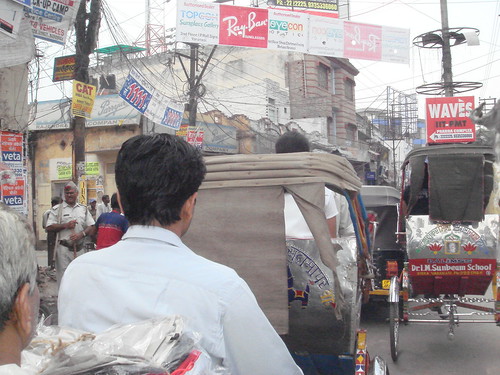
Streets of Varanasi

Through this bouquet we barreled, in an ailing autorickshaw, which our driver started by jerking a great lever on the floor of the machine, and which –we found out when he stopped mid-trip to buy 40 rupees (~$1) of petrol– required motor oil to be mixed with it’s fuel. The streets of Varanasi were crowded, but filled much more predominantly with bicycle rickshaws and cattle than motorized traffic. And what motorized traffic there was tended to be either large machinery (dumptrucks, etc.) or auto-rickshaws. We arrived first at the Little Stars School, which was located some distance from the city center, in a more residential neighborhood. We were greeted warmly there and upon learning of Scott’s illness, Asha, who heads the school, offered to make a healing rice and lentil mixture to sooth his stomach. In addition we were told that indeed we would be welcome at the ashram, located farther downstream, on the banks of the ganges. I will once again let pictures speak for the beauty of that place.

Bal Ashram

And eclipsing even the beauty of the premises itself, was the kindness and welcome with which we were received there. All there walked barefoot on the fine marble floors, and every time I passed another person within the walls of the ashram, I was acknowledged with a pressing of the hands together, a slight bow of the head and the word “namaste.” I later found that this word was a reference to the god, and the oneness present in the two exchanging the greeting. It felt good.

We were told our room was being prepared, and we were offered spicy milky tea and food. When our room was ready, Scott proceeded to sleep vehemently. Nikhil and I retired to the ashram dining area where we sat crosslegged on wooden boards, and ate a monstrous traditional indian meal from gleaming stainless steal plates.With Scott out cold, Nikhil and myself decided to take in the city on our own. We exited the gates of the ashram where our driver had, at our request, been waiting. We found him sitting overlooking the great river and smiling. We piled back into the rickshaw and off we went.

The whole while I was transfixed with the bizarre world of Varanasi. It was a feast for the eyes: dogs, cattle, oxen, buffalo and crows roaming the streets; brightly dressed women, in dramatic sarees of fine silk; men in stark white gowns and large turbans; men sleeping on piles of brick; children digging sewage from open gutters; bicycle rickshaws carrying absurd loads of brick, or piping, or oil cans; groups of 4 or 5 people crammed on a tiny motor bike, men with their heads wrapped in linen, so that only a slit remained from which to see; and women wearing all black, with a black covering for the head which had no� slit through which to see!, but yet they strode confidently through this amazing traffic.

During my transfixion, Nikhil was talking up a storm with our driver, a very fine gentleman by the name of Babaloo Baba, who it seems had now taken a partial role as tour guide in addition to our driver for the day. Our first stop was at a house of fine silks. Babaloo Baba turned onto a narrow cobblestone lane which bounced the little rickshaw quite terribly. Nakhil explained to me how it was done inside such a place. “We must look at many things and find a number of things that we are interested in. These will go in a pile, which later we can pare down to those we actually with to purchase.”And so it began. We removed our shoes and entered the ancient building. We sat cross legged on a giant mattress, which extended to all four walls of the room. All around us were placed the most intensely colored, beautifully patterned, and most elegantly textured fabrics I had ever seen, or for that matter, can even conceive the existence of. The owner of the shop, a rounded man in a deep orange silk shirt, sat with us ordering around a small harem of young boys which fetched silks so that he could dramatically unfurl them before us. We hemmed and hawed, chose a pile of things and then Nikhil went into intense haggling mode. His face turned to a sorrowful frown and he began to peer into his wallet shaking his head while saying very many things in hindi, not the least of which was “student”, and “nay nay nay”. After some bargaining, we finally agreed on a price and the man set his minions forth packaging the silks in little blue plastic bags, which were then covered with tape and cryptic ball-point pen. The entire parcel, which has some surprising weight to it was then placed in a larger bag, while Nikhil went through the process of paying with a credit card.Silks in hand, we were then taken by one of the boy minions on a tour of the silk manufacturing operation.

Sewing Silk Designs
Silk Loom

This consisted of many men in dark stone dwellings, located throughout the tiny winding streets of Varanasi. We invite you to see for yourself.Next, Babaloo Baba most verbosely drove us to a temple. At the entrance gate, we removed our shoes, cellphones, camera, matches, and anything else which might be used to defile the place, and proceeded to walk through the metal detectors. On my way through, they discovered a USB key drive in my pocket, and having never seen one before, promptly confiscated it (Nikhil was able to retrieve it upon our leaving). Inside the temple was filled with monkeys, laying around, playing with each other, or eating bits and scraps from the vicinity. I followed Nikhil through the temple. He approached a number of kiosk like stone booths, decorated with flowers and offerings to the gods, and covered with elaborate engraving and statues. At each of these, he was performed a kind of spiritual transaction, which involved a small ladelfull of a holy water. The water was poured into his open hand. Some of it he drank in a quick slurp, the rest he smoothed over his hair. Also at the temple was a giant tree, which must have, at some point, been submerged in earth much farther up its trunk, for now many long roots hung from the hulking trunk which, some 3 feet above our heads, bulged out to twice its size at foot level. All over this tree were strings and ribbons fastened there in the name of wishes, in hopes they would be later fulfilled by the gods associated with this temple. In the event that these wishes indeed came true, an offering would be made at this temple in thanks.As we left the temple, a glance at the watch showed it was getting near time to return to Scott’s side. “Just enough time to have a pan,” Nikhil said. So Babaloo Baba drove us to a pan man and I began to marvel at the manufacture of this strange item. A man sat cross legged in a little alcove in a crumbling wall, near a busy street. A crowd was gathered there and he was furiously manufacturing pan, and Indian man were eating it up just as fast. First a pan leave was taken from a large pile covered partially with a torn piece of burlap. Then, from a vast array of tiny jars and metal tins, he began to fill the leaf with a sprinkle of this, a sprinkle of that.
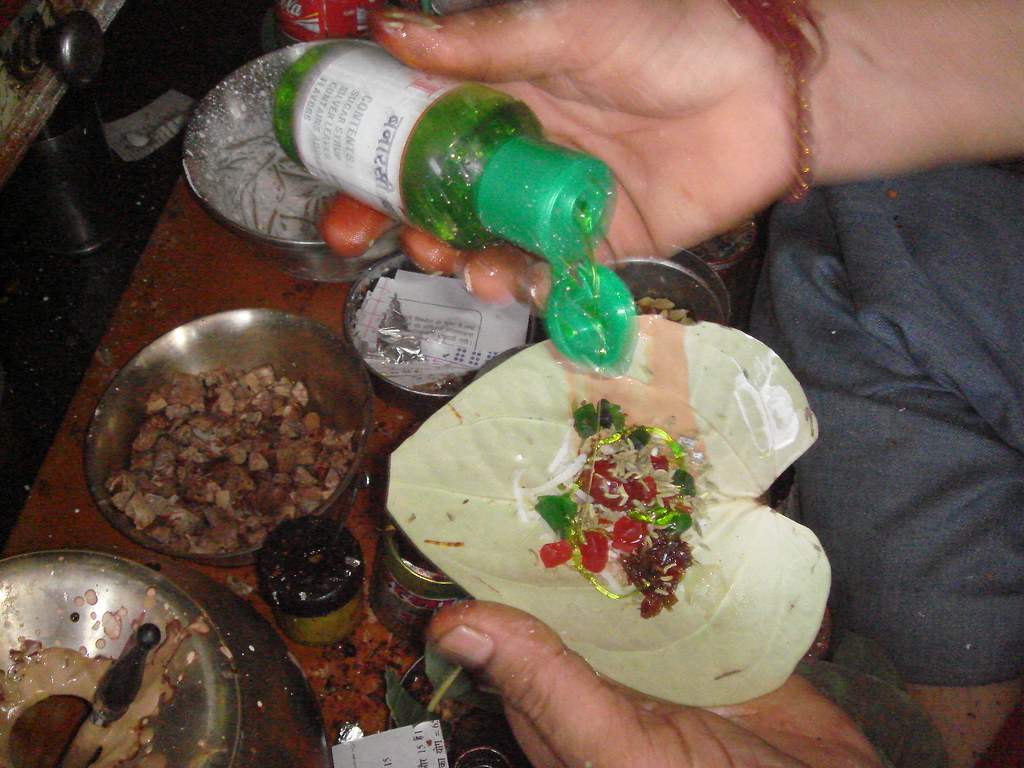
Pan Making

A number of hammered copper vessels had small brushes protruding from them, and he used these to spread a number of different pastes on the leaf. Finally he wrapped it up and placed a piece of silver foil over the top of it, to keep it closed. From his other side he grabbed a banana leaf. Wiping the leaf on his pants until it had a obtained a mellow shine, he placed the final product atop and presented it to Nikhil. “So watch me. This is how it’s done.” He placed it into his mouth and began to chew. His lips bulged, and he slurped in a little air, then he was done. Next, he handed one to me. I must admit, it looked ominous, like a tiny pandoras box, sleeping for now upon the early gleaming banana leaf…
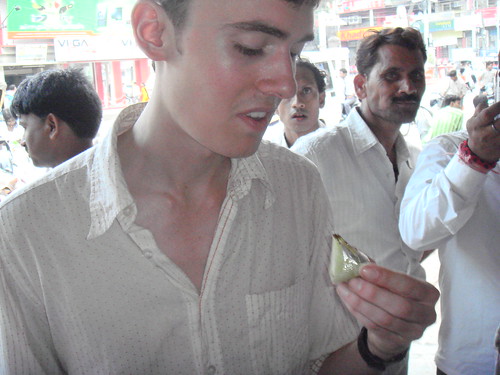
Here We Go...

In it went.

Eating the Pan

And for the time, I genuinely enjoyed the flavor. I cannot describe it any better than to say it was sweet, strong, and tasted distinctly red. I spoke through the mouthful redness, “so I just swallow it?” Nikhil nodded. Perhaps the act of eating the pan had endeared him to me, or perhaps he thought the the pan would impair my ability to cross the street, regardless, Babaloo Baba now grabbed my arm and lead my through the onslaught of scooters and rickshaws to our vehicle.
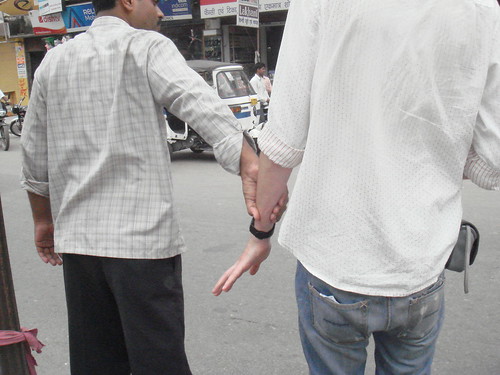
Babaloo gives me a hand

As we drove back I felt the pan in my stomach unpacking its tools and getting to work. As Nikhil explained to me, “muscles in your stomach that have not been used in a very long time are grumbling, saying ‘what is this stuff.'” Indeed… indeed.

The Grand Trunk Express

AsiaWheeling Mobile Offices

Our first AC room on the grand trunk express was delightful, as was the train car in which it rode. For the majority of the ride, we were the only people in the entire car. With two bathrooms to our-selfs. There was no dinning car, rather food was delivered from the pantry car, and the rest of the train was other cars simply full of people.

Egg Curry

Though the scenery was quite striking, the highlight of the grand trunk experience was our interactions with our chip-wallah; that is the guy who walks the train back and forth all day and call out in Hindi that he is selling chips. Not speaking Hindi, his cry befell our ears as something more like “contaminated chips and cake,” endlessly in the same nasal incantation. Since the first AC car is nice and cool, our dear friend (on whom we have now bestowed the esteemed title of Official AsiaWheeling Snack Packages Distribution Manager) began to stop by our room, and linger.

We were inside, of course, as we were for the whole ride –there being no dining car and no lock on the door– playing whist or carefully preparing correspondence for you, dear reader. Soon this became a staple of his walk back and forth on the train. The man spoke no English and we no Hindi, but indeed I believe a bond was formed. It was while sharing popular American music and eating biscuits with the chap, that we realized this fellow is badly in need of an AsiaWheeling t-shirt. So the next time he came by our room (this was likely the 12th or 13th time) we offered him the position. Needless to say, all concerned were thrilled.

Official Chipswallah of AsiaWheeling

As one of his first duties, we give him the AsiaWheeling cell-phone so that he could call his home. What he said, we have no idea, but it was a heartfelt and tearful conversation. We were later to learn that this was the first contact he has had with his mother in weeks.

The grand trunk ran into the night, loosing time steadily, until our 3 am arrival we pushed until 6 am. We considered this a boon. And that assumption was soon confirmed as we found Agra not as easily navigable as one might hope.

Race to the Grand Trunk

We awoke this morning earlier than we would have liked after a charming evening with two ravishingly capable Indian women. I mean, of course, the lovely Mendakini and Jagruti, newly christened members of the AsiaWheeling team, and official Pondicherry field command. So you, dear reader, may find it no great surprise that we were awaking at this ungodly hour to have a fine breakfast with those same two women to commemorate our last moments in beautiful Pondicherry. By the time we got a call from Jagruti, we were sipping strong south Indian coffee, chasing it with Malarone, and reading the newspaper in the courtyard of the l’Orient.

Hotel Mornings

We parked our bikes outside a french restaurant, just as the two of them arrived on motor bikes. We dined like imperialists, with more strong coffee, soft-boiled eggs and homemade bread with rich butter and jam. We dropped off the bikes with some tinges of sadness. They had served us well in this city and we would surely miss them. Who was to know what unruly, or easily spooked cycles might lie in our future? We rode back, the four of us, on the women’s mopeds. It was not the first time that I thought it might not be so bad to simply spend the rest of my time on earth clinging to a hurtling chunk of metal, piloted by a beautiful woman. But nay… there is more more wheeling to be done before I sleep.

We packed quickly, and, in my case, somewhat frantically. Both Norton and I have been paying no small attention to the mounting evidence that malarone has a somewhat jittery anxious effect of the psyche. We settled the bill and made sure to leave our mark in the guest-book before we went outside to meet our driver.

The cab company, Selvi Travels, is was started by Scott’s former colleague Maran (we thoughtfully approve if his lack of a last name) so we were given a king’s treatment. It was our first time in an AC cab, and to be honest, I prefer to sweat, windows open, and feel like part of the world which I traverse. Regardless, it was the safest I have ever felt on the insane, lane-less roads of Tamil Nadu. On the way, our driver, a tenacious man named Shiva (the name of our last driver also… more data needed before we draw conclusions here, though) pulled off at a ruined temple complex, which had turned into a tourist bonanza. The temples themselves were stunning, and Shiva walked us to the beach via a secret back rout, so as to avoid paying the 250 rupee entrance fee. Instead we made our way to a beach where a little bazaar had been erected, and a a crowd had formed around the shore where largish waves crashed, disrupting the trajectories of the many swimmers which chose to enter those treacherous waters.

Ancient Stone TempleCarvings

This was also my re-introduction to the world of panhandling children. In my time in Russia, I had developed some utility in the navigation of aforementioned emotional and delicate situation. But these skills had all but disappeared and I found myself heartbroken and guilt-ridden as we were pestered by adorable starving children. Shiva did his best to keep these children at bay, but as we left, a child was still tapping on the window of our cab, and a thin woman was begging at Scott through the glass. It was about then that we realized the aforementioned drug interaction –perhaps between Malarone and caffeine?– was in full engagement. The two of us began to get nervous (about getting sick: India is many beautiful things, hygienic is not one of them), finding a place to stay in Agra, the looming vastness of the trip, our own fortitude. We stopped for a thali at a vegetarian restaurant by the side of the road, and Scott and I sat at the table, gripped by the mild, but persistent hysteria, and ate giant piles of rice.

Thali

A full stomach was no solution, though. What we needed was progress, a feeling of accomplishing something, of bending just some modicum of the randomness of infinity to our will. We needed the internet.

So we asked Shiva to take us to an internet cafe in Chennai. Though, he spoke essentially no English, the man was able to communicate to us that he had no knowledge of Chennai and wouldn’t know the first thinga about finding an internet cafe. Our cell rang and it was our good man from the clock and breakable nick-nack shop, calling to tell us that our Jaracks (the card proving that we had a residence and some legitimacy in India) was not 2 sided, and necessitated our return to his shop for some reconnoiter of the situation.. This, we attempted to inform him, was not possible due to our imminent departure on the grand trunk express towards Agra and the Taj Mahal. Upon hearing this he promptly hung up. At this time we still know not what the situation is with the insufficient jaracks, and whether at any moment, Airtel may simple cut our service. Please, dear readers, pray with us that this does not happen. For our mobile is our only lifeline to Tamil, Hindi, and Bengali speakers that may approximate directions to our motorized vehicle drivers and paternalistic civil authorities.

As our cab drove deeper and deeper into the throbbing and scattered nervous system Chennai, Shiva began to pull over and roll down the window, asking people in Tamil/Hindi/English where we could find an internet cafe. We asked pedestrian after pedestrian, each giving us uncorrelated directions. Twice we arrived at a cafe only to find it closed on Sundays. At our wits end, we finally rolled into Chennai’s swankiest, most sprawling, most confusing, beehive of a mall.

Inside the mall we found a microscopic version of the days earlier meanders. Shopkeeper after shopkeeper pointed us in conflicting directions, across multiple floors and “phases” (your guess is as good as ours) of the mall. Finally, though, we got there. It was like a drink of cool water after days in the heat of the desert.

Chennai Internet Cafe

Refreshed and re-fueled by the interwebs, we bid Shiva farewell at the Chennai train station, tipping him a sum that must have been close to his monthly wages, just as a 10 minute summer monsoon began to pour down in heavy curtains over the expanse pavement outside. We ran through the liquid onslaught and into the station. Indeed it too was a sight to behold, and another chance to sharpen my tolerance and composure under the assault of heartbreaking child beggars. As Scott once, I believe very wisely, said “giving money to panhandlers supports the market for panhandling.” Put another way, if one wants to help those less fortunate than he, that person is much better off giving money to an organization whose business it is to redistribute, invest, and create wealth, than to attempt to do such a fragile operation at the random whim of your choice. Such a philosophy seems sound to me, and paired with the fact that, once you have given a rupee to one child beggar, you are soon swarmed by the all the rest in sight, becomes attractive enough to simply embrace.

Reserved Waiting Hall

Now, laden with 1 box of English digestive biscuits, 4 huge bottles of water, 1 Sprite, 1 Pepsi, 2/5 bottle of Indian scotch whiskey, 10 pounds of digital technology, and a 1st AC room on the Grand Trunk Express, we are settling in to blog, rage on php/kml/css, eat the Indian snacks that are being sold by fellows wandering the train, and engage in our own special blend of railroad intrigue.

What are we listening to? Scott’s digging Luke Harris’ Day for Night Mix and Woody’s chiefing out on Cha by Steven Bernstein. Oh and of course our Tamil Classics.

[audio:http://asiawheeling.com/Manjal_Poosum.mp3]

Pondicherry Wheeling

Lodgings

Day 2 in Pondicherry began with us donning our new Khadi shirts. Khadi, as I understand it, is a symbol of Indian independence from Britain. In the days when India was a British mercantile colony, the Brits would grow and harvest cotton in India and take it elsewhere to be spun into garments. These garments, often ill fitting the heat of the Indian climate, would then be sold back to the Indians at unreasonable prices. Mahatma Ghandi, as part of the Indian independence movement, promoted Khadi, or homespun cotton garments, made by surrounding villagers. These garments were much thinner and well suited to the hot and humid Indian summers. They are also, by the same token, rather translucent. So it was with only mild self consciousness that I left the hotel and joined Scott on our bicycles headed for his old office when he lived in Pondicherry in 2006.

Kammachi Amman Koil

The Business was called BookBox, though it was their non-profit side-project, planet read, that Scott worked on. We pedaled through the streets of Pondicherry, which where eerily empty. It was a Saturday morning at 10am, so we figured perhaps things were just sleepy. We stopped into a favorite restaurant of Scott’s, Bombay Meals, which, unlike many around it, appeared to be open. The owner, was lounging in the empty interior, but sent us away saying he might be open at 7pm, but no earlier. Somewhat confused, we decided to postpone breakfast and ride over to PlanetRead. When we arrived, I was impressed with the operation, and their admiration for Scott was clear. The office cook made some nice hot south Indian coffees for us and we retired to a comfortable room in the back of the office to examine some of the new products. BookBox creates digital storybooks in many languages, to be used as language teaching materials. We spoke also of new plans for expansion into language tools for the hearing impaired using the same technology. As we finished the coffee (which was splendid), we were asked if we wanted to sit in on the noontime meeting, and whether Scott would give a short speech (no particular topic was suggested). Scott of course agreed and we also agreed to join them for lunch (despite warnings of possibly excessive spice levels).I consider myself a hardened eater of spicy food, but I was expecting to be blown out of the water by the intensity of Indian spicy-ness. Not so. While the food here bursts with flavor and balanced spice.

Poundtown
It is far from gratuitous, and, in fact, more often than not milder than the raging food we used to cook back in Providence for “Sunday: Chicken and Bowling.” Though you, dear reader, cannot see, I have become choked and weepy at the mere mention…Scott’s speech was great. The highlight for me was when he quoted Henry Ford, “If I had asked people what they wanted, they would have said they wanted a faster horse…” Had he asked me, I’d have said I’m perfectly happy with my 30 pound steel atlas bicycle and panama hat.The meal was splendid: a rich chicken biryani, a stainless steel pot of curry, and splendid raita. At least here in the south, raita is nothing like the thin glop we have come to know and love at Indian restaurants in the united states, rather it consists of just two ingredients: chopped onion and yogurt, each in about equal proportion, and it is thick like coleslaw. Also it is ridiculously delicious. On the streets of Pondicherry and Chennai you can see men slicing onion with such furious precision, sweeping onion after onion aside into a giant pile waiting to become raita.Also during our visit to the BookBox headquarters, we discovered the reason for the empty streets and the closed restaurants. The entire nation had been called to strike that Saturday, in protest of recent increases in patrol prices. So we set out for our wheel, unimpeded by the usual traffic and mayhem which adhere to the city streets. Our wheel took us out into the fisherman’s neighborhood.

Fishing Boats

As we rode, the road changes from concrete to sand, and the building changed from crumbling brick and cement to palm leaves, jagged sticks, and bits of plastic. Though everywhere we go we get plenty of looks (two attractive young men in panama hats and oversized sunglasses riding bicycles –also we are the only white people), but this was a new level of attention. As we rode people called our to us in Tamil and children came over to touch the bicycles and babble at us or just wave. Most of those we passed simply stared though, with expressions ranging from mildly interested to confrontational.I must admit the experience of visiting the fishing village was emotionally tiring.

Tamil Signage

And to boot, we had been riding in 100+ degree heat with no water since all the shops were closed. As we rode back into the city we passed an ashram called Sri Aurobindo.

Thrice cycles

We parked the bikes and removed our shoes in the designated area on the other side of the street and walked across the burning hot cobblestones to enter the ashram. Not a word was permitted to be spoken inside so we simply followed the person ahead of us to a large stone table upon which an intricate image had been assembled from different cut flowers. A man walked ceaselessly around the table, waving a bundle of burning incense. All around us were small gardens and stacks of potted plants. A man with two long wispy brooms wandered sweeping dust and dried leaves from here to there, so that people could sit on the stone ground.And this we did. Again, I enjoyed the experience. I am not sure if I can say that I meditated, but I certainly found the experience to have a calming and centering effect which linger some time after the experience itself. With all the shops still closed, we left the ashram and rode the city searching for water. After some time we found a nescafe stand on the beach which sold us some bottles.

South Indian Coffee House

The effects of the water on my system were every bit as strong as the sit we had in the ashram. And for this first time in many hours we resumed laughing and joking, while we made our way back the the hotel.

Auroville

This morning we awoke to the sound of our room phone ringing. Still disheveled I passed in to Scott, who transitioned instantly from deep sleep into business mode “Yes, hello, put it through.” It turned out that for today’s activity to have any chance of working, I would need to go consume an orientation film (or “flim” as they say it in Tamil since the “lm” phoneme is difficult), and this would require we arrive by 2:30. So be it, we thought. It was to be our first full day, waking and retiring in India. Spirits were high in our fine room at the hotel l’Orient and we bustled excitedly. We had a breakfast of masala dosa –a kind of crispy flapjack filled with spicy potato– and a very tasty south Indian coffee. How’s south Indian coffee made, you ask? Play the video below.

With full stomachs, we vetured out into the steamy day. We had, as you dear reader are no doubt aware, acquired a cellular telephone and indian sim card the day before. And we find here a perfect example of how india continues to surprise me with its strange mixture of bureaucracy and ambivalence. Though we were technically required to present a passport, a passport size photo, and proof of residence before we could get a sim card, the owners of the fine shop which we entered. Mobile phones did not seem to be thier main business, rather they sold clocks, watches and breakable nicknacks.

Signing Official Documents for SIM card registration

They did a number of head wiggles and just gave us the phone on no more than an almost unreadable passport copy and a set of AsiaWeeling business cards. So providing them with these materials was the first order of the day. We stopped to buy some $3 shirts and flowing Indian pantaloons on the way back the l’Orient.

Bharati Khadi Bavan

We arrived back at the hotel (or “hotle” as the Indians would say it) to find our friend Jagruti and a white ambassador waiting to take us to a Utopian-style cashless society which exists outside of Pondicherry called Auroville. I had the night before been introduced to� the beautiful Jagruti and her devastatingly charming friend Mendakini when we took them out for seafood tandoori at the rooftop restaurant of the hotel Promenade and she had promised to the next morning to do what she could to get us into a meditation session in what I had only heard was rumored to be a one of a kind structure, housing the worlds largest crystal in the world (I mean here the kind one makes nice wine glasses out of– not the regimented molecular kind). The cab ride was delightful. Our driver was significantly older and more cautious than the previous days’, though I am still unsure which was the more dangerous of the two rides. As we neared the expansive grounds of the community, the crumbling fruit stands, nicknack shops and patched together houses dissolved into beautiful jungle, the road transitioned from cracked cement into deep red packed dirt, and soon we were passing into Auroville. We followed well marked signs towards the visitor center and arrived just as a crowd was forming outside. My first impression of Auroville was attributable (as many first impressions of places are) to the architecture. It was phenomenal, proving that despite the cashless society there was plenty of money here.

Auroville Building

Our driver left to go park the car and relax while we entered the orientation. The first part was just about the Matrimandir, an orbular building located in the center of the very much still under construction community of Auroville. The community is shaped like a galaxy, centered around a very special banyan tree, and just to the side of the banyan tree was the Matrimandir.

Matrimandir

During the film, a photo of the Matrimandir dissolved into a schematic of the interior. Inside there were spiraling walkways and a smaller orbular room in the top. Giant mirrors on the roof collected sunlight and focused it into a beam which shown down through the center of the building and through the giant crystal ball in the central room. I was honestly stunned. I thought such places only existed in science fiction novels. The second part of the film detailed the philosophy and history of Auroville, with regards to which I will refer you elsewhere for details.In the interim between the end of the orientation and the beginning of the meditation, we had a breakneck tour of the campus.

Spiral Stairwell

Everywhere we went, we saw healthy looking European and light skinned Indian people lounging or doing administrative work, all very peaceful, most were smiling. We passed outside the entrance the the inner circle of Auroville, where the great golden dome loomed over manicured lawns and curving brickwork. We were told by the woman at the gate that it was likely we would get in but only be able to stand, but Jagruti worked some magic and before we knew it we were holding deep blue translucent tokens which were to redeem our passage into the Matrimandir. We strolled around the grounds of the inner sanctum, freshening up, drinking water from a large tank with a single metal glass atop it to be used by all who wished to drink, and in no time we were in a large group of Indians and foreigners heading for the golden sphere. We stopped outside to wait until 4:30. At that time the workers )mostly dark skinned indians with singular dress and large turbans were to finish their work. We must have total silence inside the matrimandir. The crowd was given explicit instructions: do not say a word; remove your shoes; put on the socks that will be provided to you; do not cross the inner concentration room, walk only along the parameter, touch nothing but the handrails, move nothing but your own body.

So this we did. As I walked towards the great sphere, it became apparent that its many gold panels were made of smaller gold panels, forming an intricate and glittering design. At the entrance of the matrimandir we we descended a great sloping walkway of red brick, great walls of the same material rising smoothly on both sides. We silently arranged our shoes along this walkway and entered the golden door.

Inside it was cool and dark. In the antechamber, which was lit in a deep red light, we donned the socks we were handed by a smiling woman and began to file into a white marble doorway. Inside the matrimandir there was more marble, arching skyward towards a second sphere, which floated high above us. From the bottom of this sphere, a brilliant ray of light shown down into a tall obelisk, with a lens at the top. All around us were the elegant curves of the interior support structure, all lit in cool blues reds and yellows. Fountains ran along the walls, next to plaques with inscriptions in Hindi and English.

We heard only the trickle of the water was we ascended the ramps. Our feet made no sound on the ramp which, upon steepening slightly, became thickly carpeted and gripped the foot. As we neared the top of the ramp, we could see the great dome, with its single door. At this point I had become separated from scott, and was near the head of the line, so I entered an almost empty space. Once again, the temperature dropped as we entered the interior of the inner orb. The room was very dim, lit only by the light which reflected from a great crystal ball which sat atop a golden stand made of four six-pointed stars. A brilliant beam of light shown in from the sealing, so bright that the light scattered by ambient dust was stark and purest white. The beam fell directly into the center of the crystal, and passed out the bottom of the marble floor on which we walked.I took a seat with a cushion that leaned against a pillar, and sat down. I must admit, the sight of this great orb and the beam so bright as to seem almost solidified, had a profound effect.

It was the entire experience, the architecture, the silence, and the inner room itself, which transformed the consciousness of those who chose to “concentrate” as they called it. I sat town and stared into the light. I know that meditation is supposed to be about clearing ones mind, but I have never had any luck at that. The closest I can get is wheeling, or swimming laps with a snorkel… but oh… the torrent of processing that I had. in that room My mind began to churn over so many things: from Asiawheeling logistics to the meaning of existence. It seemed like only a minute later that the lights flashed silently in the room, telling us to leave. I stood and followed orders, thinking: perhaps this is indeed a step towards mind like water…

Click anywhere to cancel

Image unavailable

Welcome to India

I believe when we last spoke, your humble correspondents were pack tidily into a Korean airways flight to Mumbai. In what seemed like no time, said flight landed in Mumbai at what we were forced to begin calling 1:30 am. The first impression I had of India was that it was disorganized and completely ok with it. Also there was the head wiggle. It’s everywhere. It seems to translate roughly as “no problem.” And everyone does it. So after much confusion, wandering, and waiting around, we were shuttled from the expansive, and very much under construction, international terminal over to the domestic terminal. We waited around and drank tea from the “cafe coffee day” (as I understand it, a Starbucks competitor) until they opened up the domestic security scan around 5 am. There were separate lines for women and men, so we entered the men’s line and got scanned, then entered the gate. I say “the gate” in the same way that some might say “the terminal” because there is only one gate, which is gigantic, with multiple lines for different flights all fighting to get out the same exit. Then, passengers are bussed to different parts of the runway where their flights are waiting. The sun was just rising as we piled on the bus towards our flight, and in no time India was unfolding beneath us.

All the while, I succeeded in trouncing Scott repeatedly at whist. We walked out of the Chennai airport and into he morning heat and the midst of a giant crowd of drivers, waiving names written on cards.

Guys with names

We found ours at the end of the line, a young man who drove like a demon and spoke very little English. I quickly realized that driving like a demon was a prerequisite for any hope of navigating the boiling veins of traffic in Chennai. At first it was an intense fear of death by traffic accident which held my attention, but as near miss after near miss became the norm, I became transfixed with the sights around me.

Chennia Streets

The road outside the airport was busy, and crammed with cars, trucks, auto-rickshaws, bicyclists, and from time to time a spurt of pedestrians, forced into the road for lack of a decent sidewalk. Our driver spoke little, but honked often. It quickly became apparent that the honk of the horn in India holds a very different place than it does in the US and is polar opposite of Iowan horn etiquette. Here, the horn is used as a sonic pulse, sent out to alert other drivers of your position; in Iowa, it’s like the button like that which holds the potential of nuclear holocaust: right there in front of you but never to be touched. Slowly the scenery changed from crumbling urban proprietorships to open views of the ocean and and grass huts. As the air around us began to heat up, the driver asked to stop for a little snack, then again to wash up, we agreed and added in a stop of our own to photograph a salt producing operation.

Making Salt We also passed school after crumbling school, all focused on technology and engineering. Our driver dropped us off outside the Hotel de L’Orient in Pondicherry, and we were immediately greeted by a man in flowing robes who served us a sweet and slightly salty lime tonic.

Scott with lime

Refreshed, we were shown up to our room. The hotel is breathtaking, with a beautiful courtyard restaurant and a French colonial theme.

Our Room at the l'orient

After no more than 5 minutes of collecting ourselves, we hit the streets. First thing’s first: we rented bicycles. The entire rental (two people; three days) was only 180 rupees, or about 5 dollars. Wheeling in Pondicherry, is quite the wild ride. Bikes, like the cars, must use their bells to alert fellow traffic of their position. The road is busy with the same assortment of vehicles, and one rides on the left to boot.

Street in Pondy So naturally, I was frightened of dieing on this first day of wheeling in Asia, but as we rode, stopping to perform errands (buy a cellphone, some shirts to sweat up, handkerchiefs, visit Scott’s old pad), I began to feel what Scott describes as a “more heightened humanity” among the Indians. Each person that we interacted with was friendly, willing to chat, helpful, and seemed to give off a carefree stressless air. We stopped at one of Scott’s favorite restaurants for a thali, which was the tastiest thing I have ever had the pleasure of shoveling into my mouth with my bare right hand. By the end of the wheel I was ringing my bell like a madman and beginning to relax my fears of bodily harm. Sweaty and tired, we arrived back at the hotel to relax and write this post, grinning like buffoons, when we were confronted by the man at the door of the hotel, “a man in a jeep arrived at 1pm to talk with you, he is still waiting, let me go get him.” After some searching we finally found this fellow, who turned out to be the courier, send by our illustrious chief snake charmer and head of the Bangalore office, bearing our 1st A.C. tickets on the grand trunk express (stay tuned) to Agra, Delhi, and later to Varanasi (ditto).

Korea Part I

In Korea for the first time

After our long, parabolic flight across the Atlantic, you faithful correspondents strode somewhat bleary eyed into Seoul’s Incheon international airport, though I in retrospect I am unsure if “airport” is really the correct term. Indeed planes did land and unload/load people, but the entire international terminal was more like a spotlessly clean shopping mall, occupied exclusively by expensive European retailers and East Asian eateries than anything I have come to know as an airport. We strode through the gleaming terminal surrounded by well dressed Korean business men and young Russian couples, where the burly men struggled to keep up with giant spindly blonds. Also striking was the silence of the place. While American malls (or airports for that matter) subject their patrons to an assault of musics, screaming people, and crowded visual stimulus, this place was quite, minimal, silent, and colored tastefully in deep sea greens, stark whites and dark grays. We stopped into a food-court-type enclave and ordered a pair of Erdinger weissbeirs amidst children dressed in Pier Cardin sweater vests slurping pungent noodles from bowls of broth. We left the cafeteria in much revived spirits and we on our way the gate when we noticed this sign:

Cultural Experience

and thought perhaps this was exactly what we were looking for. We ventured in to inquire and inside we met a very kind representative who informed us that we did not have the sufficient time to make the little hand painted fans which were the activity of the day, but we stayed to chat anyways, and (don’t tell anyone) were given a free couple of fans to boot. She explained that she had visited the States once: Las Vegas “for the slots” she said; won $400. May we one day be as lucky.

With the nice Korean Culture fan woman

As we were boarding the plane we struck up a conversation with a Gujarati diamond merchant, with manufacturing operations in Surat. As we descended on the escalator, he explained he was a Jain, which among other things means he is forbidden to eat anything which grows beneath the earth: potatoes, onions etc… so while he liked Korea, or “KR, a very good place” as he put it, it was hard for him to eat there. When we finally reached the bottom of the escalator, ready to board the plane to Bombay he bid us farewell and mentioned, “I told my wife I missed my flight and I’m not coming home tonight… but I am!” May we one day be as lucky.

Korean Airlines

I awoke today somewhat groggy from our working late into the night finalizing the geoblogging software and no small time spent packing and unpacking our belongings, struggling to leave behind all but the most essential materials. I stumbled out of bed and peered over Norton’s shoulder to find to find him deep in the Unix command line, trying to download his capital markets training materials via recursive wget, just as we we were having some luck piping a list of urls into the wget procedure, the succulent aromas of fried ham, scrambled eggs and pancakes wafted upstairs. I donned my lucky shirt given to me by my good David Harrington friend We followed it like lemmings. After a delightful breakfast and an fascinating introduction to stem cell and cancer research by the illustrious John Norton, we realized it it was time we left the comfortable womb of Scott’s most gorgeous house and set forth into the unknown.

Asiawheeling at SFO

I was completely unable to contain my excitement, and grinned like a fool even throughout the entire “secondary screening” I was asked to endure by airport security. Beaming from the inside of a great glass box, I heard a soothing mechanical voice coo, “engaging air jets.” Suddenly I was hit by a barrage of tiny puffs of air, from every direction. After some whirring and clicking, a light turned green and I was told I had passed and could proceed. I walk out of security, still grinning and babbling, and joined Mr. Norton, headed for gate A7.

Korean Airlines is adorned with splendorous luxuries. I recommend the experience without a shred of reservation. For the flight attendants, in their delightful sea-foam uniforms of the flight attendants, complete with leather blazer and multiple dramatic sashes.

The food was also splendid and came often. We were given a beer and nuts course, followed by a futuristic bibimbop, with seaweed soup.

bibimbop

Desert was a round of clonozapam and a fitful sleep as we sailed through the north pacific towards Korea.

« Previous Entries Next Entries »

Privacy Policy | Terms and Conditions