A Spot of Kolkata

With woody still under the weather, once again, your dear correspondent, Mr. Scott Norton, returns to the writing desk.

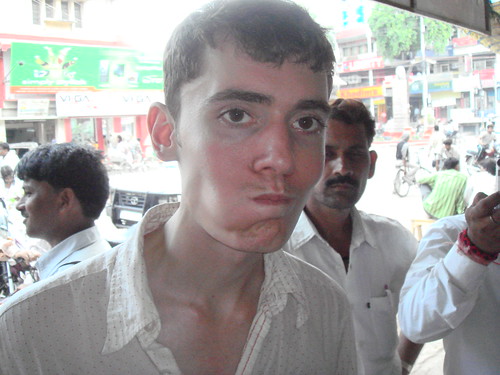
We were speeding through Eastern Bihar towards the border of West Bengal when Woody mentioned he wasn’t feeling so hot. His stomach was the culprit along with purple and green discoloration on his hands.

Discoloration.JPG

“What do you think this is?”

“Have you tried washing it off?”

“Its probably nothing.”

We both offered explanations about the blotches, but neither of us dare mention leprosy after thee encounters of the night previous. Leprosy takes longer than 12 hours to take hold, right?

The train was three hours late and Woody pounded a breakfast of omelets and toast in an attempt to reboot his system by loading his inbox. “Not helpful,” he groaned.

He put on his flowing Khadi pants, and attempted to coax his body into healing itself.

Woody Snoozing.JPG

Read the rest of this entry »

Mughal Sarai

We said a very warm goodbye to our man Nikhil and turned back towards the ashram. We were fed a simple and delightful meal of roti, rice and vegetable stew and then retired to our room. While we had much to work on, relating the events of the past few days back to you, oh dear and valued reader, we spend only a small bit of time doing this. The remainder of our last hours were spend chatting with Tejbaal Pandey, one of the more senior member of the ashram. Tejbaal had joined as a young lad, but was now slightly older than us. We spoke of our travels and of the state of affairs in India.

Upon arriving to Varanasi, we had discovered that the train to Kolkata which we originally booked was only viable if it was not late by more than an hour or two. This was not something which we could bet on, since no train we had ridden in India had yet arrived less than 3 hours late. So we had booked alternative tickets. The only option which had space in an AC compartment was leaving not from the Varanasi station, but from a nearby, older hub, in a place by the name of Mughal Sarai, at 1:55 AM.

So we had some time to wait around the ashram before we were to take the cab, being somewhat worried that Mughal Sarai was a whistle stop and we would be sitting alone on an open platform in the dead of night in the poorest province in India, we had arranged with the help of Tejbaal to have a cab come pick us up at the ashram and wait with us until the train arrived (likely late). Shortly before the aforementioned cab was to come, Tejbaal arrived in our room bearing gifts. From a plastic sack, he produced three earthenware vessels filled with lassi, like the one which had been available earlier that day outside the temple, and 3 mangos. He explained that this was some of the tastiest lassi and the best mangoes available. We drank the lassi (it was indeed splendid) and he showed us an efficient and ingenious method for consuming the mangoes. He took each mango and kneaded it in his hands, mashing the interior, until the fruit sagged in one’s hand like a water baloon. Then he plucked off the point at the very bottom of the fruit where the stem had once connected it to the tree and from that hole we drank the sweet mango pulp. As we consumed more and more, the mango skin began to fall apart. And soon we removed the pit and ate he meat off that too, finishing by scraping the last bits off the interior side of the skin with our teeth. Delicious.

With sticky hand and heavy heart, we bade farewell to the Bal Ashram and got in the cab headed for Mughal Sarai.

As we drove, it began to rain, and was pouring by the time the cab pulled up outside the station. It was not a whistle stop as we had feared. It was in fact a sizable station, and well lit. We exited the cab, leaving our bags with the driver, and entered the train station.

Warning

We’re just trying to be honest; this next part is raw.

Read the rest of this entry »

A Ride Up the Ganges

Upon returning to the Ball Ashram from my first outing in the city of life (or perhaps the city of death, or even of the dyeing…), Nikhil and I found Scott to be in much better health. He had been transformed powerfully by the mellow yellow rice which had been so lovingly made for him. We began to pump him full of fluids and Nikhil went about arranging for a boat to take us on a ride up the Ganges. This seemed to be little trouble and the boat was to leave from the ghat at the foot of the Ball Ashram. A Ghat is a sort of a landing which consists of stone steps extending down to the banks of the Ganges. Ghats are used for a variety of spiritual purposes, one the most important being the cleansing of ones soul in the river’s waters.

Our Boat Driver

We met our boatman, a lean and wiry fellow, with a mustache any 19th century field colonel would have envied, who held his well tarred wooden craft steady, while we climbed in. When we were some way from the ghat, he asked whether I wanted to give rowing the thing a shot. So I took his place and grasped the two bamboo oars.

Woody Taking the Oars

They were of drastically different lengths and widths, with the paddle portion constructed by means of a board hammered onto the bamboo. Needless to say, i rowed only in circles. The practice it must have taken for him to learn to row in a straight line with these must have been substantial. But after all aboard had had their laugh at my expense, the oarsmen moved to the rear of the boat and began to use a spare oar as a rudder. Then we all got a chance to row, doubling up Ben Hurr style.

Scott and Woody in Ben Hur

We were quickly back on track cruising towards the ghats as the sun set over Varanasi.

As night fell, we cruised by the main drag: ghat after ancient ghat. All around us the fragrant smell of incense filled the air, and funeral pyres burned on shore. We must have passed 10 or 15 cremations taking place right there in the open, so that the ashes could be scattered (or set afloat in a little vessel) on the dark and glittering surface of the ganges.

On two ghats, elaborate festivals were taking place, involving the burning of even more incense, the swinging of large racks of candles, intense drumming, on a variety of unique drums, and the blowing of conch-shell horns.

Ghat from the Ganges

On our way back, we idled in a giant cluster of similar rowing boats (these are the same boats that can also be seen fishing during the day), all filled with tourists watching the dueling festivals in one giant bobbing hoard, held together by the hands of boat wallas and passengers grasping the adjacent boat. The night brought us back to the ashram for a light meal of roti and an exquisitely spiced thin vegetarian stew.

Varanasi Wheeling

With Scott back to life, and one day left in Varanasi, we realized we were well over-due for some bicycles. On recommendation of an American girl working at the ashram, we headed to the restaurant at the Haifa hotel, towards the city center. We caught two bike rickshaws (the vessels themselves are too small for even our conniving minds to squeeze 3 humans aboard) and off we went. The city was already well underway towards its many mysterious tasks. And the streets simply boiled with fascinating activity.

Assi Ghat

At the hotel Haifa, Scott and I decided to split one order of the “American Breakfast” and one “Indian Breakfast.” Indian breakfast was a healthy stack of savory lentil pancakes, stuffed with spiced potato and a bowl of unsweetened yogurt to dip them in. The American breakfast was scrambled eggs, toast, and oatmeal. The food was quite tasty, but arrived one dish at a time and over an excruciatingly long period of time. Made all the more confounding by our being one of only two occupied tables in the restaurant. Two hours later we stepped out into the burning heat of the day, and strode next door to the bicycle shop.

We Look For This Sign

The proprietors were a little wary of us at first, demanding weighty deposits and mysterious unwritten contractual obligations. By the end of the discussion, Nikhil secured a fair deal and we were off. Little did we know, Varanasi is great for wheeling. As intense as the streets were, Nikhil deftly took bishop and lead us through the madness, Scott and I ringing our bells and he simply shouting his presence as we barreled through the tumult. We visited first a great red temple, into which only Nikhil was allowed. He purchased a coconut at a nearby shop an went in while Scott and I waited. After very little time he emerged with the coconut split in half and a decent quantity of sticky red powder, which he used to place a dot on each of our heads. The same man who sold the coconut cut it into pieces for us to eat later.

Vessels

We then wheeled to the Banaras Hindu University campus, in the center of which there was another temple. This one we were able to enter. We dropped our shoes off at a station and walked barefoot on the hot stone floor. At the entrance to the interior of the temple was a great bell, which hung over the threshold. Nikhil invited us to ring it as we walked in. The act was strangely satisfying, loud and low, echoing for some time throughout the temple. Outside the temple, lassi was for sale, served in clay bowls, made by people in the surrounding villages, which were simply discarded after consuming the sweet yoghurt inside. We were wary, fearing for out intestines. Nikhil, though, bought one and drank deeply, finishing the bowl and commenting of how very tasty it was.

Lassis in the Shade

Clay Pot Lassi

After some more wheeling around the vast campus, noting the marked focus on agricultural sciences and technology, we exited the gate of the university and took off back across Varanasi to another temple. As we rode things became more and more hectic, and soon the pedestrian traffic was so dense, that we had to walk our bikes. We stopped at the main section of ghats, and paid some gentleman to park our bicycles in a large expanse of crumbling concrete. We then ventured down the steps of the ghat. The steps were filled with people and we reached a landing half way down where Nikhil said “I am going to get a head massage; I hear they are very good here.” So with Nikhil getting the rubdown. Scott and I found no excuse not do the same.

Head Massage

The man who was massaging me was not terrific. –he was more just rubbing his hands all over me, than really digging into my muscles– but he did have some tricks up his sleeve. The most interesting of these was one in which I closed my eyes and he began to vigorously shake the skin of my face around, causing the sunlight that shown trough my eyelids to flash dramatically and produce some quite beautiful colors. Also, he went to town, as they say, on my scalp, prodding and rubbing my scull in a most delightful way. Some of the delight was diminished when he started softly whispering in my ear bargaining for the reimbursement.

Mahua TV Channel Raging on Us

But this minor displeasure was completely forgotten when I look up to see that an Indian television crew was videotaping us. After the massages were done the fellow from the crew moved in closer and explained to us that they were in a new Indian station, and set up to interview both Scott and I regarding our experiences in Varanasi. **Stay tuned oh valued reader for we will post this footage as soon as we can get our hand on it.** Then we were off towards what, Nikhil explained to us, is one of the most holy places in all of the Hindu faith. In order to get in the the temple we had to present our passport photocopies, and swear that we had no beef with the Hindu faith.

To The Golden Temple

My passport copy had become very wet with sweat and almost unintelligible during the wheel, but it seemed no problem (with Nikhil fighting on our side) and after some slight paperwork we took off our shoes, rented a locker from a stand outside the gates to stow our our cameras and anything else which could possibly be used to taint the experience of the temple, and were admitted to the first round of frisking and metal detectors. The savage security which abounded at this place was due to the threat of terrorism (how dare I assume that islamic terrorism was a unique American problem) and necessitated redundant screening. Only some months before our visit there had been bombings of temples and tourist locations.
Security was high. But we got through, and soon we were inside the temple. There were monkeys leaping from spire to spire and people everywhere. In order to reach the first holy place one had to fight through a dense crowd of sweaty people. At some point Nikhil placed a clutch of leaves in my hand and I squeezed into the front.People were placing their offerings (in my case the leaves) into a pool. There was a holy man sitting nearby arranging the flowers and leaves and every once in a while acknowledging a particularly big offering of cash money with a sage glance. I placed my leaves into the pool and leaned over the railing to touch the rock in the center (since this seemed to be the next step). As soon as I had done that, I was spit from the crowd like a watermelon seed.
We proceeded through the temple, observing similar rituals taking place all around us.The temple itself was covered with ornate engravings and the floors were cool marble, glistening with what may very possibly have been monkey dung. All around us there were workers building some additional structure onto the exterior of the temple. At some point, we became attached to a fellow who either was asked by Nikhil of or elected himself our guide throughout the temple process relevant specifically for Brahmans. Through a gaping hole in the ceiling (which may have also been a skylight), we could see an adjacent mosque. This new guide of ours explained that at one point this spot fell into strict Muslim rule. And part of the temple was leveled to build this mosque.
We were then lead to another holy place where we we gave put a few hundred rupees in a pile and we asked to repeat a prayer, would by word, then lean over and ouch our heads to the golden toe of a statue. We had just finished this and were still staring dumbfounded at the intricacy and richness of the environment around us, when our guide exclaimed, now we must go the the most holy place of all. With that, Nikhil took my hand and I took Scott’s and we began to rush in this great daisy chain through the crowd, half running, barefoot down the narrow ally to another entrance. Inside the floor was quite wet with a brown mush, discernible amidst the slime were very discrete piles of monkey dung. I barely noticed it at the time, though, so entranced was I with the surroundings.
At the direction of our guide, we sat down with a holy man, crossed legged in a tiny, well lit stone room in this section of the temple. In exchange for some offerings which Nikhil provided, and some pretty hefty monetary donations extracted from Scott and myself, the holy man walked us through the ceremony, allowing Scott and I to repeat prayers after him, and giving out us a mark of bright dust on our foreheads. We were given each a dense flower blossom and told to take it to a wall, and with it write the names of our family by smudging the yellow blossom on the stone wall. I did so, and was then directed to another locus, at which I was taught (by yet another fellow) a prayer to be said following the names of family which i wanted to send good fortune and love to. I did this for some time, marveling at the simplistic gravity of the ritual, finding it very hard not to tear up, before I was once again sent forth towards a woman in a booth where I was to take my now quite disheveled flower.
Before I could give this to her though, I was told by another fellow to return to the room of the fellow who had taught us the first blessing, again I repeated some more prayers in hindi and was asked for 1000 rupees. I had no such bills in my wallet, but gave 100 of the 150 rupees which remained. Then it was discovered that I still had the disheveled flower in my had and I was whisked back to the woman who’s business it was dealing with those. She also asked me for some rupees and I put my last 50 in her pile. She gave me a ladleful of water, much like the one Nikhil had partaken of so many time on the day before, and, under the scrutiny of all these holy people, I slurped a little bit the brushed the rest into my hair the way Nikhil had done.By this point I had broken from Nikhil and Scott and I slid back across the drizzles brown floor of the room to where they were gathered around yet another statue of a god. They had just finished offering some foods to the god and I was handed a little puffed grain ball, which I then ate and was still chewing on as we left the temple and put our bare feet on dry pavement once again.
Sadly, it was nearing time for us to end our time with Nikhil, and for us to leave this strange and wonderful city. Back at the ashram we packed and paced around the room, feeling the voltage of the eminent departure. Some 20 minutes before he needed to leave, I was looking through our silk purchases with Nikhil and we discovered, despite drastic searching through the room and our luggage, that the filthy silk merchant had simply stiffed Nikhil on one of the silks that he bought! The garment, though paid for in full, was no where to be found. So, dear reader, let this be a lesson to you as well as us. Varanasi is a great place to visit, but keep your wits about you. Even a chief snake charmer can be bitten…

Fixing Cycles

Welcome To Varanasi

Scott, Nikhil and I awoke to find the Swantaranta express running two hours late (which in Indian for on time, I believe) and that Scott had caught a case of what we might not so affectionately call the “Agra hustle.” Though Scott seemed to be recovering rapidly, the my dear partner in crime needed sleep and water to replenish his strength. We knew not exactly where we were to be staying in Varanasi, but had been in contact with a local ashram, recommended to us by a Mr. Oliver Daly who had, for some time, been occupied there. As we exited the cool comfort of the train and immersed ourselves in the grimy heat of Varanasi, it was decided that this Ashram would be made our first waypoint in the city.

Nikhil quickly propagated through the crowd of touts and rickshaw drivers, which filled the train station, collecting along the way one fellow who was to be our driver for the day. Nikhil and this driver lead us out into the packed dirt parking lot. The air smelled strongly of woodsmoke, in addition to the normal Indian cocktail of scents: open sewers, cooking spices, and pan. Ah, pan, I don’t know if I have yet described to you this most singular element of Indian life. And indeed at this point in our tale, I was rather ignorant of the stuff myself. I knew of it only these 3 things: it was made of, among other things, beetlenuts and beetle leaves, it caused a large amount of deep red salivation to occur in the mouth of the fellow who imbibed it, and smelled distinctively and strongly enough to play a leading role in the already quite savage Indian bouquet.
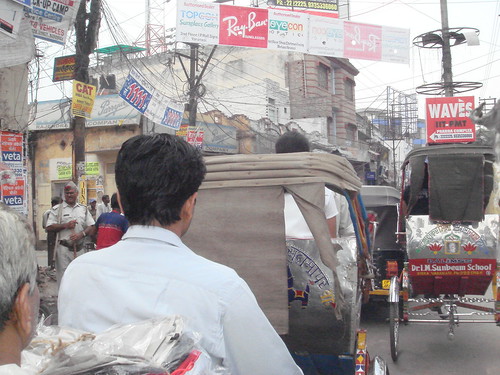
Streets of Varanasi

Through this bouquet we barreled, in an ailing autorickshaw, which our driver started by jerking a great lever on the floor of the machine, and which –we found out when he stopped mid-trip to buy 40 rupees (~$1) of petrol– required motor oil to be mixed with it’s fuel. The streets of Varanasi were crowded, but filled much more predominantly with bicycle rickshaws and cattle than motorized traffic. And what motorized traffic there was tended to be either large machinery (dumptrucks, etc.) or auto-rickshaws. We arrived first at the Little Stars School, which was located some distance from the city center, in a more residential neighborhood. We were greeted warmly there and upon learning of Scott’s illness, Asha, who heads the school, offered to make a healing rice and lentil mixture to sooth his stomach. In addition we were told that indeed we would be welcome at the ashram, located farther downstream, on the banks of the ganges. I will once again let pictures speak for the beauty of that place.

Bal Ashram

And eclipsing even the beauty of the premises itself, was the kindness and welcome with which we were received there. All there walked barefoot on the fine marble floors, and every time I passed another person within the walls of the ashram, I was acknowledged with a pressing of the hands together, a slight bow of the head and the word “namaste.” I later found that this word was a reference to the god, and the oneness present in the two exchanging the greeting. It felt good.

We were told our room was being prepared, and we were offered spicy milky tea and food. When our room was ready, Scott proceeded to sleep vehemently. Nikhil and I retired to the ashram dining area where we sat crosslegged on wooden boards, and ate a monstrous traditional indian meal from gleaming stainless steal plates.With Scott out cold, Nikhil and myself decided to take in the city on our own. We exited the gates of the ashram where our driver had, at our request, been waiting. We found him sitting overlooking the great river and smiling. We piled back into the rickshaw and off we went.

The whole while I was transfixed with the bizarre world of Varanasi. It was a feast for the eyes: dogs, cattle, oxen, buffalo and crows roaming the streets; brightly dressed women, in dramatic sarees of fine silk; men in stark white gowns and large turbans; men sleeping on piles of brick; children digging sewage from open gutters; bicycle rickshaws carrying absurd loads of brick, or piping, or oil cans; groups of 4 or 5 people crammed on a tiny motor bike, men with their heads wrapped in linen, so that only a slit remained from which to see; and women wearing all black, with a black covering for the head which had no� slit through which to see!, but yet they strode confidently through this amazing traffic.

During my transfixion, Nikhil was talking up a storm with our driver, a very fine gentleman by the name of Babaloo Baba, who it seems had now taken a partial role as tour guide in addition to our driver for the day. Our first stop was at a house of fine silks. Babaloo Baba turned onto a narrow cobblestone lane which bounced the little rickshaw quite terribly. Nakhil explained to me how it was done inside such a place. “We must look at many things and find a number of things that we are interested in. These will go in a pile, which later we can pare down to those we actually with to purchase.”And so it began. We removed our shoes and entered the ancient building. We sat cross legged on a giant mattress, which extended to all four walls of the room. All around us were placed the most intensely colored, beautifully patterned, and most elegantly textured fabrics I had ever seen, or for that matter, can even conceive the existence of. The owner of the shop, a rounded man in a deep orange silk shirt, sat with us ordering around a small harem of young boys which fetched silks so that he could dramatically unfurl them before us. We hemmed and hawed, chose a pile of things and then Nikhil went into intense haggling mode. His face turned to a sorrowful frown and he began to peer into his wallet shaking his head while saying very many things in hindi, not the least of which was “student”, and “nay nay nay”. After some bargaining, we finally agreed on a price and the man set his minions forth packaging the silks in little blue plastic bags, which were then covered with tape and cryptic ball-point pen. The entire parcel, which has some surprising weight to it was then placed in a larger bag, while Nikhil went through the process of paying with a credit card.Silks in hand, we were then taken by one of the boy minions on a tour of the silk manufacturing operation.

Sewing Silk Designs
Silk Loom

This consisted of many men in dark stone dwellings, located throughout the tiny winding streets of Varanasi. We invite you to see for yourself.Next, Babaloo Baba most verbosely drove us to a temple. At the entrance gate, we removed our shoes, cellphones, camera, matches, and anything else which might be used to defile the place, and proceeded to walk through the metal detectors. On my way through, they discovered a USB key drive in my pocket, and having never seen one before, promptly confiscated it (Nikhil was able to retrieve it upon our leaving). Inside the temple was filled with monkeys, laying around, playing with each other, or eating bits and scraps from the vicinity. I followed Nikhil through the temple. He approached a number of kiosk like stone booths, decorated with flowers and offerings to the gods, and covered with elaborate engraving and statues. At each of these, he was performed a kind of spiritual transaction, which involved a small ladelfull of a holy water. The water was poured into his open hand. Some of it he drank in a quick slurp, the rest he smoothed over his hair. Also at the temple was a giant tree, which must have, at some point, been submerged in earth much farther up its trunk, for now many long roots hung from the hulking trunk which, some 3 feet above our heads, bulged out to twice its size at foot level. All over this tree were strings and ribbons fastened there in the name of wishes, in hopes they would be later fulfilled by the gods associated with this temple. In the event that these wishes indeed came true, an offering would be made at this temple in thanks.As we left the temple, a glance at the watch showed it was getting near time to return to Scott’s side. “Just enough time to have a pan,” Nikhil said. So Babaloo Baba drove us to a pan man and I began to marvel at the manufacture of this strange item. A man sat cross legged in a little alcove in a crumbling wall, near a busy street. A crowd was gathered there and he was furiously manufacturing pan, and Indian man were eating it up just as fast. First a pan leave was taken from a large pile covered partially with a torn piece of burlap. Then, from a vast array of tiny jars and metal tins, he began to fill the leaf with a sprinkle of this, a sprinkle of that.
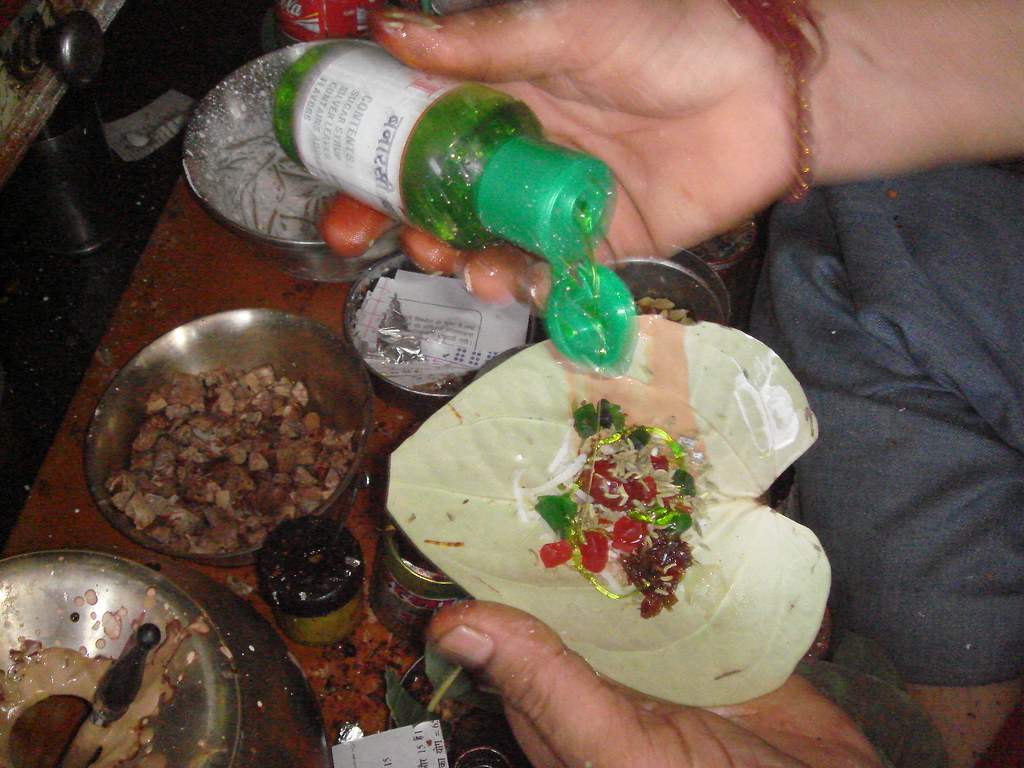
Pan Making

A number of hammered copper vessels had small brushes protruding from them, and he used these to spread a number of different pastes on the leaf. Finally he wrapped it up and placed a piece of silver foil over the top of it, to keep it closed. From his other side he grabbed a banana leaf. Wiping the leaf on his pants until it had a obtained a mellow shine, he placed the final product atop and presented it to Nikhil. “So watch me. This is how it’s done.” He placed it into his mouth and began to chew. His lips bulged, and he slurped in a little air, then he was done. Next, he handed one to me. I must admit, it looked ominous, like a tiny pandoras box, sleeping for now upon the early gleaming banana leaf…
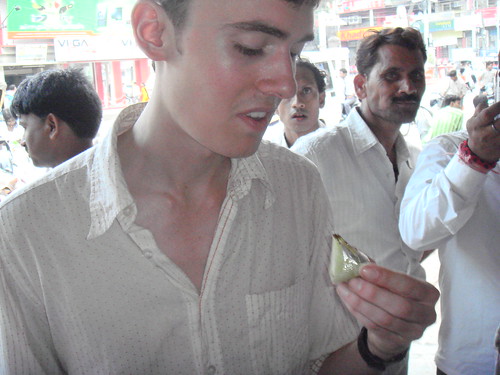
Here We Go...

In it went.

Eating the Pan

And for the time, I genuinely enjoyed the flavor. I cannot describe it any better than to say it was sweet, strong, and tasted distinctly red. I spoke through the mouthful redness, “so I just swallow it?” Nikhil nodded. Perhaps the act of eating the pan had endeared him to me, or perhaps he thought the the pan would impair my ability to cross the street, regardless, Babaloo Baba now grabbed my arm and lead my through the onslaught of scooters and rickshaws to our vehicle.
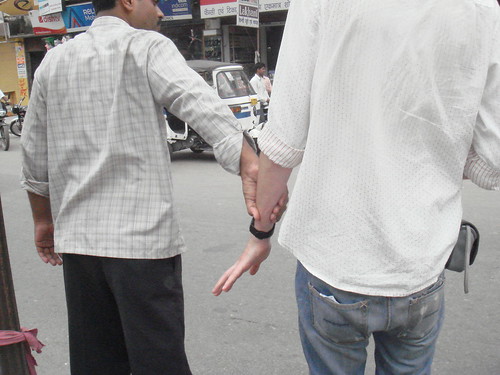
Babaloo gives me a hand

As we drove back I felt the pan in my stomach unpacking its tools and getting to work. As Nikhil explained to me, “muscles in your stomach that have not been used in a very long time are grumbling, saying ‘what is this stuff.'” Indeed… indeed.

Dash To Delhi

We checked out of the hotel Amar in Agra and caught an auto-rickshaw to the train station. When we got there we found our train to be delayed by 30 minutes. As they were announcing this news, Scott was intercepted by a fellow with a wooden box full of little instruments, not the least among them were shoe cleaning and polishing materials. Though Scott’s canvas shoes were not in need of (or indeed capable of) any polish, we asked the good sir if he might by any chance be able to repair my backpack the chest strap of which had been ripped of by a over-zestfull baggage attendant on my way from California. Upon hearing our request, the man pantomimed as though changing his hat, and proudly presented himself to us as a certified repair doctor, and to be very reasonably priced. So we agreed and he proceeded to rage on the location from which the chest strap had left, slicing it apart into its components using an old razor blade. In 20 minutes time, and much complaining about how damned sturdy my baggage was, he had re-sown the the thing to an approximation of good as new.

We thanked the fellow and he haggled us up to 100 rupees. Off we set only to find the screens of the Agra train station proclaiming our train was now delayed 3 hours. I quick calculation revealed that such a delay was getting dangerously close to cutting out our planned visit to Kaustubh Shah:s Delhi residence and even placing us in danger of meeting our train to Varanasi, and rendezvous with head snake charmer and Bangalore office chief Nikhil Kulkarni. Also of interest was the availability of “Bogie’s Position” on the information display.

Bogies Position

As the heat of the day began to dig in, we set to solving the problem. We were pricing cab fares to Delhi from Agra when the Malarone we had taken about an hour earlier kicked in, and with it, the slow clutch of impending doom. What doom? you may ask, dear reader… well we too were asking that very question. Sensing the weakness, the driver we were talking with kicked his end of the conversation into overdrive. So we agreed to pay the fellow 2500 rupees to get us to Delhi in 3 hours. We took a look at the cab, asked for non-AC to save some dough, and soon I was passing said cash to a grumpy man in a white box in the parking lot. It turned out the man were talking to was not the driver at all, but a salesman. And our driver was introduced to us. In exchange for our 2500 rupees, we were given a little slip of paper “to sign and give to this driver when you arrive.” Our belongings had been loaded into the taxi that we had been shown, but after I had payed, they were removed and placed in a smaller cab. Our driver then got in that cab, and another man climbed in shotgun. “this man is a police officer. He is just going as far as the boarder.” Scott asked for his ID, and it looked legitimate. “You will need to pay 100 rupees at each checkpoint. It is like a tourist tax.” With stomachs full of ice, we pulled onto the roads of Uttar Pradesh, headed for Delhi. I tried to nap and not to play through scenarios in my mind: kidnapping, stealing of our organs, slaughtering us in the name of all the dirty tourists who were ever ass-holes to the Indians.

And as I drifted in and out of consciousness, the crazy hour passed. The police officer got out at the boarder, and smiled at us thanking us for the ride. Horses passed and the cars was delayed a number of times, by herds of cattle, traffic jams etc. But after about 4 hours we were entering Delhi.

Ice Cream Cart

Delhi is massive and sprawling. I saw the first traffic light I had seen since California (though it seemed to be broken). Everywhere people were building. Delhi is constructing an impressive new subway system, which demanded huge holes be dug at what seemed like every street corner. Our driver quickly became hopelessly lost, requiring many more than 2 calls to Kaustubh’s house, so a member of Mr. Shah’s staff could give directions in Hindi. Finally, we were on the correct road, at house 32 and the numbers were falling as we went, moving us ever closer to the fabled building number 23 (which was by the way directly across the street from the Turkish Ambassador’s residence). Despite this, our driver drove slower than ever, and stopped repeatedly to ask for directions. We tried to tell him it was just ahead, but then it dawned on us: this neighborhood has only English street signs. Our driver could not read English and as such, was baffled. But after waiting almost 6 hours and eating only little snacks (like “magic chapata” flavored potato chips), we pulled into the drive and were met by Kaustubh’s father heading out to go do business, he was immaculately dressed in a monogramed cornflower blue shirt and looked cool despite the sticky Indian heat. He paused to smile and shake hands, and was quickly on his way.

Kaustubh's House

A well spoken man who introduced himself as Mr. Ashwani piled our luggage, Scott, another member of the staff, myself and his fine self into a small elevator. And up we went. The next moment were were standing, filthy and disheveled in an elegant apartment. Bowls of dried flowers delicately scented the apartment. Smells of fine Indian spices wafted from the kitchen and we were shown to an immaculately set table, with silver dishes. We were immediately served a steaming bowl of blended broccoli soup, accompanied by fresh buttered toast. Then came a green salad, the first such dish we had dared to eat in some time. Then the feast cam: a succulent chicken curry, fresh cucumber raita, mellow dal, roasted potatoes, spiced cauliflower and the fluffiest most flavorful basmati rice I have yet encountered. Needless to say, we were madly sated. Just as we were considering falling into the internet, our phone rang. It was non other than Nikhil Kulkarni, chief snake charmer and Bangalore office head for asiawheeling global. This meeting was one I had been most excitedly anticipating.

And Nikhil did not disappoint. His relaxed and gentle attitude, paired with sharp whit and keen instincts made him a tremendous asset to the team. Our ability to have a great time had just been increased by an order of magnitude. We had barely shaken hands by the time we were invited back into the dining room and served another meal of tomato soup and lightly grilled sandwiches, filled with herbs and goat cheese.

Now full to the point of bursting we piled in a cab bound for the Delhi station. At the station, Nikhil pointed out to us a singular phenomenon. Those people who wished to travel in the general compartment had lined up all the way down the platform. The train was idling, empty, and men were pacing back and forth with bamboo staffs, keeping these travelers in a tight line. Each member of the line looked frantic, clutching his baggage, in some cases his wife, and the fellow in front of him. Nikhil explained that each member of the line clutches the one in front of him in order to avoid people cutting. And as a second line of defense, there were the men with the staffs. We watched as many people attempted to cut in line. Some were extracted and beaten, others managed to squeeze in successfully.

Unreserved General Compartment

Still others jammed some personal item through the barred windows of the general compartment in order to secure a seat via precedent. When the train doors opened all hell broke loose. People scrambled to get into the car, the men with staffs tried in vain to keep things orderly, and most fascinatingly, this phenomenon just kept going indefinitely, the line being so long and the disorder so great.

Soon we grew tired of watching and made out way to the first AC car and our luxurious state room. We had no sooner deposited our luggage on the floor that the sound of a scuffle brought my eyes up to the window on our stateroom door. The sight I saw in it is not one I will soon forget. A young woman, hair soaked in sweat and eyes wild with the crazed fear of a cornered animal, locked her gaze onto my own from where she was being awkwardly hustled along in the arms of two men. My mouth fell open and I realized I was staring now at a blank window. I shook my head and was about to address my cabin-mates, when suddenly our stateroom door burst open and in came the girl, carried by two men, who sputtered something in broken English about them having some mandate for use of the room.

The girl was placed on our long bench, covered in sweat and still staring wildly into the infinite, eyes darting around in her sockets, but looking at nothing. One of the men with us explained, “This girl’s father has just died on the platform, and she has been seeing the body.” We, of course, told them they could have the room for as long as they required and picked up our valuables, leaving them the bottles of water we had just purchased. Nikhil rushed off to consult the conductor and soon the two of them appeared together, talking animatedly. After assuring many parties, whose affiliation to the girl and/or the deceased was unclear, that we would be fine with sitting in Nikhil’s adjacent stateroom for as long as was needed.

And that we did. It was one of Nikhil’s first very wise insights into Indian culture. “In India, emotion is worn completely on the exterior; when we are happy we sing and dance, when we mourn we allow it all to pour out.” Before too long our room was once again free and we settled in for the night, as the Saraswati Express whisked on through the steamy Indian night.

A Haircut in Uttar Pradesh

After our splendid lunch at the Indiana Multicuisine Restaurant, we walked back to our jalopies, feeling quite sated and a bit shaggy around the ears. In order to rectify the latter, we struck up a conversation with a cab driver who called himself Mr. Bom. Mr. Bom wore an immaculate white uniform and spoke very good English. When he asked us if we would by any chance be needing his services, we were unsure, but we asked for his number. “No mobile” he said, “I had once a cell phone, but I was drinking too much whiskey one night and smashed it.” “Like, in a rage?” I pantomimed, “Oh, yes, too much whiskey very risky” he replied.

With that sage wisdom under our belts, we inquired as to the location of a fine hair cutting establishment in a not to distant place. He instantly gave us directions to the very shop where he himself got his fine looking hairs cut. “30 rupees for a cut, 10 for a shave. Tell him Mr. Bom has sent you. The man’s name is Kalwa.” Great. We took off.

When we arrived, we called forth Mr. Kalwa and one of the two men inside the little shop perked up. Do you know Mr. Bom the driver? Heads nodded. So in we went and down I sat. Soon a little crowd had formed outside the restaurant, consisting of locals who wondered why these two white fellows in panama hats where getting their hair cut at the local dive barber. It was after a sheet had already been elaborately wrapped around my body and tied at the neck that Scott turned to me from his barber seat and said, “did you ask the price?”

KC Hair Dresser Did Us Right

“100 rupees.” I tried to communicate once again Mr. Bom and the good price, but now, it seemed, the two hair cutters knew no Mr. Bom and were very confused. We decided that $2.20 for a haircut and $0.83 for a shave was only mild highway robbery. Lay on McDuff.

Straight Razor

The crowd of locals grew larger as the haircuts proceeded to expertly administered straight razor shaves. We parted the crowd and left the haircutter , remounting the rusted corpses that were our bikes and rode off into the Agra heat, though it was not quite as bad, with freshly sculpted UP hairdos, and baby bottom faces, burning with aftershave from a bottle advertising the “ax effect” (no charge).
Woody on Wheels

Agra Wheeling

Feeling cheerful and relaxed, fueled by our extended stay on the Grand Trunk express, we exited the train to find ourselves surrounded once again by a crowd of people, offering all manner of goods and services to us, not the least of which was the opportunity to provide them with handouts. We quickly found ourselves walking next to a fellow who wished to drive us to our hotel. Though we had not yet determined where we were staying (despite much hacking at the internet cafe in Chennai, and much calling from our stateroom on the Grand Trunk), we felt optimistic about the fellow and decided to trust him. We haggled a little with him, got what we thought was a decent price (only 5 or 6 times what an Indian would pay) and we were off. We looked though our notebook and chose a place. The driver informed us this as a bad place. So we chose another. he seemed to like that one much better, and in no time, a tall man in a turban was opening the door to the Hotel Amar for us.

The joint looked clean and there was a fellow savagely raging away on the internet right in the lobby. So we asked to see a room. 3500 rupees, the fellow said. We frowned and gesticulated about the expense, so the man (who later turned out to be the manager) asked us how much we wanted to pay. We said 2000.

“You are my first customers of the day… so you may have it for 2000.”

This meant two things: 1: We could probably have gotten the room for 1000, and 2: Things were going just fine.

Haggled Beds

First thing is, as always, first: bicycles. So we consulted the scanned copies of lonely planet that we had obtained through inter-library loan, and set out for Raja bicycle shop. During the walk we were averaging one solicitation for a ride on a bicycle rickshaw for every 15 steps, all manner of traffic –car, bus, sheep, bicycle, camel, bullock cart. But we strode unfazed. Why were we so cool headed? Were we beginning to develop the savage asiawheeling mind like water? Were we becoming the masters of our own destiny. Or had we forgotten to take the Malarone pills? As you, dear reader, have no doubt guessed, it was the latter.

We arrived at Raja Bicycles and found it to be quite literally a crumbling hole in the wall. Inside which we found Mr. Raja himself, presiding over a pile of rusting bicycles. We (admittedly weakly) tried to haggle, but Raja stood his ground. So 100 rupees later Raja had pulled a rusted and dilapidated hunk from the pile. This bicycle’s bent frame was held together with bits of string and was it first so malformed that the wheel would not even spin. Then, before our very eyes, he produced a giant wrench. He did not use it for wrenching, rather he set upon the bike with a furious beating, attempting to align the wheel and pounding the heads of the breaks back into position. Before 2 minutes had passed, he had produced two somewhat ridable bicycles. They, however, had no bells. Bells had been so vital a part of our previous riding that we were instantly uncomfortable. Also, as we rode away on the bikes, it became obvious that the fixes that had just been performed were of the most temporary nature.

Scott and Raja Cyclewallah

Toolkit

Testing Cycle

On our way back to the hotel for that so pleasantly forgotten Malarone, we passed a stand selling water, cigarettes, and little packaged snacks. The owner was a vast man in an impressive black garb. His outfit, however, was only a dim glimmer in relation to his great beard, which was flecked with red hairs. He apparently took a liking to us and asked us to have a seat with him on the plastic chairs outside the stand. We sat and drank water while he smoked bidis. We spoke of AsiaWheeling, the disrepair bicycles we had just purchased and he even brought up Barack Obama. Perhaps the first time on this trip that I have even considered the notion of a small world.

Making Friends

With bellies full of Malarone, we remounted our medium-faithful steads and took off for the Taj Mahal. The streets of Agra were quite different than any we had yet navigated. Agra is in the province of Uttar Pradesh, and being a poorer province than where we were in the south, the ratio of cars and auto-rickshaws to beasts of burden: camels, bullocks, horses, and humans straining away on bicycle rickshaws had increased sharply. As we rode to the Taj Mahal on our crumbling bicycles, we passed one bicycle rickshaw after another, and while we had been offered rides (for 10 or 20 cents) it became clear that giving tourists rides was unfortunately not the main focus of these fellows careers. Most had been hired by other Indians to carry obscene loads of metal, towers of water bottles, or clusters of 3-4 50 gallon oil drums.

Taj Wheeling

Since pollution from cars and auto-rickshaws has begun to dull the white marble of the Taj, we soon crossed a barrier past which nothing but cycles, camels etc. were allowed. We rolled to the parking lot where we were given conflicting instructions and a number of slips of paper. In the end we gave some person 10 rupees to stop hassling us and locked the bikes to a metal fence.

The Taj Mahal was, of course, amazing. I’ll let the pictures speak.

Teardrop On The Face of Eternity

Discussing the Matters at Hand

The Reason

Masjid

Knuckleheads

After hours of ambling through the Taj, Scott in particular was boiling over. So we exited the palace and sat outside a water kiosk, collecting ourselves. On the advice of our bearded friend at the water and cigarette stall, we set out on the cycles once again, all manner of traffic whirring abound us, in search of a restaurant called Indiana. The front rim of Scott’s Cycle, which had to this point been held on via an ancient length of what appeared to be a twisted and woven plastic sack, broke free of it’s proper place and began to ride gratingly on the front tire. We stopped to fix it with a length of garbage that we found in the street. Immediately we were surrounded by beggar children vying to give us a hand with the repair. As Scott fumbled with the bit of garbage, 3 more hands with alternative bits of garbage appeared on either side. Finally, we relinquished the task and gave the fellow 10 rupees. This act brought on an onslaught of solicitations, more vehement than any we had yet endured. Despite the cold pit which had replaced my stomach, I climbed back on my cycle and attempted to coax motion from its sickly frame.

Fixing Fender

Exhausted and fully aware of the fact that we had not eaten all day, but had walked around in the glaring sun for 5 hours, we wheeled our jalopies into the parking lot of the Indiana, hidden at the end of Fatehabad road, behind the hotel Ratan Deep (in case you are ever in Agra). We parked our bikes outside and immediately ran into the manager, just leaving. He said he thought we were perhaps the first customers he had ever had who arrived on bicycles. And such tattered bicycles.

Our Junkers

We grinned and entered the restaurant. The it was cool and dim, smelled great. We were seated at a table which was so high that our lamb and cheese tandoori, palak paneer, and grahm rotis came, they hovered a mere foot under may face (the better to eat you with my dear…). When we got the check there was a 20% discount: “for arriving on cycles it said.” Yes, yes, I know what you are thinking dear reader: a more foolish man would think the deck was full of aces…

AsiaWheeling Geoblog

Until now, every post it seems, has come from your humble corespondent Mr. Woodruff Schneider. Now, in an old British colonial house in the old Indian capital of Calcutta, your perhaps less humble correspondent Mr. Scott Norton emerges from a flurry of longitude, latitude, photoshop filters, and web scripting languages.

Blogging

All the while wheeling and taking photos, I carry a small GPS datalogger that tracks our movement. I then process the data using various tools (1 2 3) and serve it to you, our most devoted readers, for enjoyment.

How can you benefit? Two ways:

  1. Point your browser to our maps page, to see up to date progress on our itinerary and photos that we’ve taken.� http://asiawheeling.com/maps/
  2. Download an automatically updating Google Earth file that contains our Blog Posts, Photos, GPS recorded routes, and planned itinerary. You’ll need Google Earth for this. Once you’ve opened the file, you can save it to your places, and every time you open Google Earth, you’ll see our fresh content.� View the File: Follow_AsiaWheeling.kml

Happy following!

Pictured Below, My Predecessor: Managing Director of the Honorable East India Company’s Geoblogging division, 1672

The Grand Trunk Express

AsiaWheeling Mobile Offices

Our first AC room on the grand trunk express was delightful, as was the train car in which it rode. For the majority of the ride, we were the only people in the entire car. With two bathrooms to our-selfs. There was no dinning car, rather food was delivered from the pantry car, and the rest of the train was other cars simply full of people.

Egg Curry

Though the scenery was quite striking, the highlight of the grand trunk experience was our interactions with our chip-wallah; that is the guy who walks the train back and forth all day and call out in Hindi that he is selling chips. Not speaking Hindi, his cry befell our ears as something more like “contaminated chips and cake,” endlessly in the same nasal incantation. Since the first AC car is nice and cool, our dear friend (on whom we have now bestowed the esteemed title of Official AsiaWheeling Snack Packages Distribution Manager) began to stop by our room, and linger.

We were inside, of course, as we were for the whole ride –there being no dining car and no lock on the door– playing whist or carefully preparing correspondence for you, dear reader. Soon this became a staple of his walk back and forth on the train. The man spoke no English and we no Hindi, but indeed I believe a bond was formed. It was while sharing popular American music and eating biscuits with the chap, that we realized this fellow is badly in need of an AsiaWheeling t-shirt. So the next time he came by our room (this was likely the 12th or 13th time) we offered him the position. Needless to say, all concerned were thrilled.

Official Chipswallah of AsiaWheeling

As one of his first duties, we give him the AsiaWheeling cell-phone so that he could call his home. What he said, we have no idea, but it was a heartfelt and tearful conversation. We were later to learn that this was the first contact he has had with his mother in weeks.

The grand trunk ran into the night, loosing time steadily, until our 3 am arrival we pushed until 6 am. We considered this a boon. And that assumption was soon confirmed as we found Agra not as easily navigable as one might hope.

« Previous Entries | Next Entries »

Privacy Policy | Terms and Conditions